
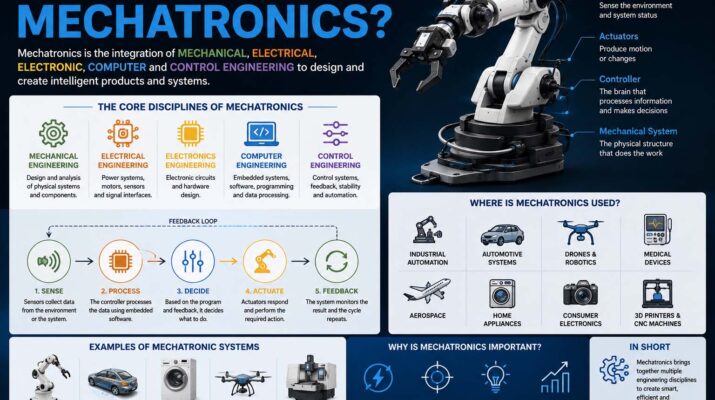
What is mechatronics? Mechatronics is a multidisciplinary technology and engineering field that combines mechanical engineering, electronics, computer programming, control systems, and automation to create intelligent machines.
Instead of designing the mechanical, electrical, and software parts of a machine separately, mechatronics brings them together as one integrated system.
You can see mechatronics technology in:
- Industrial robots
- Automated production lines
- Drones
- Smart appliances
- Automotive systems
- Medical equipment
- Warehouse automation
- Computer-controlled machinery
As automation becomes more important across industries, understanding mechatronics can help students and beginners see how modern intelligent machines actually work.
What Is Mechatronics?
Mechatronics combines multiple engineering and technology disciplines to design machines that can sense information, process it, and respond automatically.
The main areas involved are:
- Mechanical engineering
- Electrical and electronic engineering
- Computer programming
- Control systems
- Sensors and actuators
- Embedded systems
- Automation
A simple automated machine demonstrates the basic idea.
A sensor first detects something in the environment. A controller receives that information and processes it according to programmed instructions. Finally, a motor or actuator performs the required physical action.
This integration of sensing, computing, control, and mechanical movement is at the heart of mechatronics.
Understanding the Technology
Mechatronics technology refers to the practical technologies used to integrate mechanical equipment with electronics, software, sensors, controllers, and automation.
For example, consider an automated factory conveyor.
The conveyor itself is mechanical. Sensors can detect products moving along the line. A programmable controller processes sensor information, while software determines what should happen next. Motors and actuators then move, sort, stop, or redirect products.
All these technologies operate together as one system.
For a detailed academic overview of the discipline, the University of Waterloo’s Mechatronics Engineering program explains how mechanical, electrical, computer, and systems-design disciplines are integrated within mechatronics.
How Does the System Work?
A mechatronics system typically works through a continuous cycle:
Sense → Process → Decide → Act → Monitor
Understanding this process makes complicated automated machines much easier to understand.
1. Sensors Collect Information
Sensors measure physical conditions.
Depending on the machine, they may detect:
- Temperature
- Pressure
- Position
- Distance
- Speed
- Motion
- Light
- Force
The sensor converts this physical information into a signal that the control system can process.
2. Controllers Process the Information
The information then reaches a controller.
Depending on the application, this could be a:
- Microcontroller
- Programmable logic controller (PLC)
- Embedded computer
- Industrial computer
- Electronic control unit
The controller evaluates the incoming information according to programmed instructions.
3. Software Determines the Response
Software provides the logic behind the machine’s behavior.
For example, a program might tell an industrial robot to stop if a safety sensor detects a person inside a restricted area.
Understanding basic coding concepts can help beginners see how software instructions control automated equipment.
4. Actuators Create Physical Movement
Once the controller decides what should happen, an actuator can convert the control command into physical action.
Electric motors, hydraulic cylinders and pneumatic devices are common examples.
Our guide explaining what is an actuator covers this important part of automated systems in more detail.
Some machines also use electromagnetic devices. Understanding what is a solenoid provides another useful example of how an electrical signal can produce controlled mechanical movement.
5. The System Monitors the Result
The process doesn’t necessarily stop after an action occurs.
Sensors can continuously measure the result and send new information back to the controller.
This feedback allows the system to make corrections and maintain the desired operation.
Main Parts of the System
Although systems vary considerably, most mechatronics applications contain several common elements.
Mechanical Components
These are the physical parts of the machine.
Examples include:
- Gears
- Shafts
- Bearings
- Frames
- Belts
- Pulleys
- Robotic arms
Sensors
Sensors allow the system to detect its environment or monitor its own operation.
Controllers
Controllers process information and execute programmed instructions.
Actuators
Actuators create movement or another physical response.
Electronics
Electronic circuits connect sensors, controllers and output devices while managing electrical signals.
Software
Software defines how the system should respond under different conditions.
Communication Systems
More advanced machines may exchange information with other controllers, computers, networks, or cloud platforms.
Together, these elements allow a machine to perform tasks automatically.
Real-World Examples
Mechatronics may sound highly specialized, but examples are found throughout modern life.
Industrial Robots
An industrial robotic arm combines mechanical joints, electric motors, sensors, electronic controllers, and software.
Sensors monitor position while the controller coordinates each movement.
Automated Manufacturing Lines
Modern factories use sensors, conveyor systems, motors, robotics, controllers, and software to coordinate production.
These facilities also rely on measurement and control. Understanding what is instrumentation helps explain how industrial systems measure variables such as pressure, temperature, level, and flow.
Modern Vehicles
Cars contain numerous integrated electromechanical systems.
Examples can include:
- Electronic braking systems
- Engine-control systems
- Adaptive suspension
- Electric power steering
- Driver-assistance technology
- Automated transmission controls
These systems combine mechanical components with electronics, sensors and software.
Drones
A drone is another clear example of mechatronics.
It combines motors, propellers, sensors, electronic speed controllers, batteries, communication systems, and flight-control software.
Medical Equipment
Some medical technologies combine precision mechanical movement with electronics and computer control.
Examples include robotic surgical equipment, automated laboratory machines, and certain rehabilitation devices.
Smart Appliances
Modern washing machines, robotic vacuum cleaners, and other smart appliances can use sensors and programmed controllers to adjust their operation automatically.
Mechatronics vs Robotics
Mechatronics and robotics are related, but they are not identical.
In contrast, the broader field integrates mechanics, electronics, control systems, and software.
Robotics focuses specifically on designing and controlling robots.
A robot is therefore an excellent example of a mechatronic system, but mechatronics is not limited to robots.
Automated production equipment, vehicle-control systems, smart appliances, and computer-controlled machinery can all involve mechatronics without necessarily being considered robots.
Mechatronics vs Mechanical Engineering
Mechanical engineering traditionally concentrates heavily on physical systems such as machines, motion, forces, materials, thermodynamics, and mechanical design.
Mechatronics adds substantial integration with:
- Electronics
- Sensors
- Programming
- Embedded controllers
- Automation
- Control engineering
The two fields overlap, but mechatronics is especially focused on creating integrated intelligent machines.
Mechatronics vs Electrical Engineering
Electrical engineering focuses on electrical and electronic systems.
Mechatronics uses electrical engineering concepts but combines them with mechanical design and software control.
A mechatronics professional therefore needs to understand how different disciplines interact rather than working exclusively within one engineering area.
Students comparing technology careers may also find our computer engineering vs computer science guide useful for understanding how hardware-focused and software-focused disciplines differ.
What Does a Mechatronics Engineer Do?
A mechatronics engineer works with systems that combine mechanical, electrical, electronic, and software components.
Depending on the industry and job, responsibilities may include:
- Designing automated equipment
- Developing robotic systems
- Programming controllers
- Selecting sensors and actuators
- Designing control systems
- Testing prototypes
- Troubleshooting machines
- Integrating mechanical and electronic components
- Improving manufacturing processes
Because the field is multidisciplinary, these engineers often collaborate with mechanical engineers, electrical engineers, software developers, technicians, and manufacturing specialists.
What Does a Mechatronics Technician Do?
A mechatronics technician generally focuses more on practical operation, installation, testing, troubleshooting, and maintenance.
Typical responsibilities can include:
- Installing automation equipment
- Inspecting machines
- Testing sensors
- Maintaining robotic systems
- Diagnosing electrical problems
- Troubleshooting controllers
- Replacing defective components
- Supporting automated production equipment
The exact distinction between engineer and technician depends on the employer, country, education requirements, and job role.
Industries That Use Mechatronics
Mechatronics technology has applications across many industries.
Manufacturing
Automated factories use robotics, sensors, PLCs, machine-vision equipment, conveyors, and computer-controlled production machinery.
Automotive
Vehicle manufacturers use mechatronics in both factory automation and vehicle systems.
Aerospace
Aircraft and aerospace equipment use sophisticated control, sensing, actuation, and electronic systems.
Healthcare
Medical-device manufacturers use integrated mechanical and electronic technology in various diagnostic, laboratory, rehabilitation, and surgical systems.
Agriculture
Modern agricultural equipment can use GPS, sensors, automated steering, computer control, and precision machinery.
Logistics and Warehousing
Automated warehouses increasingly use conveyors, sorting equipment, mobile robots, scanners, sensors, and computerized control systems.
Skills Needed for Mechatronics
Because mechatronics combines several disciplines, students need a broad technical foundation.
Important skills can include:
- Mathematics
- Mechanical design
- Electronics
- Programming
- Control systems
- Robotics
- Computer-aided design
- Troubleshooting
- Sensors and actuators
- Communication protocols
You don’t need to master every area before beginning. Students normally develop these skills progressively through education, projects, and practical experience.
Programming in Mechatronics
Programming is an important part of many mechatronics applications.
Depending on the system, professionals may encounter:
- C
- C++
- Python
- PLC programming languages
- Embedded programming
- MATLAB or similar engineering tools
The specific language matters less for beginners than understanding programming logic, variables, conditions, loops, inputs, and outputs.
Sensors and Instrumentation in Mechatronics
Sensors are essential because an intelligent machine needs information before it can respond appropriately.
For example, an automated system might need to know:
- Where an object is located
- How quickly a motor is rotating
- Whether a door is closed
- How hot a component has become
- How much pressure exists inside a system
Instrumentation and sensing provide this information to the controller.
Without reliable measurements, automated control becomes much more difficult.
Control Systems and Feedback
Control engineering is another important part of mechatronics technology.
A basic control system receives an input, processes information, and controls an output.
More advanced systems use feedback.
For example, imagine a motor that must maintain a specific speed. A sensor continuously measures its actual speed. The controller compares that measurement with the desired speed and adjusts the motor when necessary.
This feedback loop allows machines to maintain accurate operation even when conditions change.
Advantages of Mechatronics
Integrating multiple technologies can provide several advantages.
Greater Automation
Machines can perform repetitive processes with limited direct human intervention.
High Precision
Sensors and electronic control can help machines perform highly accurate operations.
Flexible Operation
Software-controlled equipment can often be reprogrammed for different tasks.
Better Monitoring
Sensors can provide continuous information about machine operation.
Improved Productivity
Automation can increase production speed and consistency when implemented appropriately.
Challenges of Mechatronics
The multidisciplinary nature of the field also creates challenges.
System Complexity
A problem may involve mechanical hardware, electronics, software, communication, or several areas simultaneously.
Troubleshooting Difficulty
Finding a fault can require knowledge of multiple disciplines.
Continuous Learning
Technology changes quickly, so professionals need to keep developing their technical skills.
Initial Cost
Sophisticated automation equipment can require substantial investment in hardware, software, installation, and training.
Common Mechatronics Problems
Troubleshooting requires looking at the complete system rather than assuming every failure has one cause.
Sensor Problems
Possible causes include:
- Wiring faults
- Incorrect calibration
- Contamination
- Physical damage
- Communication errors
Motor or Actuator Problems
Possible causes can include:
- Electrical faults
- Mechanical wear
- Excessive loads
- Control problems
- Power-supply issues
Software Problems
Incorrect logic, configuration errors, corrupted data, or communication failures can affect machine operation.
Controller Communication Problems
Industrial equipment often depends on multiple devices communicating with one another.
A damaged cable, incorrect configuration, network fault, or failed component can interrupt communication.
How to Start Learning Mechatronics
Beginners can build their knowledge gradually.
Start With Basic Electronics
Learn about voltage, current, resistance, circuits, switches, motors, and sensors.
Learn Basic Programming
Programming teaches you how machines make logical decisions.
Study Mechanical Principles
Learn about forces, motion, gears, mechanisms, and basic machine design.
Experiment With Microcontrollers
Platforms designed for learning electronics can help beginners combine sensors, software, and motors in practical projects.
Build Simple Automation Projects
A small project that reads a sensor and controls a motor can demonstrate the fundamental mechatronics cycle.
Practice Troubleshooting
Instead of only building systems, learn to diagnose why they fail.
Troubleshooting is particularly valuable because real-world automation combines mechanical, electrical, and software problems.
Mechatronics Career Opportunities
Mechatronics knowledge can support careers involving automation, manufacturing, robotics, control systems, and equipment maintenance.
Possible job titles include:
- Mechatronics engineer
- Mechatronics technician
- Automation engineer
- Automation technician
- Robotics engineer
- Control systems engineer
- Maintenance technician
- Manufacturing engineer
- Embedded systems engineer
Actual job titles and qualification requirements vary considerably between employers and countries.
Frequently Asked Questions
What is mechatronics in simple words?
Mechatronics is the combination of mechanical engineering, electronics, software, and control technology used to create intelligent or automated machines.
What is mechatronics technology?
Mechatronics technology involves using mechanical components, electronics, sensors, controllers, software, and automation together in one integrated system.
What does a mechatronics engineer do?
A mechatronics engineer can design, program, integrate, test, and improve systems that combine mechanical equipment with electronics and software.
Is mechatronics the same as robotics?
No. Robotics is closely related, but mechatronics is broader. Robots are examples of mechatronic systems, while mechatronics also includes many automated machines that are not robots.
Does mechatronics require coding?
Programming is important in many mechatronics roles because controllers and embedded computers require software instructions. However, the amount of coding varies by job.
Is mechatronics mechanical or electrical engineering?
It incorporates elements of both. Mechatronics also includes programming, control engineering, sensors, automation, and embedded systems.
What are examples of mechatronics?
Industrial robots, drones, automated manufacturing machines, smart appliances, vehicle-control systems, and some medical devices are common examples.
Conclusion
Mechatronics brings mechanical engineering, electronics, software, sensors, control systems, and automation together to create intelligent machines.
The easiest way to understand the field is to remember its basic process:
Sense → Process → Decide → Act → Monitor.
From factory robots and automated production equipment to drones and smart vehicle systems, mechatronics technology plays an important role in modern automation.
For students and beginners, learning the fundamentals of mechanics, electronics, programming, sensors, actuators, and control systems provides a strong foundation for understanding this multidisciplinary technology field.