
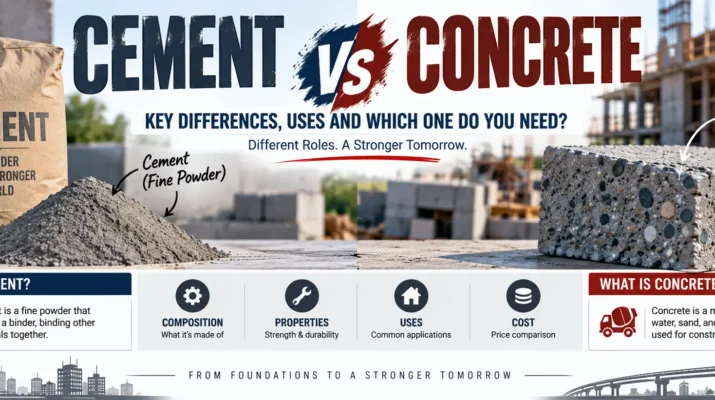
People often use the words cement and concrete as though they describe the same material. However, the cement vs concrete distinction is simple: cement is a binding ingredient, while concrete is a finished construction material made by mixing cement with water, sand, and aggregates such as gravel or crushed stone. In other words, cement helps hold concrete together, but a concrete driveway, foundation, or structural column is not made from cement alone.
Understanding this difference matters when choosing materials, discussing a construction project, or learning how modern structures are built. Although the two materials are closely connected, their composition, properties, applications, and production methods are quite different.
Cement vs Concrete: Quick Comparison
The easiest way to understand the difference is to compare their roles in construction.
| Feature | Cement | Concrete |
|---|---|---|
| What it is | A binding material | A composite construction material |
| Main ingredients | Primarily processed limestone and clay or similar raw materials | Cement, water, fine aggregate, and coarse aggregate |
| Main purpose | Binds other materials | Forms structural and nonstructural components |
| Typical appearance | Fine gray powder | Hard, stone-like material after curing |
| Common uses | Concrete, mortar, grout and other cement-based products | Foundations, slabs, columns, roads, bridges and walls |
| Strength role | Provides the binding reaction | Develops usable structural strength as a complete mixture |
| Used alone? | Rarely as a finished structural material | Yes, after mixing, placing and curing |
Therefore, when someone says a “cement sidewalk,” they usually mean a concrete sidewalk.
The distinction becomes even more useful on large engineering projects. For instance, designers comparing materials for different types of bridges need to consider the properties of reinforced or prestressed concrete rather than cement powder by itself.
What Is Cement?
Cement is a finely ground binding material. When mixed with water, hydraulic cement undergoes chemical reactions that allow it to harden and bind other materials together.
Portland cement is the most widely recognized type used in general construction. Manufacturers typically produce it by heating carefully proportioned calcium-rich and silica-, alumina-, and iron-bearing raw materials at high temperatures to form clinker. Next, they grind the clinker with a controlled amount of gypsum and sometimes other constituents to produce cement.
Once water is added, hydration begins. As a result, new compounds form and the cement paste gradually stiffens and develops strength.
Because cement acts as the binder, it represents only part of a typical concrete mixture.
What Is Concrete?
Concrete combines cementitious binder, water, and aggregates. Fine aggregate usually consists of sand, while coarse aggregate may include gravel or crushed stone.
Once these materials are mixed, the fresh concrete can be transported and placed into forms. Then, hydration and curing allow the material to develop strength over time.
Engineers can modify concrete for different applications by changing mixture proportions and using supplementary cementitious materials, chemical admixtures, fibers, or specialized aggregates.
For structural work, concrete is commonly combined with reinforcing steel because the materials complement one another. Concrete performs well under compression, while properly designed reinforcement helps resist tensile forces.
As a result, reinforced concrete appears throughout buildings, infrastructure, foundations, retaining structures, and transportation projects.
Cement vs Concrete Difference in Simple Terms
Think of cement as one ingredient in a recipe and concrete as the finished product.
A similar relationship exists between flour and bread. Flour is essential to many bread recipes, yet flour itself is not bread. Likewise, cement is essential to conventional concrete, but cement alone is not concrete.
This cement vs concrete difference explains why their names should not be used interchangeably in technical discussions.
Concrete also contains much more aggregate by volume than cement. Consequently, the properties of the aggregates, water-to-cementitious-material ratio, mixture design, placement, consolidation, and curing all influence the finished material.
Modern digital construction workflows can help teams coordinate these material requirements with structural models. For example, the benefits of using BIM in construction include improved coordination between design information, quantities, specifications, and project participants.
Portland Cement vs Concrete
The comparison between Portland cement vs concrete is especially common because Portland cement appears in so many construction specifications.
Portland cement is a type of hydraulic cement. Concrete, meanwhile, is the composite material that can use Portland cement as its primary binder.
Therefore:
Portland cement + water + aggregates = conventional concrete mixture
The actual formulation can be more complex. For example, concrete may contain fly ash, slag cement, silica fume, limestone-based materials, or other supplementary cementitious components depending on the specification and application.
Chemical admixtures can also change characteristics such as workability, setting behavior, air content, or water demand.
So, while Portland cement may be a key component, the finished concrete gets its overall performance from the complete mixture and how it is produced, placed, and cured.
Cement vs Concrete vs Mortar
Another common source of confusion is cement vs concrete vs mortar. All three terms are related, but each describes something different.
Cement is the binder.
Concrete typically combines cementitious materials, water, fine aggregate, and coarse aggregate. Meanwhile, mortar generally combines a binder, water, and fine aggregate and is commonly used to bond masonry units, fill joints, and perform certain finishing or repair tasks.
Because mortar normally lacks the coarse aggregate found in conventional concrete, its texture and intended uses differ.
For example, workers may use mortar between bricks or concrete masonry units. In contrast, they may pour concrete for a slab, footing, column, or structural wall.
Choosing between them depends on the job rather than simply selecting whichever material seems strongest.
Why Concrete Is Used for Structural Construction
Concrete offers several characteristics that make it useful for infrastructure and buildings. It can be placed into many shapes, develops substantial compressive strength, and can provide long service life when properly designed, constructed, and maintained.
However, concrete has relatively low tensile strength compared with its compressive strength. Therefore, engineers often use steel reinforcement where tensile stresses need to be resisted.
For instance, a reinforced concrete load bearing beam must be designed for expected loads, span, reinforcement requirements, concrete strength, serviceability, and other structural conditions. Simply increasing the amount of cement does not replace proper engineering.
The final performance also depends heavily on workmanship. Poor consolidation, incorrect water addition, inadequate curing, or unsuitable mixture proportions can reduce durability and performance.
How Concrete Develops Strength
Concrete does not simply “dry” into a strong material. Instead, hydration reactions between cement and water create products that bind the mixture together.
Strength develops progressively rather than instantly. Therefore, curing conditions matter.
Maintaining suitable moisture and temperature during early curing supports continued hydration. Conversely, rapid moisture loss can interfere with the intended development of the concrete.
The water-to-cementitious-material ratio also plays a major role. Adding unnecessary water may make fresh concrete easier to place temporarily, yet excessive water can increase porosity and reduce strength and durability.
For that reason, construction teams should follow the specified mixture and placement procedures rather than casually adding water at the jobsite.
Where Cement and Concrete Are Used
Because cement is primarily a binder, you encounter it mainly as an ingredient in construction products.
Typical cement-based applications include:
- Concrete
- Mortar
- Grout
- Stucco and renders
- Certain repair products
- Precast products
Concrete has a much broader direct structural role. Common examples include foundations, floors, driveways, sidewalks, retaining walls, columns, dams, tunnels, bridge components, pipes, and pavement.
In reinforced concrete construction, various mechanical connections and assemblies may also appear elsewhere in the structure. Understanding the types of bolts used in construction becomes relevant when concrete components connect with structural steel, equipment, anchors, or other assemblies.
Therefore, concrete rarely exists as an isolated material within a large engineering project. Instead, it forms part of a wider structural system.
Is Cement Stronger Than Concrete?
Comparing their strength directly can be misleading because they serve different purposes.
Hardened cement paste can develop strength, yet construction concrete is engineered as a composite material. Aggregates form much of its volume, while the hydrated cementitious paste binds those particles together.
Concrete strength depends on mixture proportions, cementitious materials, aggregate characteristics, water content, curing, age, workmanship, and testing conditions.
Consequently, saying that either “cement is stronger” or “concrete is stronger” without defining the material and test conditions oversimplifies the issue.
For real construction decisions, engineers work with specified concrete properties rather than assuming performance from the cement component alone.
Different Types of Concrete
Concrete is not one universal mixture. Instead, engineers adjust it according to structural and performance requirements.
Common categories include:
Reinforced Concrete
Steel reinforcement is embedded in concrete to help resist tensile stresses. This approach is common in buildings, foundations, bridges, and retaining structures.
Prestressed Concrete
Prestressing introduces forces into the concrete to improve its behavior under service loads. It is widely used in certain bridges, beams, floor systems, and precast elements.
Precast Concrete
Manufacturers cast precast components in controlled production environments before transporting them to the construction site.
High-Strength and High-Performance Concrete
Engineers can design mixtures for higher strength or specific durability and performance requirements. However, “high-performance” can involve more than compressive strength alone.
Fiber-Reinforced Concrete
Fibers can be incorporated to modify cracking behavior, toughness, or other properties depending on fiber type and mixture design.
Cement and Concrete in Modern Construction Technology
Construction technology increasingly connects material selection with digital design, monitoring, quality control, and automated production.
For example, BIM models can connect concrete elements with geometry, specifications, quantities, sequencing, and other project data. Meanwhile, sensors and digital monitoring systems can help teams track parameters such as concrete temperature during curing on selected projects.
Concrete production has also become more sophisticated. Ready-mix plants use controlled batching systems to measure ingredients, while engineers can design mixtures for specific strength, workability, exposure, and placement requirements.
Connection technology matters as well. Although types of rivets are more closely associated with metal construction and fabrication than concrete itself, understanding different fastening methods helps explain how concrete, steel, and other materials come together in complex structures.
Thus, modern construction depends not only on individual materials but also on how entire systems are designed and assembled.
Common Cement and Concrete Mistakes
One of the simplest mistakes is referring to every gray construction material as cement. However, terminology matters when buying products or communicating specifications.
Another mistake is assuming that adding extra cement automatically produces better concrete. Mixture design involves balancing several components, so arbitrary changes can affect workability, shrinkage, heat generation, cost, and other properties.
Likewise, adding excessive water to fresh concrete can create performance problems.
Poor curing is another avoidable issue. Even a properly proportioned concrete mixture needs suitable curing conditions to develop its intended properties.
For structural projects, always follow engineered specifications and applicable construction standards rather than relying on informal mixture recipes.
Frequently Asked Questions
Is cement the same as concrete?
No. Cement is a binding material, while concrete is a composite construction material typically made from cementitious materials, water, sand, and coarse aggregate.
Is a sidewalk made from cement or concrete?
Most conventional sidewalks are made from concrete. Cement is one of the materials used to produce that concrete.
Why do people call concrete cement?
The terms are commonly mixed up because cement is a key ingredient in concrete. However, construction professionals generally distinguish between the binder and the finished composite material.
What is the main cement vs concrete difference?
The main difference is their function. Cement acts as a binder, while concrete combines that binder with water and aggregates to create a usable construction material.
Does concrete become stronger as it dries?
Concrete strength develops mainly through hydration rather than simple drying. Therefore, maintaining suitable curing conditions during early strength development is essential.
Can cement be used by itself?
Cement paste can harden when mixed with water, but cement is generally used as a binder in concrete, mortar, grout, and related products rather than as a standalone structural building material.
The Easy Way to Remember the Difference
When comparing cement vs concrete, remember one simple rule: cement is an ingredient, while concrete is the finished composite material used for many construction applications.
Portland cement reacts with water and helps bind aggregates together. Meanwhile, concrete combines those ingredients into a material that can form foundations, slabs, columns, walls, roads, and major infrastructure.
Therefore, if you are discussing a driveway, structural slab, or reinforced building component, “concrete” is usually the correct term. If you are discussing the powdered hydraulic binder used in the mixture, “cement” is the correct term.
Knowing that distinction makes construction terminology easier to understand while also providing a better foundation for learning how modern building materials actually work.