
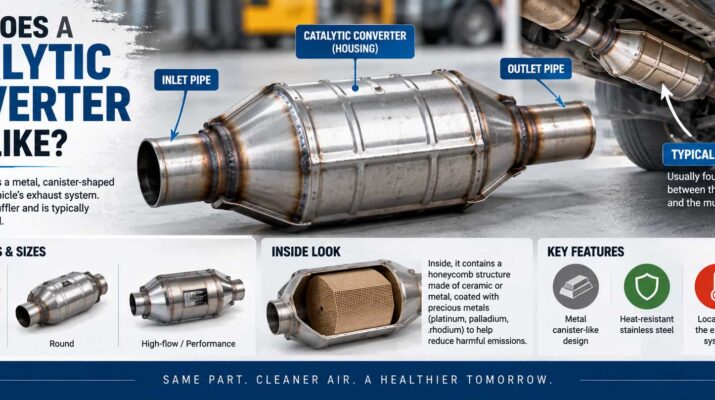
If you have looked underneath a vehicle and wondered what does a catalytic converter look like, it usually appears as a metal canister or enlarged section of the exhaust system. Depending on the vehicle, it may look oval, cylindrical, flattened, or somewhat like a small muffler. Exhaust pipes connect to both ends, while the inside contains a honeycomb-like structure coated with materials that help convert harmful exhaust gases into less harmful emissions.
Although catalytic converters differ in size and shape, knowing their location and basic construction makes them fairly easy to distinguish from mufflers, resonators, and other exhaust components. Their appearance can also provide clues about physical damage, overheating, corrosion, or tampering.
What Does a Catalytic Converter Look Like Under a Car?
A catalytic converter normally looks like a swollen metal chamber installed directly in the exhaust path. Instead of maintaining the same diameter as the exhaust pipe, the system expands around the converter and then narrows again.
Most converters have a stainless-steel outer shell that can become dull gray, brown, or slightly rusty after years of exposure to heat, road salt, moisture, and dirt. New units, by comparison, may have a bright silver metallic finish.
Common visual features include:
- A metal oval or cylindrical housing
- Exhaust tubing entering and leaving the housing
- Welded seams around the shell
- Heat shields on some vehicles
- Oxygen sensors positioned near the converter
- Flanges, clamps, or welded connections
- Manufacturer or emissions-related markings on some units
However, designs vary considerably. Therefore, you should not identify a catalytic converter by shape alone.
Some modern vehicles place converters very close to the engine, where they heat up rapidly after startup. Meanwhile, other vehicles have one or more converters farther underneath the floor.
Where Is the Catalytic Converter Located?
The catalytic converter sits somewhere between the engine and the exhaust outlet because all exhaust gases need to pass through it.
On many vehicles, you can find it underneath the car between the exhaust manifold and muffler. However, modern emissions systems often position at least one converter much closer to the engine.
That location helps the converter reach its effective operating temperature quickly.
Some engines use multiple converters as well. For instance, a V6 or V8 engine may have separate converters serving different cylinder banks, followed by other exhaust-treatment components farther downstream.
Meanwhile, turbocharged engines can have particularly compact exhaust layouts because the turbocharger and emissions hardware may sit close together. Understanding how does a turbo work can make this arrangement easier to recognize because exhaust gases drive the turbine before continuing through the emissions system.
Never crawl underneath a vehicle supported only by a jack to locate the converter. Instead, use properly rated stands, ramps, or professional lifting equipment if underbody access is required.
What Does the Inside of a Catalytic Converter Look Like?
If you are asking what does the inside of a catalytic converter look like, imagine a dense honeycomb containing hundreds or thousands of tiny passages.
This internal structure is commonly called the substrate. Depending on the design, manufacturers can use ceramic or metallic substrates.
The honeycomb creates a large surface area without completely blocking exhaust flow. Consequently, exhaust gases can travel through many small channels while interacting with the catalytic coating.
A simplified flow looks like this:
Engine → Exhaust gases → Converter inlet → Honeycomb substrate → Catalytic reaction → Converter outlet → Remaining exhaust system
The substrate receives a coating that supports catalytic materials, commonly including precious metals such as platinum, palladium, and rhodium. These materials promote chemical reactions that reduce certain harmful pollutants in the exhaust.
Therefore, the valuable material is not a solid block of precious metal. Instead, relatively small quantities are distributed across the internal catalyst surface.
What Does a Catalytic Converter Look Like Inside When Healthy?
A healthy internal substrate typically has a neat, uniform honeycomb pattern.
The tiny passages should remain open so exhaust gases can move through the converter. Meanwhile, the substrate should remain structurally intact rather than broken into loose pieces.
However, you normally cannot inspect the entire internal structure without removing the converter or using specialized inspection equipment. Therefore, technicians often diagnose converter problems through scan data, temperature measurements, exhaust testing, backpressure tests, or sensor readings rather than cutting the component open.
A borescope may sometimes help inspect accessible internal areas, depending on the exhaust design.
Since oxygen sensors help the engine computer monitor exhaust conditions before and after the converter, diagnostic trouble codes can also provide useful clues. Still, a catalyst-related code does not automatically prove that the converter itself has failed.
How Does a Catalytic Converter Work?
The converter works by promoting chemical reactions within hot exhaust gases.
Modern gasoline engines commonly use three-way catalytic converters. In suitable operating conditions, these systems help reduce carbon monoxide, unburned hydrocarbons, and nitrogen oxides.
However, the converter depends heavily on correct engine operation.
For example, an engine running excessively rich can send too much unburned fuel into the exhaust. Consequently, that fuel may burn inside the converter and create extreme temperatures.
Misfires can cause similar trouble. Likewise, oil or coolant entering the combustion process can contaminate the catalyst and reduce its effectiveness.
The converter is therefore part of a larger emissions-control system rather than an isolated component.
Hybrid vehicles also use emissions-control hardware, although their operating cycles can differ because the gasoline engine may switch on and off. If that technology is unfamiliar, understanding what is a hybrid car provides useful background on how an internal-combustion engine and electric drive system work together.
What Does a Bad Catalytic Converter Look Like?
People often ask what does a bad catalytic converter look like, yet visual inspection alone does not always reveal failure.
A converter can look completely normal outside while its internal catalyst has become contaminated, melted, cracked, or inefficient. On the other hand, obvious external damage can sometimes reveal a problem immediately.
Possible visible signs include:
- Severe dents in the housing
- Cracks or holes
- Broken welds
- Heavy corrosion
- Loose or damaged heat shields
- Dark discoloration from excessive heat
- Physical impact damage
- Missing sections or signs of exhaust modification
An overheated converter may sometimes show blue, purple, or dark discoloration on surrounding metal. However, color alone cannot provide a reliable diagnosis.
If the internal substrate breaks apart, you may also hear a rattling sound from the converter area, especially during startup or when engine speed changes.
What Does a Clogged Catalytic Converter Look Like?
If you are wondering what does a clogged catalytic converter look like, the answer can be frustrating: from the outside, it may look perfectly normal.
The blockage usually occurs internally.
Extreme heat can melt parts of the honeycomb until individual passages collapse or fuse together. Meanwhile, contamination can coat the substrate and interfere with exhaust flow.
A restricted converter may cause symptoms such as poor acceleration, reduced power, excessive exhaust heat, difficulty reaching higher engine speeds, or poor fuel economy.
However, those symptoms overlap with many other engine problems.
For example, if you are troubleshooting why does my car jump when i accelerate, ignition problems, fuel-delivery issues, transmission behavior, engine mounts, sensors, and exhaust restriction are among several possibilities that may need investigation.
Therefore, replacing the converter based only on a symptom can become an expensive mistake.
Catalytic Converter vs. Muffler: How to Tell the Difference
Catalytic converters and mufflers are both attached to the exhaust system, so beginners can easily confuse them.
| Feature | Catalytic Converter | Muffler |
|---|---|---|
| Main purpose | Reduce harmful emissions | Reduce exhaust noise |
| Typical location | Closer to engine | Farther toward rear |
| Internal design | Catalyst-coated substrate | Chambers, tubes, or sound-control materials |
| Common shape | Small oval/cylindrical canister | Often larger oval or rectangular body |
| Sensors nearby | Often | Less common |
| Operating temperature | Very high | Generally lower than converter |
Location provides one of the easiest clues. A muffler usually sits closer to the rear of the vehicle, while the catalytic converter is generally closer to the engine.
Still, compact exhaust designs can make identification less obvious. Therefore, follow the exhaust path and look for sensors, heat shields, and component markings when possible.
Can Fuel Type Change the Catalytic Converter System?
Yes. Emissions-control systems differ between gasoline and diesel vehicles, while fuel compatibility also affects how an engine and its emissions hardware operate.
For example, flex-fuel vehicles can operate on gasoline or approved ethanol blends such as E85 when designed for them. Learning what is flex fuel helps explain why engine-management systems must adapt fuel delivery while still maintaining emissions performance.
Diesel vehicles may use a diesel oxidation catalyst along with other hardware such as diesel particulate filters and selective catalytic reduction systems. Therefore, the underbody exhaust system on a modern diesel can contain several canister-like components.
As a result, identifying a component only by seeing a metal box in the exhaust line can be misleading.
Signs the Converter May Need Testing
A visual check is useful, but vehicle behavior often provides better evidence.
You may want the exhaust and engine-management systems tested if you notice a persistent check-engine light, significant power loss, unusual exhaust odors, poor acceleration, abnormal heat beneath the vehicle, or rattling from the exhaust.
Still, do not assume every check-engine light means a bad catalytic converter.
An oxygen sensor fault, fuel-system problem, vacuum leak, ignition misfire, injector issue, or another engine problem can sometimes affect catalyst-monitoring data.
Professional diagnosis may involve checking diagnostic codes, fuel trims, oxygen-sensor signals, exhaust backpressure, temperature differences, and engine performance.
Finding the original cause matters because installing a new converter without fixing an engine problem can damage the replacement.
Catalytic Converter and Torque Converter Are Completely Different
The similar names cause occasional confusion, but these two components perform unrelated jobs.
A catalytic converter belongs to the exhaust and emissions system. Meanwhile, a torque converter is part of many automatic transmissions and transfers rotating power between the engine and transmission through fluid dynamics.
If you are trying to identify drivetrain parts rather than exhaust components, a guide explaining how does a torque converter work will clarify why it sits near the transmission instead of underneath the exhaust path.
Therefore, when someone mentions a “converter” during vehicle repair, confirm which component they mean before buying parts.
Can You Tell If a Catalytic Converter Was Removed?
Usually, yes.
A missing converter may leave an obvious gap or a replacement section of straight exhaust pipe where the converter originally sat. Meanwhile, rough cuts, fresh welds, hanging wires, damaged oxygen-sensor connections, or unusually loud exhaust noise can indicate removal or tampering.
However, the exact appearance depends on the vehicle.
Because some converters sit inside or very close to exhaust manifolds, their absence may be harder to recognize from a quick look underneath the car.
If you suspect the converter is missing, have the exhaust system inspected professionally. Exhaust leaks and improper repairs can create safety problems, while emissions-system requirements also vary by jurisdiction.
Common Mistakes When Identifying a Catalytic Converter
One common mistake is assuming every oval exhaust component is a catalytic converter. Resonators and mufflers can have similar-looking metal housings.
Another mistake is expecting every converter to look identical. Vehicle manufacturers use many shapes and configurations based on engine design, available space, emissions requirements, and exhaust layout.
Likewise, surface rust does not automatically mean the converter has failed. Exhaust components experience repeated heating, cooling, moisture, and road exposure, so discoloration is common.
Finally, avoid diagnosing internal failure from appearance alone. A clean-looking converter can be inefficient or blocked internally, while an old-looking unit may still function properly.
Frequently Asked Questions
What does a catalytic converter look like on most cars?
Most catalytic converters resemble a small metal canister or enlarged section of exhaust pipe. They are commonly oval or cylindrical and have exhaust tubing connected at both ends.
What does a catalytic converter look like inside?
Inside, most converters contain a tightly packed honeycomb-like substrate with many small passages. The surface carries catalyst materials that help reduce harmful exhaust pollutants.
Is a catalytic converter the same as a muffler?
No. The catalytic converter reduces harmful emissions, while the muffler mainly reduces exhaust noise. The converter usually sits closer to the engine.
Can you see a clogged catalytic converter?
Not always. Internal melting or contamination may restrict airflow while the outside looks normal. Diagnostic testing is often needed to confirm a blockage.
Why are catalytic converters valuable?
Catalytic converters contain catalyst coatings that can include precious metals such as platinum, palladium, and rhodium. Their amounts and composition vary by converter design.
Can a car run without a catalytic converter?
An engine may physically operate after a converter is removed, but doing so can cause emissions-system faults, excessive noise or exhaust problems depending on the vehicle. It can also violate emissions or vehicle laws depending on the jurisdiction.
Know What You Are Looking At Before Replacing Anything
So, what does a catalytic converter look like? From underneath the vehicle, expect an enlarged metal chamber connected directly into the exhaust system, usually somewhere between the engine and muffler. Inside, expect a fine honeycomb-like substrate designed to expose exhaust gases to catalytic materials.
However, appearance tells only part of the story. A damaged shell may reveal an obvious problem, while a clogged or inefficient converter can look completely normal from outside.
Therefore, use visual inspection as the starting point rather than the final diagnosis. If your vehicle has power loss, catalyst-related trouble codes, excessive heat, rattling, or unusual exhaust behavior, proper testing can identify whether the converter is actually responsible before you spend money replacing it.