
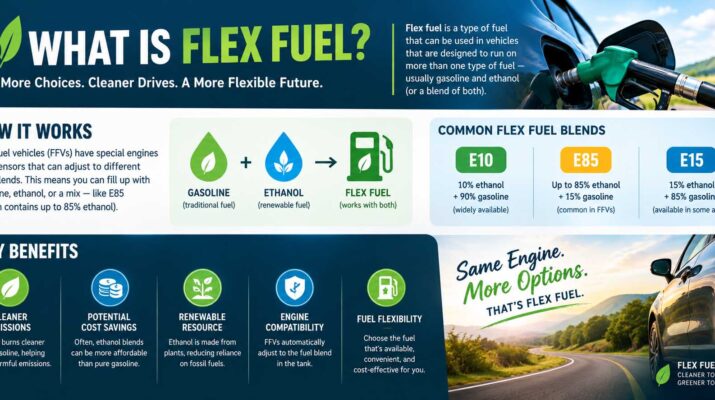
If you have ever seen a fuel pump labeled E85 or noticed “Flex Fuel” on a vehicle badge, you may have wondered what is flex fuel and why some cars can use it. Flex fuel is a gasoline-based fuel blend containing a significant amount of ethanol, most commonly a mixture of gasoline and ethanol. Vehicles designed for this fuel can automatically adjust their engine settings to run on different ethanol-gasoline blends.
Flex fuel technology gives drivers more fuel choices while making use of ethanol, which can be produced from renewable plant materials. However, it also comes with trade-offs involving fuel economy, availability, cost, and vehicle compatibility.
Understanding how the system works makes it easier to decide whether a flex-fuel vehicle is practical for your needs.
What Is Flex Fuel?
Flex fuel, short for flexible fuel, is a gasoline-ethanol blend designed for use in specially equipped engines. In the United States, one of the best-known examples is E85, which can contain roughly 51% to 83% ethanol depending on factors such as season and location.
Unlike ordinary gasoline, flex fuel contains enough ethanol that the vehicle needs specialized fuel-system components and engine controls. A compatible vehicle can detect the fuel mixture and adjust its operation automatically.
So, what is flex fuel mean in everyday terms? It means a fuel system can handle varying proportions of gasoline and ethanol without requiring the driver to manually change engine settings.
Flex fuel should not be confused with simply adding ethanol to any gasoline vehicle. A vehicle must be specifically designed or certified for flexible-fuel operation.
What Is an E85 Flex Fuel?
When people ask what is e85 flex fuel, they are usually referring to a high-ethanol blend intended for flexible-fuel vehicles.
The “E” refers to ethanol, while the number represents the approximate maximum ethanol percentage. E85 can contain up to about 85% ethanol under applicable fuel specifications, although the actual blend can vary.
Because ethanol has different chemical and combustion characteristics from gasoline, an E85-capable engine uses electronic controls to compensate for the changing fuel mixture.
What Is a Flex Fuel Vehicle?
A what is a flex fuel vehicle explanation is fairly simple: it is a vehicle engineered to operate on gasoline, ethanol-gasoline blends, or both within approved fuel specifications.
A flexible-fuel vehicle, often called an FFV, typically looks and drives much like a conventional gasoline vehicle. The major differences are found in the fuel system, engine calibration, sensors, and materials that come into contact with ethanol.
Many modern vehicles rely on an electronic engine control unit to monitor operating conditions. Depending on the design, the system can determine the ethanol content of the fuel and adjust fuel delivery and ignition-related parameters.
This automatic adjustment is what makes flexible-fuel technology convenient for drivers.
What Is Flex Fuel Vehicle Technology Used For?
Flex-fuel technology allows manufacturers to build vehicles that can use multiple fuel blends without requiring a separate engine for each fuel type.
For drivers, the main advantage is flexibility. If E85 is available, a compatible vehicle can use it. When it is not available, the vehicle can generally operate on regular gasoline or another approved fuel.
However, not every vehicle can safely use E85. Checking the owner’s manual, fuel-door label, or manufacturer documentation is essential before filling the tank.
How Does Flex Fuel Work?
The basic process starts when fuel enters the vehicle’s fuel system. Sensors and the engine management system monitor the fuel and operating conditions.
The electronic control unit then adjusts fuel injection and other engine parameters to maintain appropriate combustion.
Therefore, an engine generally needs to burn a greater volume of E85 to produce the same amount of energy.
At the same time, ethanol has a high octane rating. That characteristic can benefit engines designed to take advantage of it.
The Role of Engine Sensors
Modern FFVs use electronic sensors and software to keep the engine operating correctly across changing fuel mixtures.
Depending on the vehicle design, the system may estimate or directly determine ethanol concentration. It can then modify fuel delivery to match the fuel’s characteristics.
This process happens automatically while the vehicle is running.
The result is a system that does not require drivers to manually tell the car whether gasoline or an ethanol blend is in the tank.
Flex Fuel vs. Regular Gasoline
The biggest difference between flex fuel and conventional gasoline is ethanol content.
| Feature | Regular Gasoline | Flex Fuel / E85 |
|---|---|---|
| Main components | Primarily gasoline | Gasoline and high ethanol content |
| Typical ethanol level | Often around 10% in E10 fuel | Can contain much higher ethanol content |
| Vehicle requirement | Standard gasoline vehicles | Compatible FFVs |
| Energy per gallon | Higher | Lower |
| Octane potential | Varies | Generally high |
| Fuel availability | Usually widespread | More limited in many areas |
| Fuel economy | Generally higher per gallon | Usually lower per gallon |
The difference in energy density means that an E85 vehicle may travel fewer miles per gallon when using high-ethanol fuel.
Therefore, a lower pump price does not automatically mean lower cost per mile.
Advantages of Flex Fuel
Flexible-fuel technology has several useful characteristics, particularly for drivers who have reliable access to compatible ethanol blends.
More Fuel Choice
An FFV gives drivers more options. Depending on the vehicle and local fuel standards, the driver can choose between gasoline and an approved ethanol blend.
That flexibility can be helpful when fuel prices or availability change.
High Octane Potential
Ethanol has a relatively high octane rating. High-octane fuel can help prevent certain forms of abnormal combustion, especially in engines designed around higher-octane fuel.
However, simply putting E85 into an incompatible engine does not provide this benefit and can cause problems.
Renewable Fuel Source
Ethanol can be produced from agricultural crops and other biomass sources. As a result, it can provide an alternative to relying exclusively on petroleum-derived gasoline.
The environmental benefits vary depending on how the ethanol is produced, transported, and used.
Automatic Fuel Adjustment
Drivers do not normally need to manually tune a compatible FFV when switching between approved fuel blends.
The vehicle’s electronic engine controls handle the necessary adjustments.
Disadvantages and Trade-Offs
Flex fuel is not automatically the best choice for every driver.
Lower Fuel Economy
Because ethanol contains less energy per unit of volume than gasoline, high-ethanol blends generally produce fewer miles per gallon.
Consequently, drivers need to compare the price of the fuel with the vehicle’s actual fuel consumption rather than looking only at the price displayed at the pump.
Limited E85 Availability
Regular gasoline is widely available, while E85 availability depends heavily on location.
For someone who travels frequently, finding an E85 station can be inconvenient.
Compatibility Matters
Only vehicles specifically designed for flexible-fuel operation should use E85 or other high-ethanol blends approved for that vehicle.
Using an unsuitable fuel can damage components or cause poor engine operation.
Flex Fuel and Engine Performance
Flex fuel can affect performance in several ways, depending on the engine.
Ethanol’s high octane characteristics can support higher compression ratios or more aggressive engine calibration in designs specifically optimized for ethanol. However, an ordinary FFV is not necessarily faster simply because it can use E85.
For example, if you are learning what is rpm, you may already know that engine speed is measured in revolutions per minute. Fuel type does not directly determine RPM, but the fuel and engine-control strategy can influence how an engine produces torque across its operating range.
The actual result depends on engine design, fuel quality, calibration, and driving conditions.
Does Flex Fuel Improve Fuel Economy?
Generally, high-ethanol fuel does not improve miles per gallon compared with gasoline.
The reason is straightforward: ethanol contains less energy per gallon. An engine therefore needs to consume more fuel to travel the same distance.
However, fuel economy is only one part of the cost calculation.
Suppose E85 costs significantly less per gallon than gasoline. The lower pump price could partially or fully offset the additional fuel consumption. In another situation, the price difference may be too small to make E85 financially attractive.
A useful comparison is cost per mile, not simply cost per gallon.
How to Tell If Your Car Uses Flex Fuel
If you are unsure whether your vehicle is an FFV, do not guess.
Use these steps:
- Check the fuel-door area. Some vehicles have an E85 or Flex Fuel label near the fuel filler.
- Read the owner’s manual. Look for approved fuel types and ethanol limits.
- Check manufacturer information. Use the exact model year and engine configuration.
- Look for vehicle labeling. Some FFVs display a flex-fuel designation.
- Ask a qualified service professional. This is useful when documentation is unavailable.
The model name alone may not always be enough because fuel compatibility can vary by engine, trim, and model year.
Common Flex Fuel Problems and Troubleshooting
Flexible-fuel systems are designed to handle changing fuel mixtures, but problems can still occur.
Rough Running or Hesitation
If an FFV suddenly runs poorly after refueling, contaminated or incorrect fuel may be one possible cause.
However, ignition problems, sensors, injectors, air leaks, and other engine faults can produce similar symptoms.
Reduced Fuel Economy
Lower MPG is expected when using high-ethanol fuel. However, a sudden or unusually large drop in fuel economy may indicate another problem.
Check tire pressure, driving conditions, maintenance status, and fuel quality before assuming the ethanol blend is responsible.
Starting Problems
Ethanol fuel characteristics can affect cold starting, particularly under certain temperature conditions. Modern FFVs compensate through engine controls, but problems can still occur if the vehicle has a malfunctioning sensor or fuel-system component.
If the vehicle repeatedly struggles to start, professional diagnosis is a better approach than repeatedly changing fuel types.
Flex Fuel Compared With Other Automotive Technologies
Flex fuel is a fuel-system technology, so it should not be confused with drivetrain technologies.
For example, what is a hybrid car is a different question because a hybrid combines an internal-combustion engine with an electric motor and battery system. A vehicle can also combine different technologies depending on its design.
Likewise, flexible fuel does not determine whether a car uses front-wheel drive, rear-wheel drive, or all-wheel drive.
The technologies solve different problems. Flex fuel focuses on fuel compatibility, while hybrid systems focus on combining combustion and electric propulsion.
Flex Fuel and Turbocharged Engines
Turbocharging and flexible-fuel operation can also exist together.
If you have wondered how does a turbo work, the basic idea is that a turbocharger uses exhaust energy to compress incoming air. More air allows an engine to burn more fuel when the system is properly designed and controlled.
Because ethanol has high octane characteristics and strong charge-cooling effects, ethanol fuels can be useful in some performance-oriented engine applications. Still, the engine must be designed and calibrated for the fuel.
A turbocharged gasoline engine should never be assumed to be E85-compatible simply because it uses forced induction.
Is Flex Fuel Right for You?
Flex fuel makes the most sense when three factors line up: your vehicle supports it, E85 is readily available, and the fuel’s price makes sense for your driving habits.
For occasional drivers, the lower fuel economy may matter less. For people who drive long distances, however, the difference in fuel consumption can become more noticeable.
Before choosing E85, compare its local price with gasoline and consider how often you can conveniently refuel.
It is also worth remembering that fuel compatibility comes first. Never sacrifice vehicle safety or manufacturer requirements just to save money at the pump.
Quick Answers About Flex Fuel
Can any gasoline car use E85?
No. E85 is intended for vehicles specifically designed and certified for flexible-fuel operation. Always check the vehicle manufacturer’s specifications.
Is flex fuel the same as ethanol?
Not exactly. Ethanol is an alcohol fuel component, while flex fuel generally refers to gasoline containing a variable, relatively high proportion of ethanol for use in compatible vehicles.
Is E85 better than gasoline?
Neither is universally better. E85 can offer high octane and use renewable ethanol, while gasoline generally provides more energy per gallon and is easier to find.
Does flex fuel damage an engine?
An approved ethanol blend should not damage a properly designed FFV when used according to the manufacturer’s specifications. High-ethanol fuel in a vehicle that is not designed for it can cause problems.
Can a flex-fuel vehicle use regular gasoline?
Many FFVs are designed to run on regular gasoline as well as approved ethanol blends. Check the owner’s manual for the exact requirements of your vehicle.
The Bottom Line on Flex Fuel
So, what is flex fuel? It is a gasoline-based fuel blend containing a substantial amount of ethanol that can be used by specially designed flexible-fuel vehicles. These vehicles use sensors and electronic engine controls to adapt to changing fuel mixtures automatically.
The technology offers useful flexibility, high-octane potential, and a way to incorporate ethanol into transportation fuel. On the other hand, E85 usually provides lower fuel economy and may be harder to find than conventional gasoline.
For anyone considering flex fuel, the smartest approach is simple: confirm vehicle compatibility, compare local fuel prices, and think in terms of cost per mile rather than pump price alone. With those factors in mind, it becomes much easier to decide whether flexible-fuel technology fits your everyday driving.