
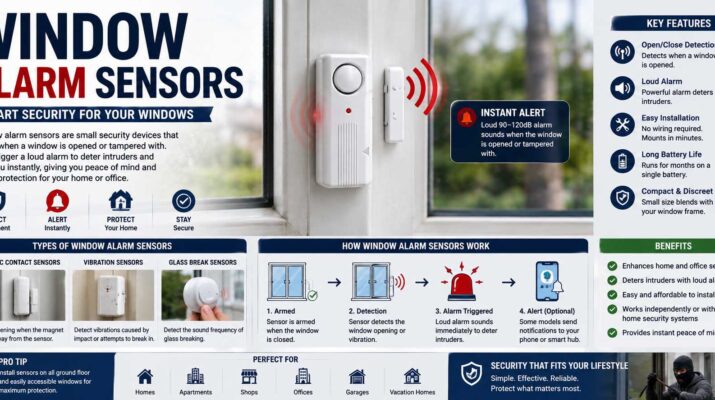
Windows can be vulnerable entry points in a home, especially when they are hidden from the street or located on the ground floor. Window alarm sensors help monitor these openings by detecting when a protected window opens or, with certain models, when glass breaks or unusual vibration occurs. Depending on the security system, a triggered sensor can sound an alarm, notify a control panel, or send an alert to a phone.
Although these devices are usually small, choosing the right sensor takes some thought. Wired and wireless models have different installation requirements, while contact, vibration, and glass-break sensors detect different events.
The best choice depends on your windows, existing security equipment, desired smart-home features, and whether you want professional or DIY installation. Understanding these differences makes it much easier to build a practical window security setup.
What Are Window Alarm Sensors?
A window alarm sensor is an electronic security device designed to monitor a window for a specific change. The most common version detects whether the window is open or closed.
A typical contact sensor has two pieces. One part attaches to the fixed window frame, while the other attaches to the movable sash. When the window closes, the two components sit close together. When someone opens the window, they separate and change the sensor’s state.
Depending on the system, that change can trigger a siren, communicate with a central alarm panel, or generate a smartphone notification.
This basic monitoring principle relates closely to what is instrumentation, since security systems use sensors and related electronics to observe conditions and communicate changes to a control system.
However, not every window sensor detects opening. Some devices respond to vibration or impact, while acoustic glass-break sensors listen for sound patterns associated with breaking glass.
How Window Alarm Sensors Work
Magnetic contact sensors are among the simplest and most widely used options.
One component normally contains a magnetic element, while the other contains the sensing mechanism. When both pieces are positioned correctly, the security system recognizes the window as closed. Once the window opens and the pieces move far enough apart, the sensor changes state.
The alarm system then decides what happens next.
For example, an armed security system may activate an alarm. Meanwhile, a smart home system might simply send a notification saying that a bedroom window has opened.
Wireless systems transmit their status using radio communication. Wired sensors, by comparison, send their signal through physical wiring connected to the alarm system.
The sensor itself doesn’t necessarily make the decision to sound an alarm. Instead, it provides information that the security controller interprets according to its settings.
Types of Window Alarm Sensors
There are several types of window alarm sensors, and each solves a slightly different security problem.
Magnetic Contact Sensors
Contact sensors monitor whether a window changes from closed to open.
They work particularly well on sliding, single-hung, double-hung, and many casement windows, provided there is enough room to position both components correctly.
Because these devices monitor movement rather than glass damage, someone breaking the glass without opening the protected sash may not trigger a basic contact sensor.
Vibration and Shock Sensors
Vibration sensors detect physical movement or impact.
For instance, repeated striking or force against a protected window may produce enough vibration to activate the sensor. Sensitivity settings vary between products, so proper adjustment matters.
If sensitivity is too high, normal household vibration may cause unwanted alerts. However, if sensitivity is too low, the sensor may not respond as expected.
Glass-Break Sensors
Glass-break detection uses a different approach.
Acoustic models listen for specific sound characteristics associated with breaking glass. One device may cover multiple windows when installed within its designed detection range.
Other glass-break devices mount directly on the glass and detect vibration or shock.
Since glass-break detection and contact sensing monitor different events, some security setups use both rather than treating one as a direct replacement for the other.
Wired Window Alarm Sensors vs Wireless Models
One of the biggest decisions is whether to use wired window alarm sensors or wireless units.
| Feature | Wired Sensors | Wireless Sensors |
|---|---|---|
| Connection | Physical wiring | Radio communication |
| Batteries | Often not required at sensor | Usually required |
| Installation | More involved | Usually easier |
| Existing alarm integration | Good for compatible wired panels | Depends on wireless protocol |
| DIY convenience | Moderate | Usually high |
| Ongoing maintenance | Less battery maintenance | Battery replacement required |
| Best suited for | Existing wired systems, renovations, new builds | Retrofits, rentals, smart homes |
Neither option is automatically better.
A house with existing alarm wiring may benefit from wired sensors because the infrastructure is already available. Conversely, adding wires throughout a finished home can create unnecessary installation work.
When planning wired installations, understanding different types of cables can also help explain why alarm wiring must match the system requirements rather than using any convenient wire.
Wireless models are often easier to install. Still, buyers should check communication range, battery requirements, hub compatibility, and supported security protocols before purchasing.
Why Wireless Window Alarm Sensors Are Popular
Wireless window alarm sensors have become a practical choice for many DIY security setups because they usually require little physical modification to the home.
Installation may involve attaching the sensor and magnet, pairing the device with a compatible hub, and configuring its behavior through an app or alarm panel.
That simplicity can be particularly useful for renters. In many cases, adhesive mounting avoids drilling, although users should verify that the mounting method is suitable for the window material.
Wireless sensors can also support remote status information. For example, compatible systems may let you check whether a window is currently open while you’re away.
That type of remote reporting is related to what is telemetry, where information measured at one location gets transmitted to another system for monitoring or analysis.
However, wireless operation introduces another maintenance requirement: batteries. Therefore, check whether the security platform provides low-battery notifications and how often the manufacturer expects batteries to need replacement.
Key Features to Compare Before Buying
Alarm window sensors can look nearly identical while offering very different capabilities. Therefore, compare the specifications instead of choosing only by appearance or price.
Security-System Compatibility
Compatibility should come first.
A sensor must communicate correctly with your alarm panel, hub, or smart-home platform. A product that uses an unsupported protocol may not pair with your existing equipment at all.
Before buying, check the manufacturer’s compatibility information for both the sensor and your specific hub or panel.
Sensor Gap
Contact sensors have a maximum allowable separation between the sensor and magnet when the window is closed.
If your window has thick trim, an unusual frame, or uneven surfaces, the two components may sit too far apart. Therefore, measure the intended mounting area before ordering.
Battery Monitoring
For wireless units, low-battery alerts are useful because they reduce the chance of leaving a sensor inactive without realizing it.
Also, check the battery type. Common, easily available batteries make long-term maintenance simpler.
Tamper Detection
Some security-focused models can report when somebody removes or opens the sensor housing.
This feature isn’t essential for every household, but it can add another layer of monitoring in a full alarm system.
Smart Notifications
Connected systems may send notifications when a window opens, closes, remains open for a set period, or changes state while nobody is home.
However, notification options depend on the platform. Therefore, review the app’s automation features rather than assuming every smart sensor offers the same controls.
Choosing Sensors for Different Window Designs
Window design affects installation more than many buyers expect.
On a traditional sliding window, a contact sensor may fit neatly on the frame and sash. Meanwhile, narrow frames can leave little room for a standard sensor housing.
Casement windows create another challenge because the sash swings outward or inward rather than sliding. Consequently, the sensor and magnet must remain properly positioned when closed without interfering with normal movement.
Tilt-and-turn windows may require even more planning because the sash moves in multiple ways.
Before purchasing multiple sensors, test the mounting concept on one window. This simple step can prevent buying a set that doesn’t physically fit the rest of your home.
How to Install Window Alarm Sensors
Always follow the instructions for your specific security product because installation varies by manufacturer.
Generally, contact sensor installation starts by cleaning and drying the mounting surfaces. Next, position the sensor and magnet so they align correctly when the window closes.
If you’re using adhesive mounting, press each component firmly according to the adhesive manufacturer’s directions. Poor adhesion can cause a sensor to fall, creating false alarms or leaving the window unmonitored.
Next, pair a wireless sensor with its hub or control panel if required. Then open and close the window while checking whether the system correctly reports both states.
For wired systems, installation can be more involved. If new wiring needs to run through walls or window frames, professional installation may be the more practical choice.
Using Window Sensors in Smart-Home Automations
Modern alarm sensors can sometimes do more than monitor intrusions.
For example, a compatible smart-home system could detect that a window is open and remind you before you leave home. Likewise, an automation might adjust heating or cooling behavior when a window remains open, depending on the equipment and platform involved.
In automated systems, a sensor provides input while another device may perform a physical action. Learning what is an actuator helps clarify this distinction: a sensor detects a condition, whereas an actuator produces physical movement or another controlled output.
Still, security functions should remain the priority when a window sensor forms part of an alarm system. Avoid creating automations that interfere with the manufacturer’s intended security behavior.
Common Problems and Troubleshooting
Window sensors are relatively simple, yet several issues can cause unreliable operation.
Sensor Shows Open When the Window Is Closed
First, inspect the alignment between the sensor and magnet. If one component shifted, the gap may now be too large.
Next, make sure the window itself closes completely. A partially latched sash can also prevent correct alignment.
Wireless Sensor Goes Offline
Start by checking the battery. If the battery is healthy, consider the distance between the sensor and hub.
Walls, building materials, and other radio devices can affect wireless communication. Therefore, follow the manufacturer’s range recommendations and troubleshooting instructions.
Frequent False Alerts
If a contact sensor generates unexpected alerts, inspect its mounting hardware or adhesive. A loose component can move enough to change the sensor state.
For vibration sensors, sensitivity may also need adjustment. However, use the manufacturer’s recommended settings rather than reducing sensitivity simply to stop notifications.
Sensor Doesn’t Trigger an Alarm
First, confirm that the alarm system recognizes the sensor. Then verify that the correct security mode is active and that the sensor belongs to the appropriate zone or automation.
If the device still doesn’t respond, test it according to the manufacturer’s procedure.
Where Should You Put Window Alarm Sensors?
Ground-floor windows are common priorities because they may be easier to access from outside. Likewise, windows hidden by fences, landscaping, side yards, or other visual barriers may deserve extra attention.
However, security planning should reflect the actual layout of the home.
Bedrooms, basements, garages, and rooms containing valuable equipment may also benefit from window monitoring. Meanwhile, upper-floor windows may matter when they are accessible from a balcony, roof, tree, or adjoining structure.
Rather than buying sensors for every window immediately, assess accessibility, existing locks, visibility, and how each room is used.
Mistakes to Avoid With Alarm Window Sensors
Buying an incompatible sensor is one of the easiest mistakes to make. Wireless doesn’t automatically mean universal, so verify the supported platform and protocol first.
Another common problem is mounting the two pieces too far apart. Even a high-quality sensor may appear unreliable if the magnet isn’t positioned within the specified operating gap.
Don’t overlook battery maintenance either. If you use many wireless sensors, enable low-battery alerts whenever the system supports them.
Also, don’t treat electronic sensors as substitutes for properly functioning locks. Alarm sensors detect or report events; they don’t physically reinforce the window.
Finally, test the system after installation and periodically afterward. A sensor that worked when first installed can shift, lose power, or develop communication problems later.
FAQs About Window Alarm Sensors
Are window alarm sensors worth using?
They can provide useful monitoring by alerting an alarm system when a protected window opens or another specified event occurs. However, their usefulness depends on correct installation, compatible equipment, reliable maintenance, and the overall security setup.
Do window sensors work when you’re home?
Yes, although behavior depends on the alarm mode and configuration. Many systems allow selected perimeter sensors to remain active while occupants are inside.
Can I install wireless window sensors myself?
Many consumer wireless sensors are designed for DIY installation. Still, carefully follow the mounting, pairing, and testing instructions supplied by the manufacturer.
Do window sensors detect broken glass?
Basic magnetic contact sensors generally monitor opening rather than glass breakage. If broken-glass detection matters, look for compatible acoustic or vibration-based glass-break sensors.
How long do wireless sensor batteries last?
Battery life varies considerably based on the product, battery type, communication frequency, environment, and usage. Therefore, use the manufacturer’s estimate and enable low-battery notifications when available.
Can window sensors work without Wi-Fi?
Some can. Many dedicated alarm systems use their own wireless communication between sensors and a hub rather than connecting every sensor directly to Wi-Fi. However, remote smartphone features may still require internet access.
Building a More Reliable Window Security Setup
Choosing window alarm sensors becomes easier once you separate the main decisions. First, decide what you want to detect: opening, vibration, broken glass, or a combination. Then choose between wired and wireless equipment based on your existing security system and installation preferences.
Next, confirm compatibility, measure the available mounting space, and check features such as battery monitoring, tamper detection, communication range, and smart notifications.
Finally, remember that sensors work best as one part of a broader approach. Secure window locks, suitable lighting, sensible access control, regular sensor testing, and a properly configured alarm system all contribute to more dependable home security.