
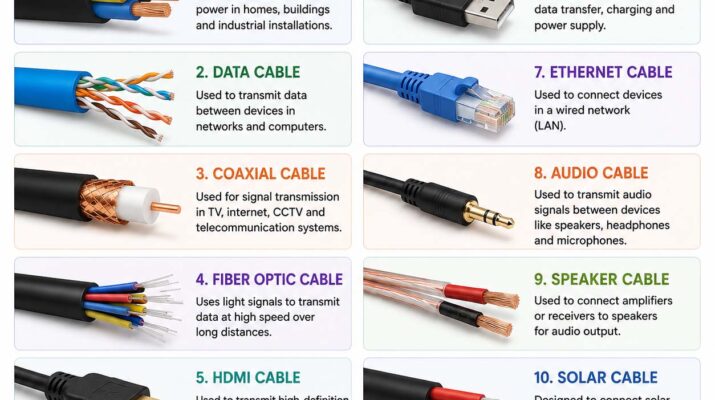
Have you ever looked behind a computer, TV, or router and wondered why there are so many types of cables? From charging your smartphone to connecting a monitor or building a home network, cables play a vital role in moving power, data, audio, and video between devices. Choosing the right cable improves performance, prevents compatibility issues, and helps your equipment work as intended.
Although wireless technology continues to grow, wired connections remain essential because they are often faster, more reliable, and more secure.
Types of Cables: Understanding the Main Categories
The easiest way to understand the many types of cables is to group them by what they do.
The four main categories are:
- Power cables
- Data cables
- Audio and video cables
- Network and communication cables
Each category contains several cable designs built for specific devices and performance requirements.
| Cable Category | Primary Purpose | Common Examples |
|---|---|---|
| Power cables | Deliver electricity | AC power cords, DC cables |
| Data cables | Transfer digital information | USB, SATA |
| Audio/Video cables | Carry sound and video signals | HDMI, DisplayPort |
| Network cables | Connect devices to networks | Ethernet, fiber optic |
Understanding these categories makes it much easier to identify the cable you need.
Power Cables
Power cables are designed to deliver electricity from a power source to electronic equipment.
You’ll commonly find them connected to:
- Desktop computers
- Monitors
- Gaming consoles
- Televisions
- Home appliances
- Industrial machinery
Different countries use different plug standards, so always check compatibility before purchasing a replacement cable.
In factories and automated systems, reliable power distribution is essential because equipment such as sensors and what is an actuator components depend on stable electrical connections to operate correctly.
Data Cables
Data cables move digital information between devices.
They’re used for:
- External storage drives
- Printers
- Cameras
- Smartphones
- Computer peripherals
Many data cables can also supply electrical power while transferring information, making them especially useful for portable electronics.
Data transfer speed depends on both the cable and the devices connected to it.
Types of USB Cables
Among today’s most widely used types of usb cables are several connector styles designed for different generations of hardware.
Common USB connectors include:
USB-A
USB-A is the traditional rectangular connector found on desktop computers, laptops, and chargers.
Although it’s gradually being replaced by newer standards, millions of devices still use it.
USB-B
USB-B connectors are commonly used for printers, scanners, and other larger peripherals.
They’re less common in consumer electronics today but remain widely used in office equipment.
USB-C
USB-C has become the modern standard for many laptops, smartphones, tablets, and accessories.
Benefits include:
- Reversible connector
- Faster charging
- Higher data transfer speeds
- Support for video output
- One cable for multiple devices
Micro-USB
Micro-USB was once the standard charging connector for Android phones and many portable gadgets.
While newer products have largely moved to USB-C, many accessories still rely on Micro-USB.
Lightning
Although technically not part of the USB connector family, Apple’s Lightning connector performs similar functions for compatible iPhones, iPads, and accessories.
Different Types of USB Cables
Besides connector shape, different types of usb cables also vary by their capabilities.
Examples include:
- USB 2.0 cables
- USB 3.0 cables
- USB 3.2 cables
- USB4 cables
- Thunderbolt-compatible USB-C cables
A cable may look identical on the outside yet support very different charging speeds, transfer rates, and display features.
That’s why reading the manufacturer’s specifications is always worthwhile.
Types of HDMI Cables
HDMI has become the standard connection for televisions, gaming consoles, streaming devices, projectors, and monitors.
Several types of hdmi cables are available.
Standard HDMI
Suitable for:
- DVD players
- Older televisions
- Basic displays
High-Speed HDMI
Designed for:
- Full HD
- 4K video
- HDR content
- Gaming systems
Premium High-Speed HDMI
Offers improved bandwidth for demanding entertainment setups and supports advanced video features.
Ultra High-Speed HDMI
The newest HDMI standard supports:
- 8K resolution
- High refresh rates
- Advanced gaming features
- Enhanced audio formats
Choosing the correct HDMI cable depends on the devices you own rather than simply buying the most expensive option.
Types of Charging Cables
Modern electronics use several types of charging cables, each designed for different devices.
Popular options include:
- USB-C charging cables
- Lightning charging cables
- Micro-USB charging cables
- Magnetic charging cables
- Laptop charging cables
- Proprietary charging cables
Some cables support fast charging, while others are limited to slower charging speeds.
The charger itself also affects charging performance, so replacing only the cable won’t always increase charging speed.
Ethernet Cables
Ethernet cables connect computers and other devices to local networks.
Common categories include:
- Cat5e
- Cat6
- Cat6a
- Cat7
- Cat8
Higher-category cables generally support faster network speeds and better shielding against interference.
Although Wi-Fi is convenient, Ethernet remains the preferred option for gaming, business networks, and servers where stable connections matter.
If you’re just beginning to understand how computers communicate, learning a few basic coding concepts can also make networking topics easier to follow because software and hardware work together to transfer information.
Fiber Optic Cables
Unlike traditional copper cables, fiber optic cables transmit information using pulses of light.
Advantages include:
- Extremely high speeds
- Long transmission distances
- Resistance to electrical interference
- Excellent reliability
Fiber optic connections are widely used by internet service providers, large businesses, cloud data centers, and telecommunications companies.
While installation costs are usually higher than copper wiring, fiber offers outstanding performance for demanding networks.
Coaxial Cables
Coaxial cables have been used for decades to carry radio frequency (RF) signals. Even though fiber and Ethernet have become more common, coaxial cables are still widely used in many homes and businesses.
You’ll often find them connected to:
- Cable television services
- Satellite receivers
- Internet modems
- Security camera systems
- Radio equipment
Their layered construction helps reduce signal interference, making them reliable over relatively long distances.
Audio and Video Cables
Not every device uses HDMI. Many professional and consumer electronics still rely on other audio and video connections.
Some common examples include:
- DisplayPort for high-performance computer monitors
- VGA for older displays
- DVI for legacy computer hardware
- RCA cables for analog audio and video
- 3.5 mm audio cables for headphones and speakers
- Optical (TOSLINK) cables for digital audio systems
Each cable is designed for specific equipment, so checking the available ports before buying a replacement is always a good idea.
Specialty Cables
Some industries require cables built for demanding environments or specialized equipment.
Examples include:
- Industrial control cables
- Marine cables
- Automotive wiring harnesses
- Solar panel cables
- Fire-resistant cables
- Underground electrical cables
These cables often include extra insulation, weather protection, or shielding to ensure reliable performance under challenging conditions.
For example, industrial automation systems frequently exchange sensor data across secure networks. Learning what is telemetry provides helpful background on how machines collect and transmit operational information over those connections.
How to Choose the Right Cable
With so many options available, selecting the correct cable becomes much easier when you focus on a few key factors.
Ask yourself:
- What devices am I connecting?
- Does the cable carry power, data, audio, or video?
- What connector type do I need?
- How long should the cable be?
- What transfer speed or resolution is required?
- Will the cable be used indoors or outdoors?
Checking your device’s manual or manufacturer specifications can prevent compatibility problems and unnecessary purchases.
Common Cable Mistakes to Avoid
Many connection problems are caused by using the wrong cable rather than a faulty device.
Here are some mistakes people often make:
- Assuming all USB-C cables have identical features
- Buying HDMI cables without considering supported resolutions
- Choosing cables that are longer than necessary
- Using damaged or frayed cables
- Ignoring power ratings for charging cables
- Mixing incompatible connectors without the proper adapter
A little research before buying can save time and money.
Tips for Making Cables Last Longer
Cables wear out over time, but proper care can extend their lifespan.
Follow these simple practices:
- Avoid bending cables sharply.
- Keep cables away from excessive heat.
- Store unused cables loosely coiled.
- Protect outdoor cables from moisture and direct sunlight.
- Replace cables with damaged insulation or exposed wires.
Good cable management also keeps your workspace safer and reduces clutter.
Why Cable Knowledge Matters
Understanding cables isn’t only useful for IT professionals. Home users, students, gamers, and DIY enthusiasts all benefit from knowing which cable fits a particular task.
Professionals in engineering, networking, manufacturing, and electronics rely on this knowledge every day. If you’re curious about careers involving these systems, learning what do engineers do offers a broader look at how technical professionals solve real-world problems using electrical and mechanical technologies.
Similarly, in industrial facilities, cable routes and instrument connections are often documented using standardized drawings. A guide to p&id meaning can help you understand how these diagrams represent equipment, piping, and signal connections.
Frequently Asked Questions
What are the most common types of cables?
The most common cable categories include power cables, USB cables, HDMI cables, Ethernet cables, fiber optic cables, coaxial cables, and audio cables.
Are all USB-C cables the same?
No. While many USB-C cables look identical, they may support different charging speeds, data transfer rates, and video capabilities.
Which HDMI cable should I buy?
Choose an HDMI cable based on your equipment. Standard HDMI works for basic devices, while High-Speed or Ultra High-Speed HDMI is better for 4K, 8K, HDR, and modern gaming systems.
Can one cable handle charging and data transfer?
Yes. Many USB-C cables support both charging and data transfer. However, performance varies depending on the cable’s specifications.
Does cable length affect performance?
It can. Longer cables may experience signal loss or reduced performance, especially for high-speed data or video connections. Using the shortest practical cable often provides the best results.
When should I replace a cable?
Replace a cable if it has exposed wires, damaged insulation, loose connectors, intermittent connections, or visible signs of wear that could affect performance or safety.
Choosing the Best Cable with Confidence
Understanding the different types of cables makes it much easier to connect devices correctly, improve performance, and avoid compatibility issues. Whether you’re selecting types of usb cables for a laptop, comparing types of hdmi cables for a home theater, or choosing types of charging cables for mobile devices, matching the cable to your equipment is the key to reliable results.
Before purchasing a new cable, check the connector type, supported standards, power requirements, and intended use. Spending a few extra minutes verifying compatibility can help you avoid connection problems and ensure your devices perform at their best for years to come.