
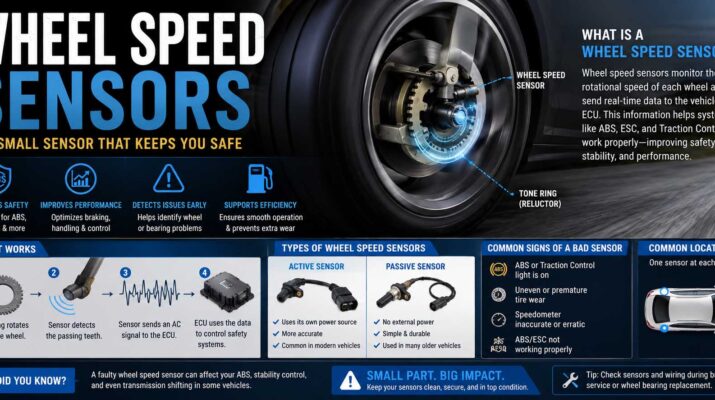
If your ABS, traction control, or stability control warning light suddenly appears, wheel speed sensors are one possible cause. These small electronic components measure how quickly individual wheels rotate and send that information to the vehicle’s control systems. Although drivers rarely see them, they play a major role in braking, traction, stability, and other vehicle functions.
Most modern cars have a sensor at each wheel. However, the exact design varies by vehicle. Some sensors work with a toothed reluctor ring, while newer designs may read a magnetic encoder built into the wheel bearing or hub.
Understanding what these sensors do can make dashboard warnings and repair estimates much easier to interpret.
What Are Wheel Speed Sensors?
A wheel speed sensor is an electronic sensing device that monitors wheel rotation. You may also hear it called an ABS sensor because the anti-lock braking system is one of its main users.
As each wheel rotates, the sensor generates or detects a changing electrical signal. The vehicle’s ABS or electronic control module interprets that signal as wheel-speed information.
For example, suppose three wheels are rotating at similar speeds while one suddenly slows sharply during hard braking. The ABS controller can recognize that the slower wheel may be approaching lockup. It can then adjust braking pressure through the ABS hydraulic system.
This process happens extremely quickly and repeatedly while the system is active.
Wheel speed sensing is a useful real-world example when learning what is instrumentation, since the vehicle measures a physical condition and converts it into data that electronic systems can process.
How Do Wheel Speed Sensors Work?
There are two broad sensor designs commonly found in vehicles: passive and active.
Passive wheel speed sensors
Traditional passive sensors commonly use electromagnetic induction. A sensor sits close to a toothed tone or reluctor ring that rotates with the wheel.
As the teeth pass the sensor, they alter the magnetic field and create an alternating electrical signal. As wheel speed rises, the characteristics of that signal change.
Because these sensors generate their own signal, they generally do not require the same external power arrangement used by active sensors.
However, passive designs can become less effective at detecting extremely low wheel speeds.
Active wheel speed sensors
Many newer vehicles use active sensors based on technologies such as Hall-effect or magnetoresistive sensing.
These sensors receive power from the vehicle and read a magnetic encoder or similar target associated with the rotating wheel assembly. As a result, they can provide accurate information even at very low speeds.
For a manufacturer’s view of this technology, see Bosch’s wheel-speed sensor overview.
The operating principle has similarities to what is an actuator, although sensors and actuators perform opposite roles in a control system. A sensor measures a condition and supplies information, whereas an actuator receives a command and produces a physical action.
Where Are Wheel Speed Sensors Located?
If you’re wondering where are wheel speed sensors located, look near the wheel hubs, wheel bearings, steering knuckles, or brake assemblies.
Normally, each sensor sits close enough to its encoder or tone ring to accurately detect wheel movement. A wiring harness then connects the sensor to the vehicle’s electrical system.
Front-wheel sensors may have wiring that moves as the wheels steer. Therefore, their harnesses need enough flexibility while still being protected from tires, suspension components, and road debris.
Rear sensor designs vary more widely. Depending on the vehicle, a sensor may attach to the hub, bearing assembly, axle housing, or another nearby component.
Because these parts sit close to the road, they regularly encounter water, dirt, salt, heat, and vibration. Consequently, wiring and connector problems can sometimes cause the same symptoms as a failed sensor.
How Many Wheel Speed Sensors Are on a Car?
For most modern passenger vehicles with four-channel ABS, the answer to how many wheel speed sensors are on a car is four—one for each wheel.
However, that is not a universal rule.
Older ABS designs may use fewer sensors. Likewise, certain trucks and specialized vehicles can use different arrangements. Therefore, checking service information for the exact make, model, year, and drivetrain is more reliable than assuming every vehicle uses the same setup.
People asking how many wheel speed sensors does a car have are usually trying to determine whether one warning light means all sensors need replacement. Usually, it does not.
A diagnostic scan can often identify which wheel is reporting an implausible signal. Still, technicians normally confirm the diagnosis before replacing parts because damaged wiring, corrosion, a tone ring problem, or a wheel bearing issue can produce similar fault codes.
What Vehicle Systems Use Wheel-Speed Data?
ABS is the best-known system that relies on wheel-speed information, yet modern vehicles can share this data with several electronic systems.
Traction control can compare individual wheel speeds to identify excessive wheelspin. Meanwhile, electronic stability control can combine wheel-speed information with steering-angle, yaw-rate, and other sensor data to evaluate vehicle movement.
Some vehicles also use wheel-speed data for functions involving hill-start assistance, electronic parking brakes, transmission behavior, driver-assistance features, or indirect tire-pressure monitoring.
In that sense, the information moves through the vehicle much like other forms of what is telemetry: a measured condition becomes electronic data that other systems can interpret.
The exact uses depend on the vehicle, so a single bad signal may sometimes trigger several dashboard warning lights at once.
Common Symptoms of Faulty Wheel Speed Sensors
Faulty wheel speed sensors do not always cause obvious mechanical symptoms. In many cases, the first sign is simply a dashboard warning.
Common symptoms include:
- ABS warning light
- Traction control warning light
- Stability-control warning light
- Traction or stability systems becoming unavailable
- Unusual ABS activation at low speeds
- Speed-related diagnostic trouble codes
- Cruise-control problems on some vehicles
- Incorrect speedometer behavior on certain designs
A warning light does not automatically prove the sensor itself has failed. Therefore, proper diagnosis matters.
For example, a damaged reluctor ring may create an irregular signal even though the sensor remains functional. Similarly, excessive wheel-bearing movement can change the sensor’s relationship with its encoder.
That connection also explains why understanding the difference between shocks and struts does not cover every wheel-area problem. Wheel hubs, bearings, brakes, suspension components, and electronic sensors all occupy the same general area but perform very different jobs.
Why Does a Wheel Speed Sensor Fail?
Wheel speed sensors work in a harsh environment, so several problems can eventually affect them.
Physical damage
Road debris or careless repair work can damage the sensor body or wiring. Meanwhile, a wire may rub against a moving component until its insulation wears through.
Corrosion and contamination
Moisture and road salt can attack electrical connectors or mounting areas. Likewise, heavy contamination may interfere with certain sensor and tone-ring arrangements.
Damaged encoder or reluctor ring
Sometimes the sensor receives blame when the real problem is the component it reads. A cracked, rusted, contaminated, or damaged tone ring can produce inconsistent wheel-speed information.
Wheel bearing problems
On vehicles with magnetic encoders integrated into wheel bearings, bearing or encoder damage can affect the signal. Incorrect installation of certain bearings can also create problems.
Connector or wiring faults
An open circuit, short circuit, corroded terminal, or loose connector can interrupt communication between the sensor and control module.
These possibilities are why replacing a sensor based solely on an ABS light can waste money.
How Are Wheel Speed Sensor Problems Diagnosed?
A technician usually starts by reading diagnostic trouble codes from the ABS or stability-control system with a compatible scan tool.
However, a code identifying one wheel does not necessarily mean the sensor itself needs replacement.
Check live wheel-speed data
A capable scan tool can display data from individual wheels while the vehicle moves. Normally, wheel speeds should track one another closely during straight-line driving.
If one reading suddenly drops to zero or behaves differently from the others, the technician has a useful starting point.
Inspect the sensor and wiring
Next, a visual inspection may reveal damaged wires, loose connectors, corrosion, impact damage, or debris.
The technician may also inspect the wheel bearing, encoder, and reluctor ring where accessible.
Perform electrical testing
Depending on sensor design, diagnostic procedures may involve resistance, voltage, power supply, ground, frequency, or waveform checks.
However, active sensors should be tested according to manufacturer procedures because they do not behave like simple passive sensors.
An oscilloscope can be particularly useful because it shows the signal pattern rather than just a single electrical measurement.
Can You Drive With a Bad Wheel Speed Sensor?
A car may continue to drive when one sensor fails, but safety-related electronic functions can become limited or disabled.
For example, conventional braking may remain available while ABS or stability control is switched off. As a result, the vehicle may behave differently during emergency braking or on slippery roads.
Because system behavior varies by vehicle and fault, drivers should not ignore ABS, brake, or stability warnings.
If a red brake warning appears, braking performance changes, or the vehicle behaves unpredictably, stop driving when safe and seek qualified assistance.
The same principle applies to electrified vehicles. If you’re learning what is a hybrid car, remember that hybrids still rely on sophisticated braking and stability electronics, even though their powertrains differ from conventional gasoline vehicles.
How Much Does Wheel Speed Sensor Replacement Cost?
Replacement cost varies considerably.
The sensor itself may be relatively inexpensive on some vehicles. However, other designs integrate the sensing target or related components into a wheel-bearing or hub assembly, which can increase both parts and labor costs.
Pricing can also depend on vehicle brand, sensor location, local labor rates, corrosion, and diagnostic time.
Therefore, ask whether the estimate covers only the sensor or a complete hub or bearing assembly. That distinction can explain why two seemingly similar repairs have very different prices.
Can You Replace a Wheel Speed Sensor Yourself?
On some vehicles, replacement looks straightforward: remove the wheel, disconnect the wiring, remove a retaining bolt, and install the new sensor.
In practice, corrosion can make the job harder.
A sensor may seize inside its mounting bore, while connectors can sit behind liners or other components. Also, improper wire routing can allow the new harness to rub against a tire or suspension part.
If you have suitable tools and reliable vehicle-specific service instructions, some sensor replacements can be reasonable DIY jobs. However, brake-area work requires safe lifting practices and correct fastener torque.
After replacement, scan the system again and verify that all wheel-speed signals behave normally.
Frequently Asked Questions
Do wheel speed sensors control the speedometer?
Sometimes wheel-speed information contributes to vehicle-speed calculations, but designs differ. Therefore, a failed sensor may affect the speedometer on certain vehicles while leaving it apparently normal on others.
Can a dirty wheel speed sensor cause an ABS light?
Contamination can sometimes interfere with the sensor or the target it reads. However, cleaning should not replace diagnosis because damaged wiring, bearings, encoders, connectors, and sensors can produce similar symptoms.
Can one bad sensor disable traction control?
Yes. Since traction control depends heavily on reliable wheel-speed information, the control module may disable the system when it cannot trust one sensor’s data.
Do wheel speed sensors need routine replacement?
Usually, no. They are generally replaced when testing identifies a failure or when another component containing the sensor or encoder requires replacement.
Is a wheel speed sensor the same as an ABS sensor?
In everyday automotive terminology, yes. People commonly use “ABS sensor” to refer to the wheel speed sensor supplying wheel-rotation information to the anti-lock braking system.
What to Remember About Wheel Speed Sensors
Wheel speed sensors are small components with a surprisingly large job. By continuously measuring individual wheel rotation, they give ABS, traction control, stability control, and other vehicle systems the information needed to react appropriately.
Most modern cars use one sensor per wheel, yet the exact design and location depend on the vehicle. More significantly, an ABS fault code does not always mean the sensor itself has failed. Wiring damage, corrosion, wheel-bearing problems, or a damaged encoder can create very similar symptoms.
Therefore, if warning lights appear, start with proper diagnostics rather than replacing parts at random. Checking fault codes, live wheel-speed readings, wiring, connectors, and the sensor target can usually narrow down the problem and lead to a more reliable repair.