
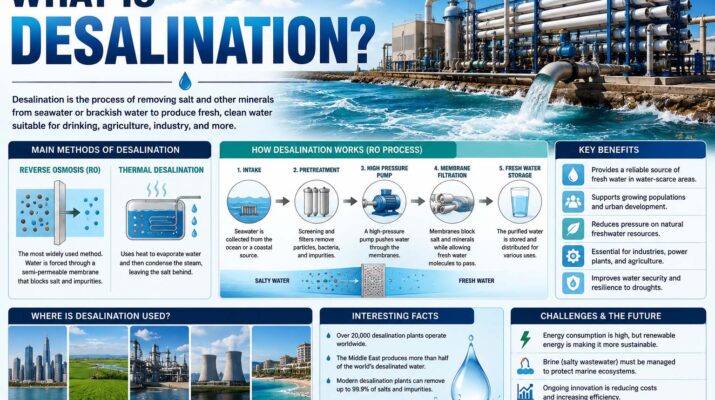
Freshwater is one of the world’s most valuable resources, yet only a small percentage of Earth’s water is suitable for drinking. Since most of the planet’s water is salty, scientists and engineers have developed ways to remove salt and other minerals to create usable freshwater. This technology is known as desalination.
If you’ve ever wondered what is desalination, the simple answer is that it’s a process that converts seawater or salty groundwater into freshwater for drinking, agriculture, and industrial use.
Today, desalination plays an important role in regions facing water shortages, especially in coastal areas where freshwater supplies are limited.
What Is Desalination?
The definition of desalination is the process of removing dissolved salts, minerals, and other impurities from seawater or brackish water to produce freshwater.
The resulting water can be used for:
- Drinking
- Cooking
- Irrigation
- Manufacturing
- Industrial cooling
- Municipal water supplies
Desalination does not create new water. Instead, it transforms water that was previously too salty into water that is safe for human use. Understanding what is a weir also provides insight into how engineers measure and manage water flow in treatment and distribution systems.
What Is the Definition of Desalination?
If you’re searching for what is the definition of desalination, here’s a simple explanation:
Desalination is a water treatment process that separates salt and dissolved minerals from saline water to produce freshwater suitable for various uses.
The term comes from the word “desalt,” meaning to remove salt.
Why Is Desalination Important?
Freshwater supplies are under pressure in many parts of the world due to:
- Population growth
- Climate change
- Drought
- Water pollution
- Limited natural freshwater sources
Desalination helps communities reduce dependence on rivers, lakes, and underground aquifers.
Many countries now include desalination as part of their long-term water management strategy. Modern plants also rely on what is instrumentation to monitor pressure, flow, water quality, and other conditions throughout the treatment process.
What Is Water Desalination Process?
Many people ask, what is water desalination process?
Although several technologies exist, the overall workflow follows similar steps.
Step 1: Water Intake
Seawater or brackish water is collected through intake pipes or wells.
Screens remove:
- Fish
- Seaweed
- Large debris
- Sand
Step 2: Pretreatment
Before desalination begins, the water is cleaned further.
Pretreatment removes:
- Fine particles
- Organic material
- Microorganisms
- Suspended solids
This protects the equipment from damage and improves efficiency.
Step 3: Salt Removal
This is the main stage.
Special technology separates freshwater from dissolved salts.
The two most common methods are:
- Reverse osmosis
- Thermal distillation
Step 4: Post-Treatment
Freshwater is adjusted before distribution.
This may include:
- Mineral balancing
- pH adjustment
- Disinfection
- Final quality testing
The finished water is then ready for homes, businesses, or agriculture.
What Is a Desalination Plant?
A desalination plant is a facility designed to convert seawater or saline groundwater into freshwater on a large scale.
A typical plant includes:
- Intake system
- Pretreatment equipment
- Pumps
- Membrane systems or evaporators
- Storage tanks
- Distribution pipelines
Some facilities produce millions of gallons of freshwater every day.
Main Types of Desalination Technology
Several methods are used worldwide.
Reverse Osmosis (RO)
Reverse osmosis (RO) is the most widely used technology today, valued for its efficiency in removing salts and other dissolved impurities from seawater and brackish water to produce clean, freshwater.
It works by forcing water through semi-permeable membranes.
The membrane allows water molecules to pass while blocking:
- Salt
- Minerals
- Bacteria
- Many contaminants
Advantages include:
- High efficiency
- Lower energy use than many thermal methods
- Excellent water quality
To better understand this process, it is helpful to learn what is biomimicry, since engineers often study natural systems when developing membranes and other efficient separation technologies.
Thermal Distillation
Thermal systems heat seawater until it becomes steam.
The steam condenses into freshwater while salt remains behind.
Common thermal methods include:
- Multi-stage flash distillation
- Multi-effect distillation
- Vapor compression
These systems are often used where energy resources are readily available.
Reverse Osmosis vs Thermal Desalination
| Feature | Reverse Osmosis | Thermal Distillation |
|---|---|---|
| Energy Use | Lower | Higher |
| Operating Cost | Lower | Higher |
| Technology | Membrane filtration | Evaporation |
| Freshwater Quality | Excellent | Excellent |
| Popularity | Very high | Moderate |
Reverse osmosis has become the preferred solution for many modern plants. Understanding what is dimensional analysis can also help when comparing pressure, flow rates, energy use, and other measurements across different water purification methods.
Where Is Desalination Used?
Desalination supports many different industries and communities.
Common applications include:
- Public drinking water
- Coastal cities
- Islands
- Hotels and resorts
- Agriculture
- Oil and gas facilities
- Ships
- Military operations
Many regions with limited rainfall rely heavily on desalinated water.
Benefits of Desalination
Desalination offers several important advantages.
Reliable Water Supply
Unlike rainfall, seawater remains consistently available.
This helps reduce water shortages during droughts.
Supports Population Growth
Growing cities require more freshwater.
Desalination provides an additional source without depending entirely on rivers or groundwater.
Improves Water Security
Countries with few natural freshwater resources can improve long-term water stability.
High Water Quality
Modern systems produce very clean water that meets strict drinking water standards after proper treatment.
Challenges and Limitations
While desalination offers many benefits, it also has drawbacks.
High Energy Requirements
Running pumps and treatment systems requires significant electricity.
Cost
Building and operating desalination plants can be expensive.
Costs include:
- Construction
- Equipment
- Maintenance
- Energy
- Skilled operators
Environmental Considerations
Desalination produces concentrated saltwater, known as brine.
Brine disposal must be managed carefully to reduce environmental impacts on marine ecosystems.
How Safe Is Desalinated Water?
Desalinated water is considered safe when properly treated.
Before entering public water systems, it undergoes:
- Quality testing
- Mineral adjustment
- Disinfection
- Regulatory inspections
Many millions of people drink desalinated water every day.
Can Desalination Solve Global Water Shortages?
Desalination is a valuable tool, but it is not a complete solution.
Water conservation remains equally important.
Communities also benefit from:
- Recycling wastewater
- Protecting freshwater sources
- Improving irrigation efficiency
- Reducing leaks
- Encouraging responsible water use
Combining multiple strategies creates a more sustainable water future.
Countries Using Desalination
Many countries rely on desalination as part of their water supply.
Examples include:
- Saudi Arabia
- United Arab Emirates
- Israel
- Australia
- Spain
- United States
Coastal regions with limited rainfall often invest heavily in desalination technology.
Everyday Products That Use Desalinated Water
Many people unknowingly use desalinated water every day.
Examples include:
- Household tap water
- Bottled drinking water in some regions
- Hotel water systems
- Industrial manufacturing
- Food processing
- Hospitals
As technology improves, desalinated water continues to become more common.
Future of Desalination Technology
Researchers continue developing better systems.
Future improvements may include:
- More energy-efficient membranes
- Renewable energy integration
- Solar-powered desalination
- Better brine management
- Lower operating costs
- Smarter monitoring systems
These innovations could make freshwater production more affordable and environmentally friendly. Many modern facilities also use what is telemetry systems to monitor pressure, water quality, equipment performance, and other plant data in real time.
Common Misunderstandings
Some myths create confusion.
“Desalinated water tastes salty.”
Properly treated desalinated water contains very little salt.
“Only deserts use desalination.”
Many coastal cities worldwide rely on desalinated water regardless of climate.
“Desalination creates unlimited water.”
Desalination increases freshwater availability, but energy, infrastructure, and environmental factors still limit production.
Quick Reference Guide
| Question | Answer |
|---|---|
| What is desalination? | Removing salt from seawater or brackish water to create freshwater. |
| Most common method? | Reverse osmosis. |
| Is desalinated water safe? | Yes, after proper treatment. |
| Main challenge? | Energy use and operating costs. |
| Main benefit? | Reliable freshwater supply. |
Frequently Asked Questions
What is desalination?
Desalination is the process of removing salt and dissolved minerals from seawater or saline water to produce freshwater for drinking, agriculture, and industry.
What is water desalination process?
The process generally includes water intake, pretreatment, salt removal using technologies such as reverse osmosis or thermal distillation, and post-treatment before distribution.
What is a desalination plant?
A desalination plant is a facility that converts seawater or brackish water into freshwater using specialized treatment equipment.
What is the definition of desalination?
Desalination is the removal of dissolved salts and impurities from saline water to produce usable freshwater.
Is desalinated water safe to drink?
Yes. Properly treated desalinated water meets drinking water standards in many countries.
Why is reverse osmosis so popular?
Reverse osmosis offers high water quality while generally using less energy than many traditional thermal methods.
Looking Ahead
Understanding what is desalination helps explain one of today’s most important water technologies. As populations grow and freshwater resources become more limited in some regions, desalination provides an additional source of clean water for homes, businesses, and agriculture.
Although it comes with challenges such as energy use and infrastructure costs, ongoing improvements in membrane technology, renewable energy, and plant efficiency continue to make desalination more practical. Alongside conservation and responsible water management, it will likely remain an important part of meeting future freshwater needs.