
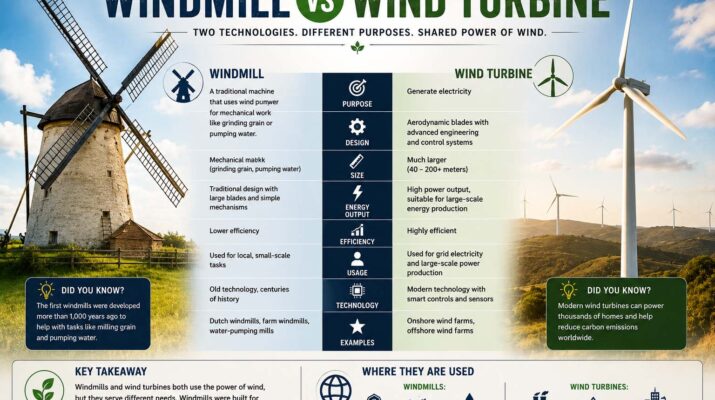
Windmill vs Wind Turbine: Many people use the terms “windmill” and “wind turbine” as if they mean the same thing. While both are powered by wind and have rotating blades, they serve very different purposes.
A traditional windmill converts wind energy into mechanical power to perform physical tasks such as grinding grain or pumping water. A wind turbine, on the other hand, converts wind energy into electricity using a generator.
Understanding the windmill vs wind turbine comparison is useful whether you’re learning about renewable energy, researching sustainable technology, or simply curious about the structures you see in rural landscapes and wind farms. Learning what is biomimicry also provides helpful background on how engineers use ideas from nature to develop more sustainable technologies.
Windmill vs Wind Turbine: Quick Comparison
Here’s a simple overview.
| Feature | Windmill | Wind Turbine |
|---|---|---|
| Main Purpose | Mechanical work | Electricity generation |
| Output | Rotational mechanical energy | Electrical energy |
| Typical Use | Grinding grain, pumping water | Power homes, businesses, and grids |
| Technology | Traditional mechanical design | Modern electrical system |
| Generator | Usually none | Yes |
| Common Today | Limited use | Widely used worldwide |
Although both rely on wind, the way they use that energy is very different.
What Is a Windmill?
A windmill is a machine that captures wind energy and converts it into mechanical motion.
Historically, windmills were used for:
- Grinding grain into flour
- Pumping water
- Irrigation
- Operating sawmills
- Processing agricultural products
The rotating blades drive gears connected directly to machinery.
Windmills have been used for hundreds of years and remain an important part of engineering history.
What Is a Wind Turbine?
A wind turbine is a modern energy system designed to generate electricity.
Instead of powering mechanical equipment directly, the rotating blades turn a shaft connected to a generator.
Wind turbines are commonly installed in:
- Wind farms
- Coastal areas
- Mountain regions
- Agricultural land
- Offshore installations
They have become one of the world’s leading renewable energy technologies.
How Each System Works
Although they both capture wind, their workflows differ.
How a Windmill Works
The process is relatively straightforward.
- Wind pushes the blades.
- The blades rotate.
- Gears transfer movement.
- Mechanical equipment performs work.
Examples include grinding wheat or pumping groundwater.
How a Wind Turbine Works
The workflow includes additional electrical components.
- Wind rotates the blades.
- The rotor spins.
- The shaft drives a generator.
- Electricity is produced.
- Power is sent through transformers.
- Electricity enters the power grid or battery system.
Understanding alternator vs generator makes it easier to see how a wind turbine converts mechanical rotation into usable electrical energy.
This conversion from mechanical energy to electrical energy is the biggest difference.
Wind Turbine vs Windmill: Key Differences
When comparing wind turbine vs windmill, several important differences stand out.
Purpose
Windmills perform physical work.
Wind turbines generate electricity.
Technology
Traditional windmills rely on gears and mechanical systems.
Modern turbines include:
- Generators
- Power electronics
- Braking systems
- Sensors
- Computer controls
Size
Modern wind turbines are often much taller.
Many utility-scale turbines exceed:
- 300 feet (91 meters)
Some offshore turbines are considerably larger.
Traditional windmills are generally much smaller.
Efficiency
Modern wind turbines capture wind energy far more efficiently than historical windmills.
Improved blade design and electronic controls maximize energy production.
Main Components
Windmill Components
A traditional windmill usually includes:
- Blades
- Shaft
- Gears
- Millstones or pump
- Tower
Wind Turbine Components
Modern turbines include:
- Rotor blades
- Hub
- Nacelle
- Gearbox (in many designs)
- Generator
- Brake system
- Tower
- Control systems
These components work together to generate electricity safely and efficiently.
Advantages of Windmills
Although older technology, windmills still offer benefits.
Advantages include:
- Simple mechanical design
- No electricity required
- Reliable water pumping
- Low operating costs
- Long service life
Many farms still use mechanical windmills for livestock water systems.
Advantages of Wind Turbines
Wind turbines provide several important benefits.
These include:
- Renewable electricity
- Low operating emissions
- Reduced fossil fuel use
- Scalable energy production
- Long operating lifespan
They play an important role in many countries’ clean energy strategies. Understanding series vs parallel also helps explain how electrical components can be arranged when distributing power through different systems.
Disadvantages of Windmills
Windmills also have limitations.
Common drawbacks include:
- Limited applications
- Lower efficiency
- Dependence on wind availability
- Mechanical wear over time
Most traditional windmills cannot generate electricity.
Disadvantages of Wind Turbines
Modern turbines face different challenges.
These include:
- High installation costs
- Weather dependence
- Visual impact
- Noise concerns in some locations
- Maintenance requirements
Despite these challenges, many projects remain economically successful over decades of operation.
Where Are They Used Today?
Windmills
Modern uses include:
- Water pumping
- Historical sites
- Museums
- Small agricultural operations
Wind Turbines
Current applications include:
- Utility-scale wind farms
- Residential renewable energy
- Commercial power generation
- Offshore energy projects
- Remote communities
Wind turbines have become much more common than traditional windmills.
Which Produces More Energy?
A wind turbine produces electricity, while a windmill usually does not.
Large commercial turbines can generate enough electricity to power hundreds or even thousands of homes, depending on wind conditions and turbine size.
Mechanical windmills simply perform physical tasks using rotational force.
Windmill vs Wind Turbine Differences Explained
The phrase windmill vs wind turbine differences often appears because people confuse the two technologies.
The easiest way to remember the difference is this:
- A windmill performs mechanical work.
- A wind turbine generates electricity.
Although their appearance may look similar, their purpose and internal systems are completely different. Understanding why are there balls on power lines also provides insight into the visibility and safety measures used when electricity is transmitted across large power grids.
Windmill vs Wind Turbine in ARK
Gamers searching for windmill vs wind turbine ARK are usually referring to the survival game ARK: Survival Evolved.
In ARK, these structures serve gameplay purposes rather than representing exact real-world engineering.
The wind turbine provides electrical power for connected devices, while gameplay mechanics, placement requirements, and efficiency depend on the game’s building system and environmental conditions.
If you’re researching real renewable energy technology, keep in mind that the game’s mechanics are simplified for gameplay balance.
IC2 Windmill vs Wind Turbine
Another popular search is IC2 windmill vs wind turbine, referring to the IndustrialCraft 2 (IC2) Minecraft mod.
In IC2:
- Windmills generally produce rotational or kinetic energy depending on the setup.
- Wind turbines are designed for larger-scale energy generation and often require more advanced infrastructure.
These mechanics are unique to the mod and should not be confused with real-world wind energy systems.
Environmental Impact
Both technologies use renewable wind energy.
Wind turbines help reduce greenhouse gas emissions by replacing electricity generated from fossil fuels.
Traditional windmills also have a small environmental footprint because they operate without fuel. Understanding What Is a KW can help readers compare the electrical output of wind turbines and other renewable energy systems.
However, modern turbines require careful planning to minimize effects on wildlife and local ecosystems.
Common Misunderstandings
Several myths continue to circulate.
Myth: Every windmill generates electricity.
False.
Most traditional windmills were designed for mechanical work.
Myth: Wind turbines are simply modern windmills.
Not exactly.
They share a similar appearance, but their engineering and purpose are different.
Myth: Wind turbines only work when it’s very windy.
Modern turbines begin producing electricity at relatively low wind speeds, though output increases as wind becomes stronger within safe operating limits.
Which One Is Better?
The answer depends on the goal.
Choose a Windmill if You Need:
- Mechanical water pumping
- Traditional agricultural equipment
- Historical restoration
Choose a Wind Turbine if You Need:
- Renewable electricity
- Residential power generation
- Commercial energy production
- Utility-scale clean energy
Each technology was designed for a different purpose.
Quick Reference Guide
| Question | Answer |
|---|---|
| Does a windmill generate electricity? | Usually no. |
| Does a wind turbine generate electricity? | Yes. |
| Which is more modern? | Wind turbine. |
| Which performs mechanical work? | Windmill. |
| Which is common in wind farms? | Wind turbine. |
Frequently Asked Questions
What is the difference between a windmill and a wind turbine?
A windmill converts wind into mechanical energy for tasks like grinding grain or pumping water, while a wind turbine converts wind into electrical energy.
Is a wind turbine better than a windmill?
For electricity generation, yes. For traditional mechanical applications like water pumping, a windmill may still be the better choice.
Why do people confuse the two?
Both have rotating blades powered by wind and often look similar from a distance.
Can a windmill generate electricity?
Traditional windmills generally do not. Modern wind turbines are specifically designed for electrical generation.
What is the purpose of a wind turbine?
Its main purpose is to convert wind energy into electricity using a generator.
Are windmills still used today?
Yes. They are still used in some agricultural settings, historical sites, and water-pumping applications.
Choosing the Right Technology
Understanding windmill vs wind turbine makes it easier to appreciate how wind power has evolved over time. Traditional windmills helped communities grind grain and pump water for centuries, while modern wind turbines focus on producing clean electricity for homes, businesses, and entire power grids.
Although they share the same natural energy source, they solve different problems. Whether you’re studying renewable energy, exploring engineering concepts, or comparing technologies in games like ARK or IndustrialCraft 2, knowing the difference helps clear up one of the most common misconceptions in wind-powered technology.