
Electrical circuits power everything from household devices to industrial machines. However, one idea matters more than most when you build or repair them: series vs parallel.
These two circuit types decide how electricity flows through each part. As a result, they also control how connected devices behave.
Whether you are a student, a DIY fan, or a technology professional, this topic is worth learning. In addition, learning what is mechatronics? can help you see how circuits work with mechanical and computer systems.
This guide explains how each setup works. Then, it compares their pros and cons and shows where each one is used in real life.
What Is a Series Circuit?
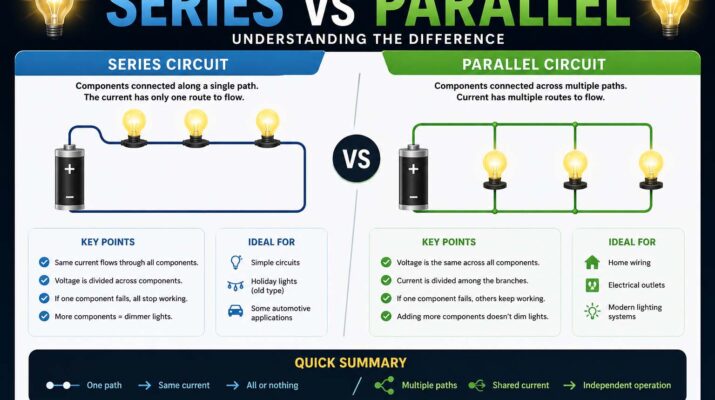
A series circuit has only one continuous path for electric current. In other words, current flows through every part one after another. Because there is only one path, all parts share the same current.
Common examples include flashlights, some decorative light strings, and simple school projects. However, any break in the path stops the whole circuit.
What Is a Parallel Circuit?
A parallel circuit gives electric current more than one path. Each part sits on its own branch. Therefore, every branch receives the same voltage. This is the key idea on the parallel side of series vs parallel.
You can find parallel circuits in home wiring, office power systems, car electronics, and computer power supplies. Overall, this layout offers more flexibility and reliability. Also, learning what is a solenoid helps explain how current in a coil can create controlled movement.
Series vs Parallel Circuit: Quick Comparison
| Feature | Series Circuit | Parallel Circuit |
|---|---|---|
| Current Path | Single path | Multiple paths |
| Voltage Distribution | Shared among components | Same across branches |
| Failure Impact | Entire circuit affected | Other branches continue working |
| Wiring Complexity | Simpler | More complex |
| Common Uses | Basic electronics | Homes and buildings |
| Reliability | Lower | Higher |
In short, this comparison shows why parallel circuits lead modern electrical systems.
How a Series Circuit Works
First, electricity leaves the battery or power supply. Next, the current passes through each part one after another. Finally, it returns to the power source.
Because there is only one path, every part depends on the others. Therefore, knowing what is continuity helps you check whether current has an unbroken path.
How a Parallel Circuit Works
Parallel circuits work in a different way. First, electricity leaves the power supply. Then, the current splits into several branches. Each branch works on its own.
Afterward, the current joins again and returns to the power source. As a result, this design improves reliability and overall performance.
Advantages of Series Circuits Over Parallel
Series circuits offer several clear benefits. First, they use a simple design with fewer wires. Because of this, they are easy to build, and beginners often use them when learning electronics.
Simpler wiring can also lower material costs. In addition, they work well for small school projects and basic devices. Therefore, series circuits stay useful despite their limits.
Advantages of Parallel Circuits Over Series
Parallel circuits are popular because of their practical benefits. For example, devices keep working even if one part fails. Each branch also receives the full supply voltage.
Moreover, a fault in one branch usually does not affect the others. Several devices can therefore run well at the same time. That is why most modern electrical systems use parallel wiring.
Disadvantages of Series Circuits Compared to Parallel
Series circuits also have some drawbacks. For instance, one broken part can stop the entire circuit. Each part also gets only a share of the total voltage.
In addition, adding more parts changes how the whole circuit performs. For these reasons, large electrical systems rarely rely on series wiring alone.
Disadvantages of Parallel Circuits Compared to Series
Although parallel circuits work well, they have some challenges. For example, extra branches need more wiring. As a result, installation can cost more because of the added materials.
Engineers also need to plan for several current paths. Nevertheless, the benefits usually outweigh these drawbacks.
Parallel vs Series: Which Is Better?
The answer to the series vs parallel question depends on how you plan to use the circuit.
Choose Series When:
Choose a series circuit when simplicity is important and costs must stay low. In addition, it is a good choice for classroom demonstrations.
Choose Parallel When:
Choose a parallel circuit when reliability matters most. Likewise, it is the right option when several devices must work on their own with steady voltage.
In most real situations, parallel vs series comparisons favor parallel circuits because of their flexibility.
Batteries in Series vs Parallel
One of the most common questions in electronics involves batteries in series vs parallel.
Batteries in Series
When you connect batteries in series, the voltage increases. However, the capacity stays the same. For example, two 12V batteries in series produce a 24V output.
Batteries in Parallel
When you connect batteries in parallel, the voltage stays the same. Instead, the capacity increases. For instance, two 12V batteries in parallel still give a 12V output. However, they can power devices for longer because the available capacity is higher.
This difference matters in solar energy systems, electric vehicles, backup power systems, and recreational vehicles (RVs). Therefore, the right battery setup helps a system perform properly. Similarly, larger installations may use single phase vs three phase power, depending on their voltage, equipment, and energy needs.
Series vs Parallel in Real-World Applications
Household Wiring
Homes almost always use parallel circuits. As a result, each appliance works on its own and receives reliable power. Troubleshooting is also easier. For example, if one light bulb burns out, the other lights keep working normally.
Flashlights
Many traditional flashlights use series circuits because they offer a simple and compact design.
Christmas Lights
Older light strings often used series wiring. In contrast, many modern versions use parallel circuits, so one failed bulb does not turn off the whole string.
Automotive Systems
Modern vehicles mainly use parallel circuits for lights, accessories, sensors, and control modules. Consequently, each system can work on its own. Overall, these examples show that the best circuit type depends on the job.
Troubleshooting Series and Parallel Circuits
Knowing the series vs parallel difference makes electrical problems much easier to find.
Common Series Circuit Problems
Typical issues include burned-out bulbs, loose connections, damaged wires, and broken switches. Because every part shares one path, a single fault can stop the entire circuit.
Common Parallel Circuit Problems
Typical issues include failed branches, overloaded circuits, faulty outlets, and damaged wiring in one branch. However, each branch works on its own. Therefore, troubleshooting usually focuses on the affected section, not the whole circuit.
In addition, the right testing tools help you find faults more quickly and safely. For a clear lesson with diagrams, see The Physics Classroom guide to circuit connections.
Future of Series and Parallel Circuit Design
Although technology keeps changing, series and parallel circuits remain basic building blocks. You will find them in renewable energy systems, electric vehicles, smart homes, robotics, consumer electronics, and industrial automation.
Engineers often combine both setups to improve efficiency and reliability. Likewise, understanding alternator vs generator is useful because both devices produce electricity for different systems.
Series vs Parallel: Frequently Asked Questions
What is the difference between series and parallel circuits?
A series circuit has one path for electric current. In contrast, a parallel circuit has several paths, so each part can work on its own.
Which is better, series or parallel?
For most homes and businesses, parallel circuits are the better choice. This is because they offer better reliability, steady voltage, and more flexibility.
Why do homes use parallel circuits?
Homes use parallel wiring so each appliance and light gets the correct voltage. Also, the other devices keep working if one of them fails.
How do batteries in series vs parallel differ?
Batteries in series increase the voltage. On the other hand, batteries in parallel increase capacity without changing the voltage.
Are series circuits still used today?
Yes. Series circuits remain common in school projects, battery packs, some devices, and uses that need one current path.
Key Takeaways on Series vs Parallel
Understanding series vs parallel circuits is essential for anyone interested in electronics or technology. Whether you compare a series vs parallel circuit or study batteries in series vs parallel, the same ideas apply. In short, the key differences are current paths, voltage sharing, reliability, and performance.
Series circuits remain useful for simple projects and learning. However, parallel circuits are the standard choice for modern homes, businesses, and factories. This is because they offer greater reliability, steady performance, and better safety. Finally, knowing how each setup works helps you design, troubleshoot, and maintain electrical systems with confidence.