
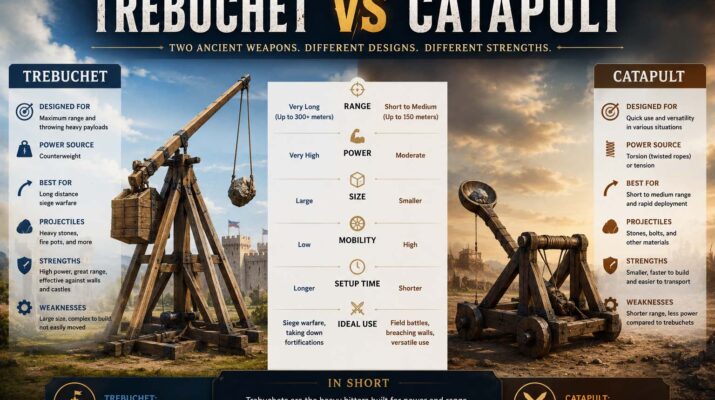
The debate over trebuchet vs catapult has fascinated historians, engineers, students, and tech fans for centuries. Both machines played a big role in ancient and medieval warfare. In particular, they let armies attack castles and walls from a safe distance.
Although people often use the two names as if they mean the same thing, the machines work in very different ways. As a result, learning how each one works teaches you a lot about military history, physics, and mechanical engineering.
This guide explains the differences between trebuchets and catapults. In addition, it compares their strengths and weaknesses and shows why they remain popular in history and STEM classes.
What Is a Trebuchet?
A trebuchet is a siege engine that uses a heavy counterweight to throw objects over long distances. Its main parts are a sturdy frame, a long throwing arm, a sling, and a heavy counterweight.
When the counterweight drops, gravity makes the throwing arm spin fast. As a result, the sling flings the stone toward its target.
Trebuchets became common during the Middle Ages because they could throw large stones with great accuracy and range.
What Is a Catapult?
A catapult is a broad group of siege machines that launch objects without explosives. Unlike a trebuchet, most catapults don’t rely on gravity. Instead, they store energy through tension, torsion (twisting), or elastic force.
Common catapult designs include mangonels, onagers, and ballista-like machines. Once released, the stored energy pushes the object toward its target.
Ancient peoples, such as the Greeks and Romans, used catapults widely. The Britannica guide to catapults also notes that the trebuchet was the gravity-powered exception among these machines.
Trebuchet vs Catapult: Quick Comparison
| Feature | Trebuchet | Catapult |
|---|---|---|
| Power Source | Gravity and counterweight | Tension or torsion |
| Range | Very long | Moderate to long |
| Accuracy | Generally higher | Moderate |
| Projectile Size | Large objects | Smaller to medium objects |
| Construction Complexity | More complex | Simpler |
| Reload Speed | Slower | Faster |
| Historical Popularity | Medieval period | Ancient and medieval periods |
Overall, both machines played important roles in battle. However, each one did best in different situations.
How Does a Trebuchet Work?
A trebuchet works on a simple but very effective idea. First, the crew lifts the heavy counterweight into position. Next, they place a stone, fireball, or other object in the sling.
Then, they release the lock, and the counterweight drops under gravity. Finally, the throwing arm swings up fast and lets go of the object at the right moment.
In fact, a free body diagram can show how gravity and other forces act on the trebuchet during launch.
How Does a Catapult Work?
Catapults rely on stored energy instead of gravity. First, the crew pulls the throwing arm backward. As a result, ropes, springs, or twisted fibers build up tension and store energy.
Next, they release the trigger. Then, the stored energy whips the arm forward and launches the object toward its target.
Also, learning what is RPM helps explain how fast the arm spins as it passes energy to the object. Because of this design, catapults could fire faster than trebuchets.
Catapult vs Trebuchet: Which Was More Powerful?
The catapult vs trebuchet debate usually comes down to power and how well each worked in battle.
Trebuchets generally offered greater range, bigger projectiles, and better accuracy. As a result, they caused more damage in a siege. For example, large stones from a trebuchet could seriously break castle walls.
Catapults, on the other hand, offered practical benefits. For instance, they were faster to set up and could fire more often. In addition, they were simpler to build and easier to repair.
Therefore, during long battles with many launches, catapults were often more practical. Even so, trebuchets usually hit with more destructive force.
Trebuchet vs Catapult vs Ballista
Many discussions expand to include trebuchet vs catapult vs ballista. Although all three are siege weapons, each one launches in a different way.
The trebuchet uses gravity and a counterweight. Meanwhile, the catapult uses stored tension or twisting energy. In contrast, the ballista works much like a giant crossbow.
Instead of throwing heavy stones, ballistas fire bolts or spears with impressive precision.
Catapult vs Trebuchet vs Ballista: Battlefield Roles
Comparing catapult vs trebuchet vs ballista shows that each machine had its own special job.
Armies used the trebuchet for castle sieges, wall breaking, and long-range bombardment. Similarly, they used the catapult for general battle support, medium-range attacks, and quick launches. Finally, the ballista handled precise targeting, attacks on soldiers, and defense of forts.
For this reason, commanders often used several siege engines together to get the best results.
Why Trebuchets Became So Popular
Trebuchets were a major step forward in medieval engineering. First of all, their greater range let crews hit targets from safer distances. In addition, their heavy stones caused serious damage to buildings.
Moreover, they were often more accurate than earlier siege weapons. Besides that, huge stones flying through the air spread fear among defenders.
Together, these advantages made trebuchets one of the most effective siege weapons of the medieval era.
Engineering Principles Behind Siege Machines
Trebuchets and catapults show several key engineering ideas that schools still teach today. For example, potential energy is the energy an object stores because of its position. Later, that energy turns into motion.
Similarly, mechanical advantage means a lever multiplies force. Thus, a small push can move or launch a much heavier object. In addition, learning what is dimensional analysis helps students compare the measurements in these systems.
Next, energy transfer turns stored energy into the motion of the object. Finally, projectile motion shows how launch angle, weight, and release timing affect range and accuracy.
As a result, studying these machines gives students a hands-on introduction to physics and engineering.
Troubleshooting Common Model Trebuchet Problems
Building small trebuchets is a popular STEM activity. However, performance problems are common.
For example, a short launch distance often comes from too little counterweight or the wrong sling length. Likewise, too much friction or poor release timing can cut distance.
Similarly, poor accuracy may come from uneven building, a wrong release angle, or loose parts. In addition, a weak frame hurts results, so a stronger frame often improves both stability and launch power.
Above all, testing, measuring, and adjusting are key parts of the engineering design process.
Trebuchet vs Catapult Meme Culture
The trebuchet vs catapult meme has become surprisingly popular online. In fact, many online groups jokingly argue that trebuchets are better.
For example, fans point out that trebuchets throw heavier objects and reach greater range. Moreover, they show impressive engineering and played a big role in medieval warfare.
Although these memes are funny, they have introduced many young people to the history and science behind siege machines.
Trebuchet vs Catapult in Modern Education
Today, trebuchets and catapults are no longer weapons. Instead, people use them for physics demos, engineering lessons, and history reenactments. In addition, they are popular in STEM competitions and classroom science projects.
Building working models helps students understand forces, motion, and simple machines. Likewise, exploring Leonardo da Vinci inventions gives useful background on levers and other early machines.
Frequently Asked Questions
What is the difference between a trebuchet and a catapult?
A trebuchet uses a heavy counterweight and gravity to launch objects. In contrast, most catapults rely on stored tension or twisting energy.
Which is stronger, a trebuchet or a catapult?
Trebuchets generally throw heavier objects over greater distances. As a result, they deliver more destructive force.
What is a ballista?
A ballista is a large, crossbow-like siege weapon. Rather than throwing large stones, it fires bolts or spears with high accuracy.
Why were trebuchets so effective?
They combined long range, large projectiles, and reliable launching power. Therefore, they worked extremely well during medieval sieges.
Are trebuchets still used today?
Yes. However, people now build them mainly for school demos, engineering contests, and history reenactments.
Why are trebuchet memes so popular?
Many internet users admire the engineering behind trebuchets. Also, they enjoy jokingly comparing them with catapults, so the topic became a long-running meme.
Trebuchet vs Catapult: Why These Machines Still Matter
The trebuchet vs catapult comparison shows two of history’s most impressive engineering feats. Catapults offered faster firing and simpler building. On the other hand, trebuchets delivered greater range, better accuracy, and more destructive power.
Beyond this matchup, comparisons such as trebuchet vs catapult vs ballista show how each siege engine filled a unique role. So, whether you love medieval history, engineering, physics, or the famous trebuchet vs catapult meme, these machines still inspire people today.
In the end, their clever designs also explain ideas like what is an actuator, energy transfer, and mechanical advantage that matter in modern engineering.