
If you’ve ever walked down a city street, you’ve probably noticed that most manhole covers are round. At first glance, the shape may seem unimportant, but there’s actually a fascinating engineering explanation behind it.
The question “why are manhole covers round” has become one of the most famous engineering interview questions because it demonstrates practical design thinking, safety considerations, and manufacturing efficiency.
What Is a Manhole Cover?
A manhole cover is a removable lid placed over an underground access opening.
These openings allow workers to access:
- Sewer systems
- Storm drains
- Utility tunnels
- Electrical infrastructure
- Water pipelines
- Telecommunications systems
Manhole covers protect both pedestrians and underground infrastructure while allowing maintenance crews to safely inspect and repair utility networks.
Why Are Manhole Covers Round?
The primary reason why are manhole covers round is simple:
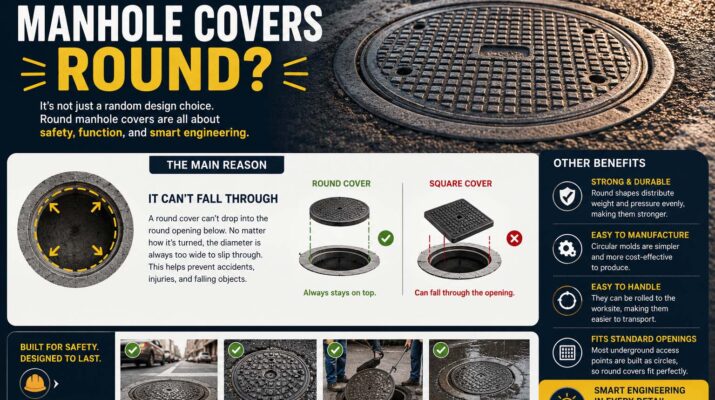
A round cover cannot fall through its own opening.
Because a circle has the same diameter from every angle, the cover always remains larger than the hole regardless of how it is rotated.
This design significantly improves safety and reduces the risk of accidents.
A square cover, by comparison, could potentially fall through the opening if tilted diagonally.
This single engineering advantage is considered the most important reason for choosing a circular design.
Why Manhole Covers Are Round: Key Advantages
Several practical engineering benefits support the use of round covers.
Safety
Safety is the most important factor.
A round cover always stays securely on top of the opening.
Workers do not need to worry about the cover accidentally slipping into the hole during installation or maintenance.
Easier Handling
Since many manhole covers weigh between 90 and 250 pounds (40–115 kg), rolling them makes transportation much easier for maintenance crews.
Uniform Load Distribution
Circular shapes distribute weight more evenly.
Heavy vehicles passing over the cover create pressure that spreads around the entire circumference. A free body diagram can help illustrate how these forces act on the cover and spread across its circular surface.
This reduces stress concentrations and improves durability.
Better Alignment
A round cover always fits correctly.
There is no need to align corners or match a specific orientation during installation.
This saves time and simplifies maintenance operations.
Why Are Manhole Covers Round and Not Square?
Many people specifically ask why are manhole covers round and not square.
Let’s compare the two shapes.
| Feature | Round Cover | Square Cover |
|---|---|---|
| Can Fall Through Opening | No | Potentially Yes |
| Easy to Roll | Yes | No |
| Even Load Distribution | Excellent | Moderate |
| Installation Simplicity | High | Medium |
| Manufacturing Efficiency | High | Moderate |
| Worker Safety | Excellent | Lower |
While square covers are occasionally used in specialized situations, round covers generally perform better in most urban infrastructure applications.
Why Are Manhole Covers Round? Engineering Reason Explained
The phrase why are manhole covers round engineering reason usually refers to the combination of geometry, safety, and practicality.
Engineers typically evaluate designs based on:
- Functionality
- Safety
- Durability
- Cost efficiency
- Ease of maintenance
Round covers perform exceptionally well across all of these categories.
Geometric Stability
A circle maintains constant width regardless of rotation.
This property ensures that the cover remains securely supported by the opening. Learning what is dimensional analysis can also help explain how engineers compare measurements when designing circular covers and openings.
Structural Efficiency
Circular designs naturally resist stress and pressure.
Many engineering structures use circular shapes for similar reasons, including:
- Pipes
- Tunnels
- Storage tanks
- Pressure vessels
The manhole cover benefits from these same structural principles. Learning what is the strongest metal can also help explain why material strength matters when selecting covers that must withstand repeated vehicle loads without developing weak points.
The History of Round Manhole Covers
Manholes have existed for centuries in different forms.
As urban sewer systems expanded during the 19th and 20th centuries, engineers searched for designs that were:
- Safe
- Affordable
- Easy to maintain
Round covers quickly became the standard because they solved several engineering challenges at the same time.
Today, they remain the most common design used around the world.
Are All Manhole Covers Round?
No.
Although round covers dominate modern infrastructure, some locations use other shapes.
Square Covers
Often found in:
- Utility vaults
- Electrical access points
- Private industrial facilities
Rectangular Covers
Common for:
- Cable access systems
- Drainage channels
- Specialized maintenance openings
Custom Shapes
Certain applications require unique designs based on available space or infrastructure requirements.
However, round covers remain the preferred option for most sewer and utility systems.
Engineering Principles Behind Circular Design
The round shape demonstrates several important engineering concepts.
Equal Radius Distribution
Every point on a circle is the same distance from the center.
This creates consistent structural behavior.
Reduced Stress Concentration
Sharp corners often experience higher stress levels.
Round shapes eliminate corners entirely.
Improved Durability
Even force distribution helps extend the lifespan of both the cover and its supporting frame.
These concepts are widely applied by professionals exploring what do engineers do, where safe and durable designs are essential for public infrastructure.
Manufacturing Benefits of Round Manhole Covers
Round covers also offer practical manufacturing advantages.
Simplified Production
Circular molds are relatively simple to manufacture and maintain.
Standardization
Cities can use standardized sizes and replacement parts.
Reduced Installation Errors
Workers do not need to worry about orientation during installation.
These advantages help reduce long-term infrastructure costs.
Common Myths About Round Manhole Covers
Myth 1: Round Covers Are Only Chosen for Appearance
False.
The design is primarily based on engineering performance and safety.
Myth 2: Square Covers Are Always Unsafe
Not necessarily.
However, round covers naturally provide additional safety advantages.
Myth 3: Circular Covers Cost More
In many situations, manufacturing efficiencies make round covers a cost-effective choice throughout their service life.
Real-World Examples
Most major cities around the world use round manhole covers.
Examples include:
- New York City
- London
- Tokyo
- Paris
- Toronto
- Sydney
Their widespread adoption demonstrates how effective the design has proven in real-world infrastructure.
Troubleshooting Common Manhole Cover Issues
Although manhole covers are highly durable, they can occasionally develop problems.
Loose Covers
Possible causes:
- Wear over time
- Frame damage
Solution:
- Replace worn components
- Inspect supporting structures
Noise From Traffic
Possible causes:
- Improper seating
- Surface wear
Solution:
- Refit or replace the cover
Corrosion
Cause:
- Environmental exposure
Solution:
- Use corrosion-resistant materials
- Perform routine inspections
These maintenance practices help ensure reliable long-term performance.
Frequently Asked Questions
Why are manhole covers round?
Because a round cover cannot fall through its own opening and provides important safety and engineering advantages.
Why are manhole covers round and not square?
Round covers distribute weight more evenly, are easier to handle, and cannot accidentally fall into the opening.
Is safety the main engineering reason?
Yes. Preventing the cover from falling through the opening is the most important design advantage.
Are all manhole covers circular?
No. Some utility systems use square or rectangular covers, but round designs remain the most common.
Can square manhole covers be used?
Yes, but they generally do not provide the same combination of safety, efficiency, and practicality.
Why is this question common in engineering interviews?
It tests problem-solving ability and encourages candidates to think about practical engineering design.
Why This Design Has Stood the Test of Time
The answer to why are manhole covers round combines geometry, engineering, safety, and practicality. A round cover cannot fall through its opening, distributes loads evenly, is easier to transport, and simplifies installation and maintenance. These advantages have made the circular design the preferred choice for cities worldwide, demonstrating how a simple engineering decision can deliver long-term safety, efficiency, and reliability.