
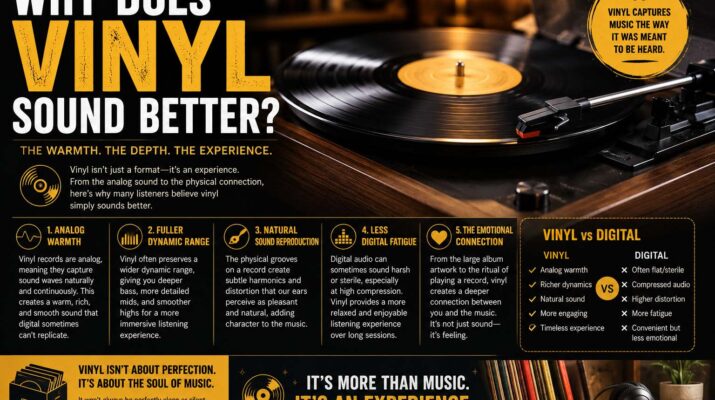
Why does vinyl sound better to some music lovers? Many listeners describe records as warmer, richer, and more immersive than CDs or streaming audio. However, others prefer digital recordings because they offer greater accuracy, convenience, and consistently clean playback.
The answer involves audio engineering, mastering techniques, playback equipment, and personal preference. Vinyl records reproduce music through physical grooves, while digital systems reconstruct audio from numerical samples. As a result, each format has different technical characteristics.
Although modern digital audio generally provides greater measurable accuracy, vinyl playback can introduce subtle tonal changes that some listeners enjoy.
If you’ve wondered why music sounds better on vinyl, this guide explains the technology behind records, compares analog and digital sound, and explores what makes vinyl listening special.
Why Does Vinyl Sound Better to Some Listeners?
Vinyl doesn’t automatically deliver higher-quality audio than digital formats.
In fact, properly implemented digital audio generally offers better technical performance in areas such as dynamic range, background noise, channel separation, and signal accuracy.
However, technical measurements don’t fully explain listening preferences.
Many people appreciate vinyl because of:
- Warm or smooth tonal characteristics
- Different mastering choices
- The physical experience of playing records
- A more focused listening environment
- The character of analog playback equipment
- Collectible album artwork and packaging
Therefore, the appeal of vinyl often comes from the complete listening experience rather than superior technical fidelity.
How Vinyl Records Produce Their Unique Sound
Unlike CDs, MP3 files, and streaming services, vinyl records store audio information through physical grooves.
During record production, a cutting stylus creates a modulated groove in a lacquer disc or another suitable mastering medium. Manufacturers then use the resulting master to produce records.
When you play a record, the turntable rotates it at a controlled speed.
Meanwhile, the stylus follows the groove’s movements, and the cartridge converts those movements into electrical signals.
A phono preamplifier then applies the appropriate equalization and amplifies the signal for further playback.
Finally, your amplifier and speakers reproduce the sound.
This mechanical process contributes to vinyl’s distinctive playback characteristics.
However, not every vinyl record comes from an entirely analog recording. Many modern releases begin with digital recordings or digital masters before engineers cut them onto vinyl.
How Record Speed Affects Vinyl Sound Quality
Vinyl records commonly rotate at:
- 33⅓ RPM
- 45 RPM
RPM means revolutions per minute and describes how many complete rotations a record makes each minute.
For example, a 45 RPM record can provide more groove length per second than a 33⅓ RPM record of the same diameter.
Under suitable mastering conditions, that additional groove length can support better high-frequency reproduction or reduced distortion.
However, record diameter, groove spacing, cutting level, and playing time also affect sound quality.
Therefore, a faster record doesn’t automatically sound better.
For a detailed explanation of rotational speed, see our guide on what is rpm.
Why Does Vinyl Sound Better Than Digital Audio to Some Listeners?
Understanding the difference between analog and digital playback helps explain why listeners experience the formats differently.
How Analog Audio Reproduces Vinyl Sound
Analog audio represents sound through continuously varying physical or electrical signals.
On vinyl, groove movements correspond to the recorded audio signal.
During playback, the stylus and cartridge translate those movements into an electrical signal.
However, this mechanical process introduces limitations such as surface noise, tracking distortion, and gradual record wear.
How Digital Audio Reproduces Music
Digital systems represent audio through numerical samples.
For example, a standard audio CD uses:
- A sampling rate of 44,100 samples per second
- A bit depth of 16 bits
- Two audio channels for stereo playback
Digital-to-analog converters reconstruct an analog signal from the stored samples.
When engineers design and operate digital systems correctly, they can reproduce the original band-limited audio signal with extremely high accuracy.
Therefore, digital audio doesn’t inherently sound harsh or unnatural.
In addition, high-quality digital recordings can preserve subtle musical details without the surface noise associated with vinyl.
Why Vinyl Sounds Warmer and More Natural
Several factors influence the warm sound that vinyl enthusiasts describe.
However, warmth is a subjective listening impression rather than a single measurable audio property.
How Vinyl Mastering Affects Sound Quality
One of the strongest explanations for why vinyl can sound better involves mastering.
Mastering engineers prepare recordings for their intended playback formats.
Because vinyl has physical limitations, engineers must consider groove spacing, bass content, high-frequency energy, and tracking performance.
As a result, a vinyl release may receive a different master from its digital counterpart.
These differences can affect:
- Dynamic range
- Tonal balance
- Perceived loudness
- Bass presentation
- Instrument separation
- Overall listening comfort
For example, a digital release may use aggressive loudness processing while a vinyl edition uses a less compressed master.
In that situation, listeners may prefer the vinyl version because of the mastering decisions rather than the format itself.
However, separate vinyl mastering doesn’t always guarantee greater dynamic range.
Some releases use nearly identical processing across both formats.
How Harmonic Coloration Changes Vinyl Sound
Analog playback equipment can introduce small amounts of harmonic distortion.
For example, cartridges, phono stages, amplifiers, and other components may slightly change the original signal.
Depending on the type and amount of distortion, these changes can affect perceived warmth or fullness.
However, harmonic distortion isn’t automatically pleasant.
Excessive distortion can reduce clarity, particularly during loud or complex musical passages.
Therefore, the goal of a good vinyl system is controlled, accurate playback rather than adding as much coloration as possible.
Why Vinyl Can Sound Smoother
Some listeners describe vinyl as smoother or less aggressive than digital audio.
This impression may result from mastering choices, cartridge frequency response, or other playback characteristics.
For example, a cartridge with a gently reduced high-frequency response may make bright recordings sound softer.
However, vinyl doesn’t universally remove harsh frequencies, and digital audio doesn’t inherently exaggerate them.
In fact, both formats can reproduce detailed high-frequency content when the recording and equipment allow it.
How Playback Equipment Influences Vinyl Sound
The equipment used to play music can strongly influence sound quality.
For example, a carefully adjusted turntable with good speakers may sound more engaging than a poorly configured digital system.
However, the opposite can also be true.
A high-quality digital setup can outperform an inexpensive turntable in clarity, noise control, and frequency accuracy.
Therefore, fair comparisons should use similar speakers, listening levels, and recording masters whenever possible.
Why Does Music Sound Better on Vinyl?
Sound quality isn’t the only reason people enjoy records.
The physical listening experience also matters.
Playing an album involves several deliberate actions:
- Removing the record from its sleeve
- Placing it on the turntable
- Checking that the surface is clean
- Lowering the stylus
- Listening to the music
- Turning the record over when necessary
Unlike streaming, this process encourages some listeners to experience an album from beginning to end.
As a result, they may pay closer attention to arrangements, lyrics, and subtle musical details.
In addition, large album covers, liner notes, and collectible packaging can strengthen the connection between listeners and their favorite music.
However, focused listening isn’t exclusive to vinyl.
You can enjoy the same attentive experience with CDs, lossless streaming, or high-quality digital files.
Why Vinyl and Digital Sound Different: Quality Comparison
When comparing vinyl with digital audio, it’s useful to separate measurable performance from personal preference.
| Feature | Vinyl Records | Digital Audio |
|---|---|---|
| Background noise | May include surface noise | Very low with quality playback |
| Dynamic range | Limited by mechanical and playback factors | Generally higher |
| Channel separation | Limited by groove and cartridge characteristics | Generally excellent |
| Playback wear | Records and styluses can wear | No physical wear during file playback |
| Frequency response | Depends on mastering and equipment | Highly accurate with suitable equipment |
| Distortion | Mechanical and electrical sources | Usually very low |
| Convenience | Requires physical handling | Easy access and navigation |
| Listening character | May include audible coloration | Typically more transparent |
From a technical perspective, digital audio generally provides greater fidelity.
However, a technically superior format doesn’t guarantee that every listener will prefer its sound.
For example, someone may enjoy the gentle coloration of a particular cartridge even when a digital system reproduces the recording more accurately.
Therefore, personal preference remains an important part of the comparison.
Why Does Vinyl Sound Better Than CD for Some Albums?
Compact discs became popular because they offered convenient playback, low background noise, and excellent durability under normal handling.
However, some listeners prefer vinyl editions of certain albums.
One possible reason is mastering.
How the Loudness War Affected Sound Quality
During the late 1990s and 2000s, many commercial recordings used increasingly aggressive dynamic compression and limiting.
This trend became widely known as the loudness war.
Heavy processing can reduce the difference between quiet and loud passages.
As a result, some recordings may sound consistently loud but less dynamic.
Certain vinyl editions use different mastering decisions that preserve more variation between musical passages.
However, vinyl doesn’t always have greater dynamic range than CD.
A well-mastered CD can reproduce excellent dynamics, while a poorly mastered vinyl release can sound compressed or distorted.
Why Comparing the Same Master Matters
To compare formats fairly, listeners should consider whether both releases use the same source and mastering decisions.
Otherwise, they may be comparing two different versions of the music rather than the technical capabilities of vinyl and CD.
For example, an older CD with a carefully preserved dynamic range may sound better than a newer vinyl edition with aggressive processing.
Therefore, mastering quality often matters more than format preference.
How Turntable Equipment Affects Vinyl Sound Quality
Not every turntable produces the same results.
A complete vinyl playback system contains several components, and each affects the final sound.
Turntable Speed and Stability
The turntable rotates the record at a stable speed while limiting unwanted vibration.
Speed instability can produce audible pitch variations.
Therefore, a reliable motor, stable platter, and suitable isolation are valuable features.
Cartridge Quality and Sound Reproduction
The cartridge converts stylus movement into an electrical signal.
Its design affects tracking ability, frequency response, distortion, and channel separation.
However, an expensive cartridge won’t necessarily perform well if the user installs it incorrectly.
Stylus Condition and Audio Clarity
The stylus makes direct contact with the record groove.
Its shape and condition influence how accurately it follows recorded movements.
For example, a worn stylus can increase distortion and potentially damage records.
Therefore, inspect and replace it according to the manufacturer’s guidance.
Phono Preamp and Frequency Balance
Vinyl mastering uses standardized equalization to manage the physical limitations of record grooves.
During playback, the phono preamplifier applies complementary equalization to restore the intended frequency balance.
This process commonly follows the RIAA playback curve.
For broader technical information about audio engineering, the Audio Engineering Society provides professional resources covering sound reproduction, recording, and audio technology.
Speakers and Listening Quality
Speakers strongly influence the listening experience.
Even a carefully configured turntable may sound disappointing through poorly positioned or unsuitable speakers.
For example, speaker placement and room acoustics affect bass response, stereo imaging, and overall clarity.
Therefore, improving speakers or their placement may deliver more noticeable results than replacing an already capable turntable.
Factors That Influence Vinyl Sound Quality
Several practical factors determine how a record sounds during playback.
Record Condition and Pressing Quality
Clean, well-manufactured records usually produce fewer unwanted noises than damaged or poorly pressed records.
Common problems include:
- Surface scratches
- Dust inside grooves
- Warping
- Manufacturing defects
- Excessive groove wear
However, expensive or heavyweight vinyl doesn’t automatically guarantee better audio quality.
Mastering and pressing quality remain important.
Turntable Setup and Alignment
Incorrect adjustments can introduce distortion or uneven playback.
For example, common setup problems include:
- Incorrect tracking force
- Poor cartridge alignment
- Dirty stylus
- Improper anti-skate adjustment
- Unstable turntable placement
- Incorrect playback speed
Therefore, checking the manufacturer’s setup instructions is often more useful than immediately purchasing expensive upgrades.
Room Acoustics and Sound Quality
Room acoustics affect both analog and digital systems.
For example, hard walls and floors can create reflections that influence clarity.
Meanwhile, furniture, carpets, and suitable acoustic treatment can help control unwanted reflections.
However, room treatment should match the actual acoustic problem.
Simply adding soft furnishings won’t correct every issue.
How to Improve Vinyl Sound Quality: Step-by-Step Guide
A few practical adjustments can improve the listening experience without requiring an entirely new system.
Step 1: Keep Records Clean
Dust and debris can produce pops, crackles, and unnecessary stylus wear.
Therefore, use a suitable record brush to remove loose dust before playback.
For deeper cleaning, follow methods appropriate for vinyl records.
Step 2: Clean the Stylus
A dirty stylus may struggle to track grooves accurately.
As a result, playback can become distorted.
Use a cleaning tool approved by the cartridge manufacturer, and handle the stylus carefully.
Step 3: Check Tracking Force
Correct tracking force helps the stylus remain properly seated in the groove.
However, both excessive and insufficient tracking force can create problems.
Therefore, follow the cartridge manufacturer’s recommended range rather than guessing.
Step 4: Store Records Properly
Store records vertically in suitable protective sleeves.
In addition, keep them away from excessive heat, moisture, and direct sunlight.
Avoid stacking heavy piles of records horizontally for extended periods.
Step 5: Upgrade Components Gradually
Before buying new equipment, identify what limits your current system.
For example, poor speaker placement may be a bigger problem than cartridge quality.
Likewise, incorrect turntable setup can make an expensive cartridge perform poorly.
Therefore, upgrade components based on actual performance needs rather than following a fixed purchasing order.
Troubleshooting Common Vinyl Sound Problems
If your records sound disappointing, check these common causes before replacing equipment.
| Problem | Possible Cause | Practical Solution |
|---|---|---|
| Crackling sounds | Dust or debris | Clean the record carefully |
| Skipping | Damage, incorrect tracking force, or vibration | Inspect the record and check the setup |
| Distorted vocals | Worn stylus or tracking problems | Inspect the stylus and cartridge alignment |
| Uneven playback speed | Motor, belt, or speed-control issue | Check the turntable’s speed system |
| Hum from speakers | Grounding or electrical interference | Check connections and grounding |
| Weak bass | Incorrect wiring, setup, or speaker placement | Inspect the signal chain and speaker positions |
| Excessive surface noise | Dirty or worn record | Clean and inspect the pressing |
However, avoid changing multiple settings at once.
Instead, test one possible cause at a time so you can identify which adjustment improves the sound.
Does Vinyl Have Any Disadvantages?
Although vinyl offers an enjoyable listening experience, it also has practical limitations.
Common disadvantages include:
- Records require regular cleaning.
- Turntables need occasional adjustments.
- Styluses wear out and require replacement.
- Physical records take up storage space.
- Heat and poor handling can damage records.
- Albums often require turning over during playback.
- Good playback equipment can be expensive.
- Surface noise may interrupt quiet musical passages.
In addition, vinyl is less convenient for travel and portable listening.
However, collectors may enjoy the maintenance and physical interaction involved in the hobby.
Therefore, the disadvantages depend partly on what you value in a music format.
How Physical Interaction Changes the Vinyl Listening Experience
Our enjoyment of music involves more than frequency response and dynamic range.
Attention, expectations, memories, and physical interaction can influence how we experience recordings.
For example, handling an album sleeve and placing a record on a turntable can create a sense of anticipation.
This physical interaction relates to broader concepts explored in our guide on what are haptics.
However, haptic technology and ordinary tactile experiences aren’t identical.
The connection here is the role that touch and physical interaction can play in how people engage with technology.
As a result, vinyl listening may feel more personal to someone who enjoys the ritual of playing physical media.
Vinyl Sound Quality vs. Digital Accuracy
From an engineering perspective, modern digital audio generally offers greater signal accuracy.
High-quality digital playback can provide:
- Very low background noise
- Low distortion
- Excellent channel separation
- Wide dynamic range
- Consistent reproduction
- No mechanical groove wear
Vinyl playback introduces additional mechanical and electrical variables.
However, those characteristics don’t prevent listeners from enjoying records.
For example, a carefully configured analog system may deliver an appealing sound even when it measures less accurately than a digital system.
Why Signal Quality Matters
Every audio system relies on properly functioning electrical connections.
Loose or damaged connections can cause interruptions, hum, or inconsistent performance.
For example, checking cable connections can help troubleshoot audio equipment before replacing expensive components.
Readers interested in basic electrical testing can explore what is continuity to understand how technicians check whether an electrical path remains connected.
However, continuity testing alone doesn’t measure overall audio fidelity.
Therefore, good connections are necessary for reliable playback but don’t determine whether vinyl or digital sounds better.
Common Myths About Why Vinyl Sounds Better
Several popular beliefs about records oversimplify the differences between audio formats.
Therefore, it’s helpful to separate technical facts from listening preferences.
Myth: Vinyl Always Sounds Better
Not necessarily.
Mastering, playback equipment, room acoustics, and personal preference all affect the listening experience.
Therefore, some vinyl releases sound excellent, while others disappoint.
Myth: Pops and Crackles Mean Better Sound Quality
Surface noise comes from mechanical playback, record condition, or contamination.
However, it isn’t evidence of superior audio fidelity.
A clean, well-maintained record should generally minimize unnecessary noise.
Myth: Expensive Turntables Fix Every Problem
Higher prices don’t automatically guarantee better results.
For example, incorrect cartridge alignment can cause distortion even on an expensive turntable.
Therefore, proper setup remains essential.
Myth: Streaming Cannot Sound Good
Modern streaming services can deliver high-quality digital audio.
In addition, lossless formats can preserve the audio information contained in the source recording.
However, streaming quality still depends on the recording, mastering, playback settings, and equipment.
Should You Buy Vinyl Records?
Vinyl may be worth exploring if you enjoy physical media and dedicated listening sessions.
For example, collectors often appreciate:
- Album artwork
- Printed liner notes
- Physical ownership
- Collecting special editions
- Building a home audio system
- Listening to complete albums
- Learning about analog equipment
However, digital audio may be more practical if you prioritize portability, affordability, and instant access.
In fact, many music enthusiasts use both formats.
They may stream music during daily activities while reserving vinyl records for focused listening at home.
Therefore, you don’t need to choose one format exclusively.
Frequently Asked Questions About Vinyl Sound
Why Does Vinyl Sound Better to Some People?
Some listeners prefer the tonal character of analog playback, different mastering decisions, and the physical experience of playing records.
However, personal preference doesn’t mean vinyl is technically more accurate.
Why Does Music Sound Better on Vinyl?
Vinyl can encourage focused listening, while playback equipment and mastering choices may create a different tonal presentation.
As a result, some people find the experience warmer or more engaging than casual digital listening.
Why Does Vinyl Sound Better Than Digital?
Some vinyl releases use different mastering techniques or playback equipment that produces pleasing coloration.
However, digital audio generally provides better measurable accuracy, lower noise, and greater dynamic range.
Why Does Vinyl Sound Better Than CD?
A particular vinyl edition may sound more appealing because it uses a different master.
However, CDs can reproduce music with excellent accuracy and aren’t inherently inferior.
Is Vinyl Worth Collecting Today?
Yes, for people who enjoy physical albums, artwork, and dedicated listening sessions.
However, collecting records requires storage space, maintenance, and suitable playback equipment.
Does Expensive Vinyl Always Sound Better?
No. Price alone doesn’t determine sound quality.
For example, mastering quality, pressing condition, cartridge setup, and speaker performance can matter more than the cost of an individual record.
Can Vinyl Records Wear Out?
Yes. Repeated playback can gradually wear record grooves, particularly when the stylus is damaged or the turntable is incorrectly adjusted.
However, proper cleaning, storage, and equipment maintenance can help reduce unnecessary wear.
The Bottom Line: Why Does Vinyl Sound Better?
The question why does vinyl sound better doesn’t have one universal answer.
Digital formats generally deliver greater technical accuracy, lower noise, and more consistent playback. However, vinyl offers a distinctive combination of mastering choices, analog playback characteristics, and physical interaction.
For some listeners, these qualities create a warmer and more engaging musical experience.
Nevertheless, a well-mastered digital recording can sound outstanding, just as a poorly produced vinyl record can disappoint.
Rather than treating vinyl and digital as competing technologies, consider them different ways to enjoy music.
If you appreciate album artwork, the ritual of using a turntable, and listening to complete records, vinyl can provide a rewarding experience. On the other hand, digital audio remains an excellent choice for convenience, portability, and accurate reproduction.
The best format is the one that helps you enjoy your favorite music.