
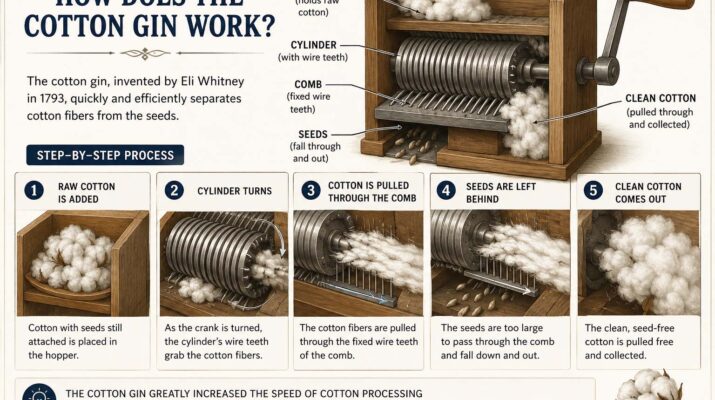
Have you ever wondered how does the cotton gin work and why this machine became such an influential invention in agricultural history? Before mechanical cotton gins became widespread, workers separated cotton fibers from their seeds by hand. This process required considerable time and effort, especially when processing short-staple cotton.
The cotton gin changed this process by using mechanical parts to separate fibers from seeds much faster. However, its historical impact extended beyond engineering. In the United States, the invention also helped expand cotton cultivation and the demand for enslaved labor.
Although Eli Whitney developed his famous cotton gin in the late 18th century, the basic principle remains relevant to modern cotton processing. This guide explains the machine’s operation, its components, its historical significance, and the technology used in modern facilities.
What Is a Cotton Gin?
A cotton gin is a machine that separates cotton fibers from the seeds inside harvested cotton.
The word “gin” comes from “engine,” an older term for a mechanical device.
In a traditional saw-type cotton gin, rotating teeth pull cotton fibers through narrow openings. Meanwhile, the larger seeds cannot pass through those openings, so the machine separates them from the fibers.
As a result, cotton processors can prepare large quantities of fiber for subsequent cleaning, packaging, and textile production.
Why Cotton Needs Ginning
Freshly harvested cotton contains fibers attached to seeds.
Before manufacturers can spin the fibers into yarn, they must separate most of the seeds and remove unwanted material.
For example, raw cotton may also contain leaves, stems, dirt, and other field debris.
Therefore, cotton processing facilities often combine seed separation with additional cleaning equipment.
Understanding this mechanical process also provides useful background for students exploring what is mechatronics?, a field that combines mechanical systems with electronics and control technology.
Why Was the Cotton Gin Invented?
Before efficient mechanical ginning became common, separating seeds from short-staple cotton required extensive manual labor.
Workers could remove seeds by hand, but the process limited how quickly farmers could prepare cotton for market.
Consequently, cotton processing created a major production bottleneck.
In 1793, Eli Whitney developed a cotton gin design that made separating seeds from short-staple cotton considerably faster.
However, cotton-cleaning machines existed before Whitney’s invention, including roller-gin designs.
Whitney’s contribution became especially significant because his machine addressed the challenges of processing short-staple cotton.
The Historical Impact of the Cotton Gin
The machine helped make large-scale cotton production more profitable in the United States.
However, this economic expansion had devastating consequences.
Rather than eliminating the need for enslaved labor, increased cotton production helped drive the expansion of slavery across the American South.
As cotton cultivation spread, plantation owners demanded more labor for planting, maintaining, and harvesting crops.
Therefore, the invention’s history includes both technological progress and the expansion of an exploitative agricultural system.
The Smithsonian Institution’s National Museum of American History provides educational resources about American inventions, industry, and the historical context in which technologies developed.
How Does the Cotton Gin Work?
The basic operating principle involves pulling cotton fibers away from seeds using mechanical movement.
In a traditional saw-type cotton gin, rotating teeth catch the fibers and draw them through narrow openings.
However, the seeds are too large to follow.
As a result, the machine separates the two materials without requiring workers to remove each seed individually.
The Basic Cotton Ginning Process
The main stages include:
- Raw cotton enters the machine.
- Rotating teeth catch the cotton fibers.
- The teeth pull fibers through narrow openings.
- Larger seeds remain behind.
- Brushes or another removal system separate fibers from the rotating teeth.
- Cotton fibers and seeds move to different collection areas.
This process allows mechanical equipment to handle much greater quantities of cotton than manual separation.
However, actual operating methods vary between historical machines and modern industrial gins.
How Does the Cotton Gin Work Step by Step?
Understanding each stage makes the machine easier to visualize.
Although modern facilities use more complex equipment, the following explanation describes the main separation process of a traditional saw-type cotton gin.
Step 1: Feeding Raw Cotton Into the Machine
First, workers or automated equipment feed harvested cotton into the processing system.
At this stage, the cotton still contains seeds and may include leaves, stems, and other field material.
Modern facilities commonly remove larger debris before the cotton reaches the gin stand.
As a result, the machine receives material that is better prepared for seed separation.
Step 2: Rotating Teeth Catch the Cotton Fibers
Next, a rotating cylinder or series of saw blades catches the cotton fibers.
The teeth grip the flexible fibers and move them toward narrow openings.
However, the mechanism must operate at suitable speeds to maintain effective separation.
Excessive or unsuitable processing conditions can damage fibers and reduce quality.
Step 3: Narrow Openings Separate the Seeds
As the teeth move, they pull cotton fibers through spaces between metal ribs.
The fibers can pass through these openings, but the larger seeds cannot.
Consequently, the seeds separate from the fibers and move toward a collection area.
This size-based separation is the central principle of the traditional saw gin.
Step 4: Brushes Remove the Fibers
After separation, rotating brushes remove cotton fibers from the saw teeth in traditional designs.
Without this removal stage, fibers could remain attached and interfere with continuous operation.
Therefore, the brush system helps maintain a steady flow of processed cotton.
Modern machines may use different removal arrangements depending on their design.
Step 5: Collecting the Cotton and Seeds
Finally, the equipment directs the separated materials toward different outlets.
The cotton fibers continue through additional cleaning and handling stages.
Meanwhile, facilities collect the seeds for suitable agricultural or industrial uses.
For example, processors may use cottonseed for oil production or other applications after appropriate processing.
Main Parts of a Cotton Gin and Their Functions
Each component performs a specific task during seed separation.
| Component | Main Function |
|---|---|
| Feed system | Introduces cotton into the processing equipment |
| Rotating saws or teeth | Catch and move cotton fibers |
| Metal ribs | Create narrow openings that prevent seeds from passing |
| Brush system | Removes fibers from rotating teeth in traditional designs |
| Seed outlet | Directs separated seeds away from the machine |
| Cotton outlet | Transfers processed fibers to the next stage |
| Drive system | Supplies mechanical power to moving components |
These parts work together to support continuous processing.
However, modern cotton gins may include additional equipment and different mechanical arrangements.
How Does the Cotton Gin Work? Simple Explanation
Imagine trying to pull soft threads through a narrow opening while keeping larger objects on the other side.
The threads can pass through because they are flexible and thin.
However, the larger objects cannot fit through the same space.
A traditional cotton gin follows a similar principle.
Its rotating teeth pull cotton fibers through narrow gaps, while the larger seeds remain behind.
As a result, the machine separates fibers and seeds through mechanical movement.
Although this comparison simplifies the engineering, it explains the central idea without requiring advanced technical knowledge.
The Engineering Behind Cotton Ginning
To understand how does the cotton gin work from an engineering perspective, it helps to examine how rotating teeth, metal ribs, and controlled mechanical movement separate cotton fibers from their seeds.
Cotton gins demonstrate several important mechanical engineering principles.
These include rotational motion, material separation, controlled feeding, and mechanical power transmission.
Rotational Motion
A rotating mechanism continuously moves cotton fibers through the separation area.
For example, traditional designs use a shaft that drives saws or teeth.
As the shaft rotates, the teeth repeatedly catch and pull fibers.
Mechanical Separation
The machine relies on differences in the physical characteristics of cotton fibers and seeds.
Cotton fibers are flexible, while seeds are relatively large and rigid.
Therefore, carefully designed openings allow fibers to pass while restricting seeds.
Controlled Operating Speed
Machine speed affects processing capacity and fiber quality.
However, increasing speed does not always improve results.
Operators must balance throughput with the condition of the incoming cotton and the equipment’s operating requirements.
Students interested in machine design can also explore what do engineers do to understand how engineering professionals develop, test, and improve mechanical systems.
Manual Cotton Cleaning vs. Modern Cotton Gins
Modern cotton gins operate on a much larger scale than early machines.
However, the basic goal remains the same: separating usable cotton fibers from seeds.
| Feature | Early Cotton Gin | Modern Cotton Gin |
|---|---|---|
| Power source | Human or other mechanical power | Usually electric motors |
| Processing capacity | Relatively limited | High-volume commercial processing |
| Feeding | Primarily manual | Often automated |
| Cleaning equipment | Basic | Multiple cleaning stages |
| Monitoring | Direct observation | Sensors and electronic controls |
| Production management | Manual | Often computerized |
Modern facilities also use equipment to manage airflow, moisture, and material movement.
As a result, they can process cotton more consistently while monitoring quality.
Where Are Cotton Gins Used Today?
Cotton gins operate in agricultural processing facilities that prepare harvested cotton for textile manufacturing and other uses.
After ginning, processors typically prepare the cotton lint for transportation to textile mills.
From Cotton Harvesting to Textile Production
A simplified production sequence includes:
- Farmers harvest cotton.
- Processing facilities remove large contaminants.
- Ginning equipment separates seeds from fibers.
- Additional cleaning removes unwanted material.
- Workers or automated systems compress cotton lint into bales.
- Textile mills process the fibers into yarn.
- Manufacturers produce fabric and finished textile products.
Therefore, ginning serves as an early stage in the wider cotton manufacturing process.
Later production stages may involve spinning, weaving, knitting, cutting, and sewing.
For example, manufacturers may use an industrial sewing machine to assemble finished products after the fabric has undergone other manufacturing steps.
Advantages of Using a Cotton Gin
Mechanical ginning provides several practical benefits.
Faster Cotton Processing
The machine separates seeds much faster than traditional hand cleaning.
As a result, processors can handle larger quantities of harvested cotton.
Greater Production Capacity
Commercial facilities use high-capacity equipment to process cotton at scale.
Therefore, mechanical ginning supports large agricultural supply chains.
More Consistent Processing
Properly adjusted equipment can provide repeatable separation results.
However, fiber quality also depends on harvesting conditions, moisture, cleaning methods, and machine settings.
Less Manual Seed Separation
Mechanical equipment reduces the amount of direct handwork required to separate seeds.
Nevertheless, workers remain essential for operating, maintaining, inspecting, and managing processing facilities.
Limitations of Cotton Gin Machines
Despite their benefits, cotton gins require proper operating conditions and maintenance.
Regular Maintenance Requirements
Moving components experience wear during operation.
For example, saws, brushes, bearings, and drive systems may require inspection or replacement.
Therefore, maintenance schedules help prevent unexpected failures.
Sensitivity to Cotton Condition
Wet or heavily contaminated cotton can create processing problems.
As a result, facilities must manage moisture and remove unwanted material.
Equipment and Energy Costs
Commercial ginning equipment requires substantial investment.
In addition, motors, cleaning systems, and supporting machinery consume energy.
Therefore, facilities must consider processing volume and operating expenses when selecting equipment.
Potential Fiber Damage
Poor adjustments or unsuitable operating conditions can damage cotton fibers.
However, careful equipment setup and monitoring help reduce this risk.
How Modern Cotton Gins Have Improved
Modern cotton processing facilities use advanced equipment to improve efficiency and consistency.
Common technologies include:
- Automated feeding systems
- High-capacity cleaning equipment
- Dust collection systems
- Moisture monitoring
- Electronic control panels
- Fiber quality monitoring
- Computerized production tracking
For example, sensors can help operators identify changes in operating conditions.
Meanwhile, automated controls can support more consistent material flow.
However, technology cannot eliminate every processing challenge.
Cotton quality, equipment condition, and operator decisions still influence results.
Complete Cotton Gin Workflow
A commercial cotton processing facility performs more than seed separation.
The complete workflow typically includes several connected stages.
Receiving and Preparing Cotton
First, harvested cotton arrives at the facility.
Workers and equipment prepare the material for processing.
For example, pre-cleaning systems may remove leaves, stems, and other large contaminants.
Separating Seeds From Fibers
Next, the cotton enters the gin stand.
The separation mechanism removes seeds from the fibers.
However, the exact method depends on the type of gin and the cotton being processed.
Cleaning and Handling Cotton Lint
After separation, additional equipment may remove remaining impurities.
The facility then transfers the lint toward packaging equipment.
Compressing Cotton Into Bales
Finally, the processing facility compresses cotton lint into bales for storage and transportation.
As a result, textile manufacturers can receive the fiber in a practical form for further processing.
Common Cotton Gin Maintenance Checklist
Routine maintenance helps maintain equipment performance and reduce downtime.
| Inspection Item | Why It Matters |
|---|---|
| Saws or teeth | Supports effective fiber separation |
| Metal ribs | Maintains suitable separation openings |
| Brushes | Helps remove fibers from rotating parts |
| Bearings | Reduces friction-related problems |
| Drive belts | Supports reliable power transmission |
| Motors | Provides consistent mechanical power |
| Cleaning equipment | Prevents excessive material buildup |
| Dust collection | Helps manage airborne cotton dust |
However, maintenance procedures should follow the manufacturer’s instructions and workplace safety requirements.
Operators should isolate equipment from power before performing work that exposes moving parts.
Cotton Gin vs. Manual Cotton Cleaning
Mechanical ginning and manual seed removal achieve the same basic result.
However, their processing capacity differs significantly.
| Feature | Mechanical Cotton Gin | Manual Seed Removal |
|---|---|---|
| Processing speed | Much faster | Slow |
| Production capacity | High | Limited |
| Direct hand separation | Minimal | Extensive |
| Equipment requirements | Requires machinery | Requires basic tools or handwork |
| Suitability for commercial processing | High | Generally impractical at scale |
Therefore, commercial cotton production relies on mechanical ginning rather than large-scale manual seed removal.
Technology Behind Modern Cotton Gins
Modern cotton processing combines mechanical engineering with electrical systems and automated monitoring.
Control equipment helps operators observe machine conditions and coordinate processing stages.
Sensors and Instrumentation
Facilities may monitor variables such as:
- Equipment speed
- Airflow
- Temperature
- Moisture
- Motor performance
- Processing conditions
For example, moisture measurements can help operators make decisions about cotton handling and preparation.
In addition, airflow monitoring can support the operation of pneumatic transport and cleaning systems.
Readers interested in industrial measurement can explore what is instrumentation to understand how sensors and control equipment support manufacturing processes.
Mechanical and Electrical Power Systems
Modern facilities generally use electric motors to operate their machinery.
These motors drive components such as fans, conveyors, cleaning equipment, and gin stands.
Although power generation is a separate topic, understanding alternator vs generator provides useful background on electrical equipment and energy conversion.
Troubleshooting Common Cotton Gin Problems
Even properly maintained machinery can develop performance issues.
However, identifying symptoms early can help operators prevent larger problems.
Poor Fiber Separation
Possible causes include:
- Worn saw teeth
- Damaged separation ribs
- Incorrect feed rates
- Unsuitable machine adjustments
Therefore, trained personnel should inspect the relevant components and compare their condition with manufacturer specifications.
Excessive Fiber Damage
Potential causes include:
- Incorrect operating settings
- Worn components
- Excessive mechanical handling
- Poor incoming cotton condition
For example, aggressive processing can reduce fiber quality.
As a result, operators should review machine settings and material conditions before making adjustments.
Unusual Machine Vibration
Common causes may include:
- Loose fasteners
- Worn bearings
- Misaligned components
- Damaged rotating parts
However, operators should not attempt repairs while machinery is running.
Instead, trained maintenance personnel should follow approved shutdown and isolation procedures.
Reduced Processing Capacity
If production slows, possible causes include:
- Inconsistent feeding
- Equipment wear
- Drive-system problems
- Cleaning-system blockages
- Unsuitable cotton moisture
Therefore, systematic inspection can help identify the underlying problem.
How the Cotton Gin Influenced Modern Manufacturing
The cotton gin demonstrated the potential of mechanical equipment to accelerate repetitive processing tasks.
Its development also contributed to the expansion of cotton-based textile production.
However, its historical significance cannot be separated from the expansion of slavery in the United States.
By making short-staple cotton more profitable to process, the machine helped increase demand for cotton cultivation and enslaved agricultural labor.
From an engineering perspective, cotton ginning illustrates principles that remain relevant in industrial machinery.
These include mechanical separation, continuous material handling, power transmission, and production efficiency.
Over time, manufacturers introduced more sophisticated machinery, electrical drives, sensors, and automated control systems.
Therefore, studying the cotton gin offers insight into both industrial technology and the social consequences of technological change.
Frequently Asked Questions About the Cotton Gin
How Does the Cotton Gin Work?
A traditional saw-type cotton gin uses rotating teeth to pull cotton fibers through narrow openings.
However, the larger seeds cannot pass through the openings.
As a result, the machine separates the fibers from the seeds.
What Is the Cotton Gin and How Does It Work?
A cotton gin is a machine that removes seeds from harvested cotton.
Traditional saw-type machines use rotating teeth and metal ribs to separate fibers from seeds.
Meanwhile, other gin designs use different mechanical arrangements.
How Does the Cotton Gin Work Step by Step?
First, cotton enters the machine.
Next, rotating teeth catch the fibers and pull them through narrow openings.
The seeds remain behind, while the machine removes the separated fibers from the rotating mechanism.
Finally, the equipment directs fibers and seeds toward separate collection areas.
Can You Explain the Cotton Gin in Simple Terms?
Think of a machine pulling soft threads through narrow gaps.
The threads pass through, but larger objects cannot.
Similarly, a traditional cotton gin pulls flexible fibers away from larger cotton seeds.
Who Invented the Cotton Gin?
Eli Whitney developed his well-known cotton gin in 1793.
However, earlier cotton-cleaning machines already existed.
Whitney’s design became particularly influential in processing short-staple cotton in the United States.
Are Cotton Gins Still Used Today?
Yes. Modern cotton processing facilities continue to use ginning equipment.
However, today’s machines are much larger and often include automated feeding, cleaning, and monitoring systems.
What Happens to Cotton Seeds After Ginning?
Facilities collect the separated seeds for further processing or suitable agricultural and industrial uses.
For example, cottonseed can serve as a raw material for oil production.
However, its intended use determines the additional processing required.
Final Thoughts
Understanding how does the cotton gin work helps explain why this machine became an important development in agricultural engineering.
By separating cotton fibers from seeds mechanically, the cotton gin made processing faster and supported large-scale textile production.
However, its influence was not entirely positive. In the United States, increased cotton profitability contributed to the expansion of slavery and plantation agriculture.
Today, modern ginning facilities combine traditional separation principles with advanced machinery, electronic controls, and quality monitoring.
As a result, the cotton gin remains a useful example of how mechanical engineering can transform an industry while also producing far-reaching economic and social consequences.