
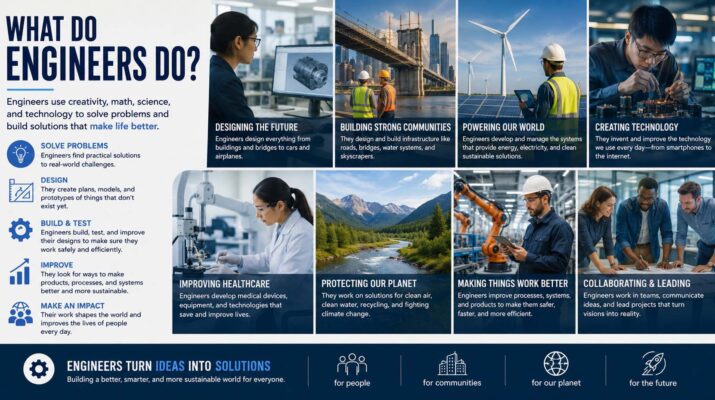
Engineers play an essential role in the modern world. If you wonder what do engineers do, the answer covers many activities, from designing buildings and developing software to creating machines and improving electrical systems. Engineers apply science, mathematics, creativity, and problem-solving skills to develop practical solutions for transportation, healthcare, communication, technology, and infrastructure.
Their work affects nearly every part of society. For example, help develop roads, smartphones, bridges, airplanes, factories, and power systems. Although each discipline focuses on different challenges, all engineers aim to solve problems efficiently, safely, and reliably.
Engineering also offers opportunities to combine innovation with practical work. As technology advances, professionals in this field continue to contribute to industries that depend on better products, systems, and infrastructure.
What Software Engineers Do
Software engineers design, develop, test, and maintain digital systems. Their work includes computer programs, websites, mobile applications, and operating systems. They turn ideas and technical requirements into software that solves specific problems.
These professionals use programming languages such as Python, Java, C++, and JavaScript to build applications. They also collaborate with designers, project managers, and cybersecurity specialists to create secure, reliable, and user-friendly products.
For example, software help develop mobile apps, video games, online banking platforms, and artificial intelligence tools. Learning basic coding concepts provides a useful foundation for people interested in this career.
Daily responsibilities vary by role, but common tasks include:
- Writing and reviewing code.
- Finding and fixing software bugs.
- Testing applications before release.
- Improving performance and security.
- Updating existing programs and systems.
- Collaborating with teams to meet project requirements.
Because many businesses depend on digital platforms and cloud-based technologies, software engineers help organizations maintain efficient operations. Students exploring technology careers can also compare computer engineering vs computer science to understand the differences between these fields.
Mechanical Engineering Responsibilities
Mechanical engineers design, develop, analyze, and improve machines and mechanical systems. Their work spans industries such as automotive manufacturing, aerospace, energy production, robotics, and industrial manufacturing.
They apply physics, thermodynamics, and materials science to create equipment that performs reliably and efficiently. For instance, a mechanical engineer might develop an engine, improve a heating system, design manufacturing equipment, or help build a robotic mechanism.
Many mechanical engineers work closely with production teams to test products and maintain quality standards. Before a product reaches customers, they may evaluate its performance, durability, safety, and manufacturing costs.
Energy efficiency and sustainability also shape modern mechanical engineering. Engineers develop and improve technologies such as electric vehicles, renewable energy equipment, and advanced robotics to address practical challenges.
In addition, mechanical systems increasingly combine mechanical components with electronics and software. Learning about what is mechatronics? helps explain how these technologies work together.
Civil Engineering and Infrastructure
Civil engineers plan, design, and oversee infrastructure projects that communities depend on every day. Their work includes roads, bridges, airports, tunnels, dams, railways, water systems, and buildings.
These professionals help ensure that infrastructure remains safe, durable, and suitable for its intended purpose. They consider environmental conditions, material strength, construction costs, and the needs of the people who will use each structure.
Civil engineers may perform several tasks during a project:
- Surveying sites and evaluating land conditions.
- Preparing engineering designs and project plans.
- Estimating construction costs and material requirements.
- Supervising construction activities.
- Checking compliance with relevant safety standards.
- Inspecting structures and planning maintenance.
For example, transportation engineers help improve highways, public transit, and traffic flow. Meanwhile, civil engineers working in water resources may design drainage networks, reservoirs, and flood-control systems.
By coordinating with architects, contractors, surveyors, and other specialists, they help deliver infrastructure that serves communities over the long term.
Electrical Systems and Power Engineering
Electrical engineers design, develop, test, and maintain electrical systems and electronic equipment. Their work supports homes, industries, transportation networks, communication systems, and power generation.
They work with electricity, electronic circuits, telecommunications, control systems, and power distribution. As a result, their projects may involve computers, medical devices, renewable energy equipment, industrial automation, or large electrical networks.
An electrical engineer might design wiring for a building, improve battery performance, develop a control system, or help maintain a reliable power supply. These professionals also use specialized software and testing equipment to evaluate performance and identify potential problems.
Power generation and distribution form another major area of this discipline. Engineers help deliver electricity to homes and businesses while improving efficiency, reliability, and safety. In addition, they support renewable energy technologies, including solar panels and wind turbines.
Industrial processes often combine electrical systems with sensors and control equipment. Understanding what is instrumentation explains how these tools measure and monitor operating conditions. Similarly, learning what is an actuator shows how control signals can produce physical movement in automated systems.
How Engineers Improve Everyday Life
Engineers improve everyday life in ways people may not always notice. Whenever someone drives on a highway, uses a smartphone, switches on a light, or connects to the internet, engineering plays a role in making that experience possible.
Different disciplines address different needs. However, engineers often collaborate to solve complex problems. For example, building a modern factory may require civil engineers to plan the structure, mechanical engineers to develop equipment, electrical engineers to design power systems, and software engineers to create monitoring and automation tools.
Engineering also supports economic development. Businesses rely on engineers to improve manufacturing processes, reduce waste, maintain equipment, and develop new products. These improvements can increase productivity and help organizations respond to changing customer needs.
Safety is another major responsibility. Engineers evaluate designs, test systems, and identify potential risks before problems cause harm. Their work helps make infrastructure, machines, and technologies more reliable.
The U.S. Bureau of Labor Statistics’ overview of architecture and engineering occupations provides further information about engineering careers, typical job duties, education requirements, and employment outlook.
Conclusion
Understanding the work of engineers reveals how much their expertise contributes to modern life. These professionals use science, mathematics, creativity, and technical knowledge to solve problems, improve existing systems, and develop new technologies.
Software engineers build digital products, mechanical engineers develop machines, civil engineers create essential infrastructure, and electrical engineers design systems that power homes, businesses, and industries. Although their responsibilities differ, each discipline contributes to a more efficient, connected, and reliable world.
For students and aspiring professionals, exploring these career paths is a useful first step toward finding a field that matches their interests and skills.