
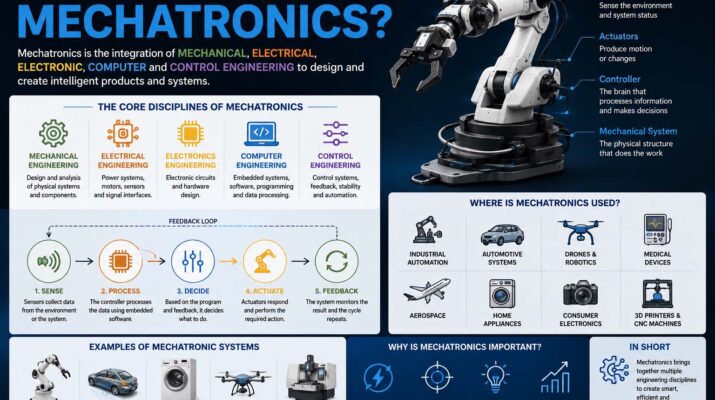
What is mechatronics? It is a technology and engineering field that combines mechanical engineering, electronics, programming, control systems, and automation. As a result, engineers can build smart machines that sense, think, and move on their own.
Instead of designing the mechanical, electrical, and software parts separately, mechatronics brings them together as one system.
You can see mechatronics in industrial robots, automated production lines, drones, and smart appliances. In addition, it appears in car systems, medical equipment, warehouse automation, and computer-controlled machines.
Automation is growing in almost every industry. Therefore, learning mechatronics helps students and beginners see how modern smart machines really work.
What Is Mechatronics?
Mechatronics combines several engineering and technology fields to design machines that can sense information, process it, and respond automatically.
The main areas are mechanical engineering, electrical and electronic engineering, and computer programming. Besides these, it also includes control systems, sensors, actuators, embedded systems, and automation.
A simple automated machine shows the basic idea. First, a sensor detects something in the environment. Next, a controller processes that information using programmed instructions. Finally, a motor or actuator performs the needed physical action.
In short, this mix of sensing, computing, control, and movement is the heart of mechatronics.
Understanding the Technology
Mechatronics technology means the practical tools used to join mechanical equipment with electronics, software, sensors, controllers, and automation.
For example, think about an automated factory conveyor. The conveyor itself is mechanical. Meanwhile, sensors detect products moving along the line.
A programmable controller reads the sensor data, while software decides what should happen next. Then, motors and actuators move, sort, stop, or redirect the products. As a result, all these technologies work together as one system.
For a detailed academic overview, see the University of Waterloo’s Mechatronics Engineering program. It explains how mechanical, electrical, computer, and systems design come together.
How Does the System Work?
A mechatronics system usually works through a continuous cycle:
Sense → Process → Decide → Act → Monitor
Once you understand this cycle, complicated automated machines become much easier to follow.
1. Sensors Collect Information
Sensors measure physical conditions. For instance, they may detect temperature, pressure, position, or distance. Similarly, other sensors track speed, motion, light, or force.
After that, the sensor turns this physical information into a signal the control system can process.
2. Controllers Process the Information
Next, the information reaches a controller. Depending on the machine, this could be a microcontroller or a programmable logic controller (PLC). Alternatively, it may be an embedded computer, an industrial computer, or an electronic control unit.
The controller then checks the incoming information against its programmed instructions.
3. Software Determines the Response
Software provides the logic behind the machine’s behavior. For example, a program might tell an industrial robot to stop when a safety sensor detects a person nearby.
Because of this, learning basic coding concepts can help beginners see how software controls automated equipment.
4. Actuators Create Physical Movement
Once the controller decides what should happen, an actuator turns the command into physical action. Electric motors, hydraulic cylinders, and pneumatic devices are common examples.
Our guide explaining what is an actuator covers this part in more detail. In addition, some machines use electromagnetic devices. Likewise, learning what is a solenoid shows how an electrical signal can create controlled movement.
5. The System Monitors the Result
However, the process does not always stop after an action. Sensors can keep measuring the result and send new information back to the controller.
Consequently, this feedback lets the system make corrections and keep working as intended.
Main Parts of the System
Although systems vary a lot, most mechatronics machines share several common parts.
Mechanical Components
These are the physical parts of the machine. For example, they include gears, shafts, bearings, and frames. Belts, pulleys, and robotic arms are also mechanical components.
Sensors
Sensors allow the system to detect its environment. In addition, they help it monitor its own operation.
Controllers
Controllers process information. Then, they carry out programmed instructions.
Actuators
Actuators create movement or another physical response. In other words, they are the muscles of the machine.
Electronics
Electronic circuits connect sensors, controllers, and output devices. At the same time, they manage the electrical signals between them.
Software
Software defines how the system should respond. As a result, the same machine can react differently under different conditions.
Communication Systems
Advanced machines may share information with other controllers, computers, networks, or cloud platforms. Together, all these parts allow a machine to perform tasks automatically.
Real-World Examples
Mechatronics may sound specialized. However, you can find examples all around you.
Industrial Robots
An industrial robotic arm combines mechanical joints, electric motors, sensors, controllers, and software. While sensors monitor position, the controller coordinates each movement.
Automated Manufacturing Lines
Modern factories use sensors, conveyors, motors, robots, controllers, and software to coordinate production. Moreover, these factories rely on measurement and control.
For this reason, learning what is instrumentation helps explain how factories measure pressure, temperature, level, and flow.
Modern Vehicles
Cars contain many electromechanical systems. For example, they use electronic braking, engine control, and adaptive suspension. Electric power steering, driver-assistance features, and automatic transmission controls are also common.
In each case, mechanical parts work together with electronics, sensors, and software.
Drones
A drone is another clear example of mechatronics. Specifically, it combines motors, propellers, sensors, speed controllers, batteries, radio links, and flight-control software.
Medical Equipment
Some medical technologies combine precise mechanical movement with electronics and computer control. For instance, robotic surgical tools, automated lab machines, and some rehabilitation devices all use mechatronics.
Smart Appliances
Modern washing machines and robot vacuum cleaners use sensors and programmed controllers. As a result, they can adjust their operation automatically.
Mechatronics vs Robotics
Mechatronics and robotics are related, but they are not identical.
In fact, mechatronics is the broader field that joins mechanics, electronics, control systems, and software. In contrast, robotics focuses only on designing and controlling robots.
A robot is therefore a great example of a mechatronic system. However, mechatronics is not limited to robots. Production equipment, vehicle controls, smart appliances, and computer-controlled machines also use it.
Mechatronics vs Mechanical Engineering
Mechanical engineering mainly focuses on physical systems. For example, it covers machines, motion, forces, materials, heat, and mechanical design.
Mechatronics adds electronics, sensors, programming, and embedded controllers. In addition, it brings in automation and control engineering.
Although the two fields overlap, mechatronics focuses more on building complete smart machines.
Mechatronics vs Electrical Engineering
Electrical engineering focuses on electrical and electronic systems. On the other hand, mechatronics uses these ideas together with mechanical design and software control.
Therefore, a mechatronics professional must understand how different fields work together. Also, students comparing tech careers may find our computer engineering vs computer science guide useful.
What Does a Mechatronics Engineer Do?
A mechatronics engineer works with systems that combine mechanical, electrical, electronic, and software parts.
For example, they may design automated equipment, develop robots, and program controllers. In addition, they often choose sensors and actuators and design control systems. Testing prototypes, fixing machines, and improving factory processes are also part of the job.
Because the field covers many areas, these engineers often work with mechanical engineers, electrical engineers, software developers, and technicians.
What Does a Mechatronics Technician Do?
A mechatronics technician usually focuses on hands-on work. For instance, they install, test, troubleshoot, and maintain machines.
Typical tasks include installing automation equipment, inspecting machines, and testing sensors. Furthermore, technicians maintain robots, find electrical problems, and fix controllers. They also replace faulty parts and support production equipment.
However, the exact difference between an engineer and a technician depends on the employer, country, and job role.
Industries That Use Mechatronics
Mechatronics technology is used in many industries.
Manufacturing
Automated factories use robots, sensors, PLCs, and machine-vision cameras. In addition, they rely on conveyors and computer-controlled production machines.
Automotive
Car makers use mechatronics in their factories. Likewise, they use it inside the vehicles they build.
Aerospace
Aircraft use advanced control, sensing, and electronic systems. As a result, many flight functions depend on mechatronics.
Healthcare
Medical device makers combine mechanical and electronic technology. For example, they use it in diagnostic, lab, rehabilitation, and surgical systems.
Agriculture
Modern farm equipment can use GPS, sensors, and automatic steering. Moreover, it often includes computer control and precision machinery.
Logistics and Warehousing
Automated warehouses use conveyors, sorting machines, and mobile robots. Also, they rely on scanners, sensors, and computer control systems.
Skills Needed for Mechatronics
Because mechatronics combines several fields, students need a broad technical base.
Important skills include mathematics, mechanical design, electronics, and programming. In addition, control systems, robotics, and computer-aided design are very useful. Troubleshooting, sensors, actuators, and communication protocols also matter.
Fortunately, you do not need to master every area before you start. Instead, most students build these skills step by step through study, projects, and practice.
Programming in Mechatronics
Programming is an important part of many mechatronics jobs. For example, professionals may use C, C++, or Python. Similarly, they may work with PLC languages, embedded code, or MATLAB.
However, the exact language matters less for beginners. Above all, focus on logic, variables, conditions, loops, inputs, and outputs.
Sensors and Instrumentation in Mechatronics
Sensors are essential because a smart machine needs information before it can respond.
For example, a system may need to know where an object is or how fast a motor spins. Similarly, it may need to know if a door is closed. It may also check how hot a part is or how much pressure is in a system.
Instrumentation and sensing give this information to the controller. Without reliable measurements, automated control becomes much harder.
Control Systems and Feedback
Control engineering is another key part of mechatronics technology. A basic control system receives an input, processes it, and controls an output. However, more advanced systems use feedback.
For example, imagine a motor that must hold a set speed. A sensor keeps measuring its actual speed. Then, the controller compares that reading with the target and adjusts the motor when needed.
As a result, this feedback loop keeps machines accurate even when conditions change.
Advantages of Mechatronics
Combining several technologies brings many benefits.
Greater Automation
Machines can repeat tasks with little human help. Therefore, workers can focus on more skilled jobs.
High Precision
Sensors and electronic control help machines work very accurately. Consequently, products come out more consistent.
Flexible Operation
Software-controlled equipment can often be reprogrammed. As a result, one machine can handle different tasks.
Better Monitoring
Sensors give constant updates about machine operation. Thus, problems can be spotted early.
Improved Productivity
When used correctly, automation can raise production speed and consistency.
Challenges of Mechatronics
However, mixing so many fields also creates challenges.
System Complexity
One problem may involve hardware, electronics, software, or communication. In fact, it can involve several of these at once.
Troubleshooting Difficulty
Finding a fault can require knowledge of many fields. Because of this, repairs may take longer.
Continuous Learning
Technology changes quickly. Therefore, professionals must keep building their skills.
Initial Cost
Advanced automation equipment can be expensive. In particular, hardware, software, installation, and training all add to the cost.
Common Mechatronics Problems
Good troubleshooting looks at the whole system. In other words, do not assume every failure has just one cause.
Sensor Problems
Sensor faults can come from bad wiring or wrong calibration. In addition, dirt, physical damage, and communication errors can cause trouble.
Motor or Actuator Problems
Motors and actuators can fail because of electrical faults or mechanical wear. Likewise, heavy loads, control errors, and power supply issues can stop them.
Software Problems
Wrong logic or setup errors can affect how a machine runs. Similarly, corrupted data or failed communication can cause problems.
Controller Communication Problems
Industrial equipment often depends on many devices talking to each other. Therefore, a damaged cable, wrong setting, network fault, or failed part can break that link.
How to Start Learning Mechatronics
Beginners can build their knowledge slowly over time.
Start With Basic Electronics
First, learn about voltage, current, resistance, and circuits. After that, study switches, motors, and sensors.
Learn Basic Programming
Programming teaches you how machines make logical decisions. As a result, you will understand how controllers think.
Study Mechanical Principles
Learn about forces, motion, gears, and mechanisms. In addition, study basic machine design.
Experiment With Microcontrollers
Learning boards let beginners combine sensors, software, and motors. Consequently, you can turn ideas into working projects.
Build Simple Automation Projects
For example, a small project that reads a sensor and controls a motor shows the full mechatronics cycle.
Practice Troubleshooting
Instead of only building systems, learn to find out why they fail. This is because real-world automation mixes mechanical, electrical, and software problems.
Mechatronics Career Opportunities
Mechatronics knowledge supports careers in automation, manufacturing, robotics, control systems, and maintenance.
For example, you could work as a mechatronics engineer or technician. Similarly, automation engineer, automation technician, and robotics engineer are common job titles. Control systems engineer, maintenance technician, manufacturing engineer, and embedded systems engineer are also options.
However, job titles and required qualifications vary between employers and countries.
Frequently Asked Questions
What is mechatronics in simple words?
Mechatronics combines mechanical engineering, electronics, software, and control technology. As a result, it creates smart or automated machines.
What is mechatronics technology?
Mechatronics technology uses mechanical parts, electronics, sensors, controllers, software, and automation together in one system.
What does a mechatronics engineer do?
A mechatronics engineer designs, programs, tests, and improves systems. Specifically, these systems combine mechanical equipment with electronics and software.
Is mechatronics the same as robotics?
No. Robotics is closely related, but mechatronics is broader. For example, robots are mechatronic systems, but many automated machines are not robots.
Does mechatronics require coding?
Programming is important in many roles because controllers need software instructions. However, the amount of coding depends on the job.
Is mechatronics mechanical or electrical engineering?
It includes parts of both. In addition, mechatronics covers programming, control engineering, sensors, automation, and embedded systems.
What are examples of mechatronics?
Common examples include industrial robots, drones, and automated factory machines. Smart appliances, vehicle control systems, and some medical devices are also good examples.
Conclusion
So, what is mechatronics? It brings mechanical engineering, electronics, software, sensors, control systems, and automation together to create smart machines.
To sum up, the easiest way to understand the field is to remember its basic process:
Sense → Process → Decide → Act → Monitor.
From factory robots to drones and smart cars, mechatronics plays an important role in modern automation. Finally, learning the basics of mechanics, electronics, programming, sensors, and control gives beginners a strong foundation in this exciting field.