
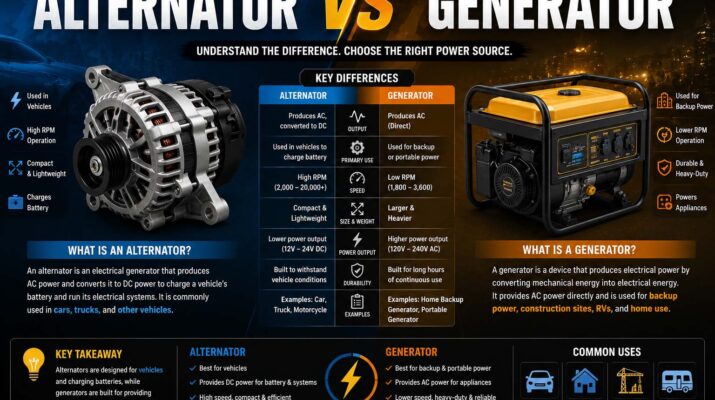
The alternator vs generator comparison often confuses beginners because both devices convert mechanical energy into electrical energy. However, they differ in design, electrical output, and practical applications.
An alternator is a type of electrical generator that produces alternating current (AC). In conventional vehicles, rectifier diodes convert this electricity into direct current (DC) to charge the battery and power electrical components.
A generator is a broader term for equipment that converts mechanical energy into electricity. For example, portable and standby generator sets provide power during outages, construction projects, and industrial operations.
Understanding these differences helps you identify electrical equipment, troubleshoot charging problems, and choose the right power solution.
If you’re new to electrical systems, understanding series vs parallel is also helpful. These circuit arrangements explain how current flows through connected components and why electrical devices behave differently.
Alternator vs Generator: Quick Comparison
Although the terms overlap technically, people commonly use alternator for a vehicle’s charging device and generator for standalone power equipment.
| Feature | Automotive Alternator | Standalone Generator |
|---|---|---|
| Main purpose | Charge vehicle battery and power electronics | Supply independent electricity |
| Electrical output | AC internally, converted to DC | Usually AC, depending on design |
| Power source | Vehicle engine | Engine, turbine, or another mechanical source |
| Battery charging | Primary function | Possible with suitable charging equipment |
| Maintenance | Usually relatively low | Depends on engine and generator design |
| Size | Compact automotive component | Varies from portable to industrial |
| Common applications | Cars, trucks, and conventional vehicles | Homes, construction sites, and businesses |
| Operating conditions | Requires a suitable mechanical drive | Requires a mechanical energy source |
Therefore, the most useful comparison focuses on how each machine delivers electricity and where people use it.
What Is an Alternator and How Does It Work?
An alternator is an electrical machine that generates alternating current through electromagnetic induction.
In conventional gasoline and diesel vehicles, the engine usually drives the alternator through a belt. As the engine runs, the alternator supplies electricity to the vehicle’s electrical system.
Its main functions include:
- Charging the vehicle battery.
- Powering headlights and electronic accessories.
- Supporting ignition and control systems.
- Maintaining suitable charging voltage.
For example, when you drive at night, the alternator helps supply electricity to the headlights, dashboard, and other accessories.
Meanwhile, the battery provides stored energy when the engine is not running.
Without a working charging system, the battery gradually loses its charge. Consequently, the vehicle may eventually stall or fail to restart.
However, battery-electric vehicles generally use different electrical architectures and do not need conventional engine-driven alternators.
What Is an Electrical Generator?
A generator converts mechanical energy into electrical energy. Unlike the everyday automotive meaning of alternator, the word generator describes a broad category of electrical machines.
Common examples include:
- Portable generators.
- Standby home generators.
- Industrial generators.
- Diesel-powered generators.
- Gasoline-powered generators.
- Wind turbine generators.
- Hydroelectric generators.
For instance, a portable generator can supply electricity to selected appliances during a power outage.
Similarly, an industrial generator can provide emergency power for essential equipment.
A complete generator set usually includes an engine, electrical generator, controls, and supporting components.
As a result, it can provide electricity independently of the power grid when it has a suitable energy source.
How Do Alternators and Generators Produce Electricity?
Both machines rely on electromagnetic induction. When a magnetic field changes relative to a conductor, it induces electrical voltage.
However, their internal arrangements and output systems vary.
How Does an Alternator Work?
An automotive alternator produces electricity through a rotating magnetic field and stationary windings.
The process follows several steps:
- Engine rotation: First, the engine turns a belt connected to the alternator pulley.
- Rotor movement: Next, the pulley rotates the alternator’s rotor.
- Magnetic induction: As the rotor spins, its magnetic field moves relative to the stator windings.
- AC production: Consequently, the stator generates alternating current.
- Rectification: Then, rectifier diodes convert AC into DC.
- Electrical supply: Finally, the charging system powers vehicle electronics and replenishes the battery.
In addition, a voltage regulator controls the electrical output.
Therefore, the alternator helps maintain the vehicle’s electrical supply while the engine runs.
How Does a Generator Work?
A generator also uses mechanical rotation and electromagnetic induction.
For example, an engine-driven generator set generally operates as follows:
- First, the engine produces mechanical power.
- Next, the engine rotates the generator’s shaft.
- As the rotor turns, electromagnetic induction generates electrical voltage.
- Then, the output system regulates or conditions the electricity as required.
- Finally, connected appliances or equipment receive electrical power.
Most household portable generators supply AC. However, other generator designs can produce DC or use electronic conversion systems.
For a broader explanation of electricity production, the U.S. Energy Information Administration’s guide to electricity generation explains how mechanical energy drives electrical generators.
The relationship between electricity and magnetism also appears in other devices. For example, learning what is a solenoid helps explain how an energized coil creates a magnetic field that can produce mechanical movement.
Alternator vs Generator: Main Differences
The biggest practical difference involves electrical output, intended use, and equipment design.
However, an alternator is technically a type of generator. Therefore, comparisons should distinguish automotive alternators from traditional DC generators or complete standalone generator sets.
Alternator vs Generator Electrical Output: AC vs DC
An alternator produces AC internally.
However, an automotive rectifier converts that electricity into DC before it reaches the battery and vehicle electrical system.
Generators may produce AC or DC depending on their construction.
For example, traditional automotive DC generators use commutators to deliver DC output.
In contrast, most modern portable generator sets produce AC for household appliances.
Electrical output also depends on the number of phases. Understanding single phase vs three phase helps explain how alternating current is supplied to homes, commercial buildings, and industrial machinery.
Alternator and Generator Efficiency
Modern automotive alternators generally offer practical efficiency advantages over older automotive DC generators.
For example, they can provide useful charging output across a broad range of engine speeds.
However, efficiency varies according to machine design, operating speed, and electrical load.
A complete portable generator also consumes fuel to drive its electrical machine. Therefore, comparing its overall fuel efficiency directly with an automotive alternator would not be meaningful.
Alternator and Generator Maintenance Requirements
Automotive alternators generally require less commutator-related maintenance than traditional DC generators.
This is because conventional alternators use slip rings rather than large commutator assemblies.
Nevertheless, alternator bearings, brushes in applicable designs, voltage regulators, and electrical connections can still wear or fail.
Standalone generator sets also need engine servicing. Consequently, maintenance may include oil changes, filter replacements, and fuel-system inspections.
Alternator vs Generator Size and Weight
Automotive alternators are relatively compact because manufacturers design them for limited engine space.
Meanwhile, portable generator sets contain additional components, including engines, frames, fuel systems, and controls.
As a result, complete generator sets are usually larger and heavier than individual automotive alternators.
However, their larger size reflects their different functions.
Car Generator vs Alternator: Older and Modern Vehicles
The car generator vs alternator comparison is especially relevant to automotive history.
Older vehicles often used DC generators. However, manufacturers gradually adopted alternators as electrical demands increased.
Older Vehicles With DC Generators
Traditional automotive generators commonly used brushes and commutators.
These systems generally:
- Produced relatively limited output at low engine speeds.
- Required periodic maintenance.
- Supported simpler electrical systems.
- Used mechanical or electromechanical regulation.
For example, many vintage vehicles had fewer electrical accessories than modern cars.
Therefore, their charging requirements were usually lower.
Modern Vehicles With Alternators
Modern conventional passenger vehicles generally use alternators.
Their advantages include:
- Better charging performance at low speeds in many designs.
- Compact construction.
- Electronic voltage regulation.
- Support for modern electrical accessories.
- Reduced commutator-related maintenance.
In addition, some vehicles use advanced charging controls to manage electrical demand.
As a result, the charging system can respond to changing operating conditions.
Why Modern Cars Use Alternators
Modern vehicles require electricity for numerous components.
For example, these include:
- Infotainment systems.
- Headlights and interior lighting.
- Electronic control modules.
- Heated seats.
- Cameras.
- Driver-assistance systems.
Therefore, manufacturers need charging systems that can support varying electrical loads.
Alternators provide an effective solution for conventional combustion-engine vehicles.
Advantages of Alternators
Automotive alternators offer several benefits.
Alternator Battery Charging Benefits
An alternator helps replenish battery energy while the engine runs.
As a result, the battery remains available for starting and other electrical needs.
However, charging performance depends on engine speed, electrical demand, and system condition.
Compact Alternator Design
Alternators fit into relatively small engine compartments.
Therefore, manufacturers can integrate them into different vehicle layouts.
Alternator Maintenance Advantages
Compared with traditional automotive DC generators, alternators avoid large commutator assemblies.
Consequently, they generally need less routine attention to those components.
Alternator Benefits for Modern Vehicles
Modern vehicles depend on a steady electrical supply.
For example, alternators help power lighting, control modules, and other accessories while the engine operates.
Advantages of Electrical Generators
Standalone generator sets remain valuable because they provide electricity independently of the grid.
Portable Power
Portable generators can support selected electrical equipment during:
- Power outages.
- Camping trips.
- Construction projects.
- Outdoor events.
For example, a properly sized unit can operate suitable tools or appliances when grid power is unavailable.
Generator Power for Off-Grid Use
Generator sets can operate wherever an appropriate energy source is available.
Therefore, they are useful in remote locations and temporary work environments.
However, fuel-powered models require fuel, safe ventilation, and regular maintenance.
Industrial Generator Power Capacity
Industrial generators can supply substantial electrical output.
Common applications include:
- Factories.
- Hospitals.
- Data centers.
- Emergency facilities.
In addition, large power stations use generators driven by turbines.
Electricity from these facilities travels through transmission networks. If you’ve noticed colored spheres attached to overhead wires, our guide explaining why are there balls on power lines describes how these markers help pilots identify potentially dangerous obstacles.
Alternator Disadvantages and Limitations
Despite their benefits, automotive alternators have limitations.
Common drawbacks include:
- Dependence on a mechanical drive.
- Inability to provide independent household backup power in a normal vehicle installation.
- Bearing and electrical component wear.
- Possible voltage regulator failure.
- Potential drive-belt problems.
For example, a damaged drive belt may prevent the alternator from charging the battery properly.
Consequently, the vehicle may operate on stored battery energy until the charge becomes insufficient.
Generator Disadvantages and Limitations
Standalone generators also have limitations.
Depending on their design, drawbacks may include:
- Fuel consumption.
- Engine noise.
- Exhaust emissions.
- Regular servicing.
- Storage requirements.
- Limited operation between refueling.
For example, gasoline-powered portable generators require sufficient fuel and periodic maintenance.
More seriously, fuel-powered generators produce carbon monoxide.
Therefore, never operate a portable fuel-powered generator inside a home, garage, or other enclosed space. Follow the manufacturer’s instructions for safe outdoor placement away from openings.
Alternator vs Generator Diagram: Electricity Flow
A simplified diagram helps explain how mechanical energy becomes electrical energy.
Alternator Diagram and Electrical Flow
Engine → Drive Belt → Rotor → Magnetic Field → Stator AC Output → Rectifier Diodes → DC Electrical System → Battery and Accessories
First, the engine supplies mechanical rotation. Next, electromagnetic induction produces AC.
Then, rectifier diodes convert the output into DC.
As a result, the electrical system can charge the battery and power vehicle components.
Standalone Generator Diagram
Engine or Turbine → Rotating Shaft → Electrical Generator → Output Regulation and Protection → Connected Electrical Loads
Although the mechanical process is similar, the output arrangement depends on generator design.
For example, a household generator normally supplies AC directly through its output system.
How RPM Affects Alternator and Generator Output
Rotational speed influences how many times a generator’s magnetic field changes relative to its windings.
Therefore, generator designs must account for speed when controlling voltage and frequency.
If you’re unfamiliar with engine-speed measurements, learning what is rpm helps explain revolutions per minute and how rotating machinery operates.
In addition, automotive alternators use voltage regulation to help maintain suitable output as engine speed changes.
Common Signs of Alternator Problems
A failing alternator can produce several symptoms.
For example, drivers may notice:
- Battery warning lights.
- Dim headlights.
- Flickering dashboard lights.
- Weak battery charging.
- Electrical accessories malfunctioning.
- Difficulty starting after the battery loses charge.
However, these symptoms do not always indicate alternator failure.
Battery problems, damaged wiring, or loose electrical connections can cause similar issues.
How to Check an Alternator
First, inspect the drive belt and battery terminals for visible problems.
Next, a technician may use a multimeter to measure battery voltage with the engine off and running.
In many conventional 12-volt systems, charging voltage is often around 13.5–14.8 volts. However, modern smart charging systems may operate outside this range under certain conditions.
Therefore, compare measurements with the vehicle manufacturer’s specifications.
If the cause remains unclear, professional charging-system testing can identify the problem.
Common Generator Problems and Troubleshooting
Standalone generators can experience mechanical and electrical faults.
Common problems include:
- Difficulty starting.
- Low output voltage.
- Fuel delivery problems.
- Dirty spark plugs.
- Worn electrical components.
- Overloaded circuits.
- Unexpected shutdowns.
For example, connecting equipment that exceeds the generator’s rated capacity can cause overload protection to activate.
Therefore, check both running and starting power requirements before connecting appliances.
In addition, regular maintenance helps reduce preventable failures.
Maintenance Tips for Alternators and Generators
Proper maintenance improves reliability and may extend equipment life.
However, the correct schedule depends on the manufacturer’s recommendations.
Alternator Maintenance
For automotive alternators:
- Inspect the drive belt.
- Check battery terminals.
- Keep electrical connections clean.
- Listen for unusual bearing noises.
- Investigate charging warnings promptly.
In addition, inspect related charging-system components when diagnosing electrical problems.
Generator Maintenance
For engine-driven generators:
- Change engine oil as recommended.
- Inspect air filters.
- Check fuel-system components.
- Test the equipment periodically.
- Inspect electrical outlets and connections.
- Follow fuel-storage recommendations.
Before servicing a generator, shut it down and allow hot components to cool.
Also, never connect a portable generator directly to household wiring without an approved transfer arrangement installed by a qualified professional.
Alternator vs Generator: Which Is Better?
Neither machine is universally better.
Instead, the right choice depends on your intended application.
Choose an Alternator for Vehicle Charging
An automotive alternator is suitable when you need:
- Reliable battery charging.
- Electrical power for vehicle accessories.
- Compact installation.
- Compatibility with a conventional vehicle charging system.
However, replacement alternators must match the vehicle’s electrical and mechanical specifications.
Choose a Generator for Independent Power
A standalone generator set is suitable when you need:
- Emergency backup electricity.
- Portable power.
- Temporary construction-site electricity.
- Off-grid operation.
Before buying one, calculate the electrical requirements of the equipment you intend to operate.
Then, choose a model with suitable output capacity, safety features, and connections.
Real-World Alternator and Generator Applications
Understanding practical examples makes the differences easier to remember.
Passenger Cars
Conventional passenger cars use alternators to charge their batteries and power electrical systems.
As a result, the battery does not need to supply all electrical loads while the engine runs.
Generators for Emergency Home Backup
A home may use a portable or standby generator during a power outage.
For example, a properly installed standby system can support selected circuits when utility electricity becomes unavailable.
Portable Generators for Construction Sites
Construction workers often use portable generators where permanent electrical service is unavailable.
Therefore, they can operate suitable tools and temporary lighting.
Standby Generators for Hospitals
Hospitals may use large standby generators to support designated emergency electrical loads.
However, these systems require appropriate installation, testing, and maintenance.
Frequently Asked Questions About Alternators and Generators
What Is the Difference Between Alternator vs Generator?
An alternator is a type of generator that produces AC.
However, in everyday automotive discussions, an alternator usually refers to the device that charges a vehicle battery.
Meanwhile, a generator often refers to standalone equipment that supplies electricity to external loads.
Which Is Better, Generator vs Alternator?
Neither is better for every application.
For example, an automotive alternator is designed for vehicle charging. In contrast, a standalone generator set is suitable for backup and portable electricity.
What Is the Difference Between Car Generator vs Alternator?
Older vehicles often used DC generators with commutators.
However, modern conventional vehicles generally use alternators with rectifiers and electronic voltage regulation.
As a result, they can better support modern electrical demands.
Can an Alternator Replace a Generator?
Not as a direct replacement in most practical situations.
An alternator can generate electricity when an appropriate mechanical source drives it. However, a standalone power system also needs suitable regulation, protection, and supporting equipment.
Therefore, converting one system into another requires additional components and engineering.
What Does an Alternator vs Generator Diagram Show?
A diagram illustrates how mechanical energy becomes electrical energy.
For example, an automotive alternator diagram shows the rotor, stator, rectifier, and battery connections.
Meanwhile, a standalone generator diagram shows its mechanical drive and electrical output arrangement.
Why Do Modern Cars Use Alternators Instead of Generators?
Modern conventional cars use alternators because they provide practical charging performance, compact construction, and relatively low maintenance compared with traditional automotive DC generators.
In addition, their output supports modern vehicle electronics.
Choosing the Right Power Solution
Understanding alternator vs generator becomes easier once you recognize that an alternator is technically a type of electrical generator.
In everyday use, however, people usually compare automotive alternators with standalone generator sets.
An automotive alternator charges the vehicle battery and supplies electricity while the engine operates. In contrast, a standalone generator provides independent power for homes, businesses, construction sites, and other applications.
Although both rely on electromagnetic induction, their designs and intended uses differ.
Therefore, choosing the right equipment depends on whether you need reliable vehicle charging or an independent source of electrical power.