
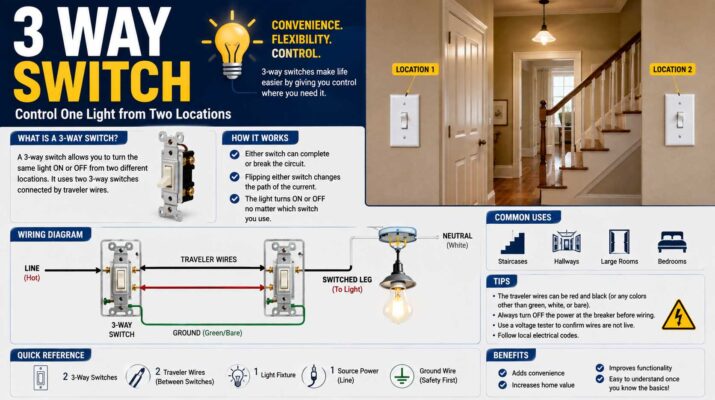
A 3 way switch lets you control the same light or electrical load from two different locations. You commonly find this setup at opposite ends of a hallway, at the top and bottom of a staircase, or near two entrances to a large room. Although it looks similar to a standard wall switch from the front, its internal connections work differently. Therefore, understanding the terminals and traveler wires matters before troubleshooting or replacing one.
Despite the name, a 3-way switch does not mean there are three switches. Instead, two 3-way switches work together to control one load from two locations. If you need control from three or more locations, the circuit normally adds one or more 4-way switches between the two 3-way switches.
Because household wiring can cause serious shock, burns, or fire, electrical work should follow local electrical codes. If you cannot confidently identify the conductors or verify that power is off, use a qualified electrician.
What Is a 3 Way Switch?
A 3-way switch is a type of electrical switch with three current-carrying terminals: one common terminal and two traveler terminals. It normally also has a grounding terminal.
Unlike a basic single-pole switch, it does not simply turn one connection on or off. Instead, the switch directs the common terminal to one of two traveler terminals.
The second 3-way switch does the same thing at the other end of the circuit. As a result, changing either switch position can change whether the electrical path to the light is complete.
This arrangement is easier to understand once you know the difference between series vs parallel circuit concepts. However, a 3-way lighting circuit should not be treated as a simple textbook series circuit because the switches select between alternative traveler paths.
How Does a 3 Way Switch Work?
Inside each 3-way switch, the common terminal connects to one traveler terminal at a time.
Imagine two paths running between the switches. When both switches select a path that completes the route through the circuit, the light receives power. Flip either switch, and its internal connection moves to the other traveler.
Depending on the position of the second switch, that action either completes or interrupts the path.
Therefore, there is no fixed “ON” or “OFF” position for a traditional 3-way wall switch. A switch pointing upward may correspond to the light being on at one moment and off at another.
That behavior is completely normal.
3 Way Switch Wiring: Understanding the Connections
Correct 3 way switch wiring depends on identifying the function of each conductor rather than relying only on insulation color.
A typical 3-way setup involves several key connections.
Common Terminal
The common terminal is usually visually different from the two traveler terminals. For example, many switches use a darker screw for the common connection.
Depending on where the switch sits in the circuit, the common conductor may connect to the incoming line supply or to the conductor leading toward the light.
This distinction makes the common wire especially significant when replacing an existing switch.
Traveler Terminals
Two traveler conductors connect the pair of 3-way switches.
Each switch alternates its common terminal between these two travelers. Therefore, both travelers are necessary for conventional 3-way operation.
Different types of cables may be used depending on the wiring layout, building method, electrical code, and installation age. For that reason, conductor colors should not be your only method of identification.
Ground Connection
Modern installations normally include an equipment-grounding path, and the switch should be grounded as required by the applicable electrical code and device instructions.
Older homes may have wiring configurations that differ significantly from modern installations. Therefore, do not assume an old electrical box contains the same conductors as a current installation.
Reading a 3 Way Switch Wiring Diagram
A 3 way switch wiring diagram becomes much easier to understand when you follow the electrical functions instead of trying to memorize wire colors.
At a conceptual level, the circuit looks like this:
Power source → Common terminal on Switch 1 → Traveler path → Switch 2 → Common terminal → Light → Neutral return
Two traveler conductors run between the switches, giving the switches alternative paths.
However, real installations can route the supply, load, and cables in different ways. For example, power may enter a switch box in one installation while another layout may place the light fixture at a different point in the cable route.
Therefore, a generic diagram should never be treated as proof of how an existing home is wired.
3 Way Switch Diagram vs. Single-Pole Switch
A standard single-pole switch and a 3-way switch can look almost identical after installation. Once removed from the box, however, the terminal arrangement reveals the difference.
| Feature | Single-Pole Switch | 3-Way Switch |
|---|---|---|
| Control locations | One | Two |
| Current-carrying terminals | Typically two | Three |
| Traveler terminals | No | Two |
| Common terminal | Not used in the same way | Yes |
| Fixed ON/OFF markings | Often possible | Usually absent |
| Typical use | Bedroom or closet | Hallway or staircase |
A normal single-pole switch simply opens or closes a controlled path. By comparison, a 3-way switch selects between two traveler paths.
That is why substituting one switch type for the other will not provide correct 3-way operation.
Where Are 3 Way Switches Commonly Used?
The design is useful anywhere reaching one switch location every time would be inconvenient.
Staircases are a classic example. One switch can sit at the bottom while another sits at the top, so users can control the light before entering or leaving the stairs.
Hallways work similarly. Meanwhile, large rooms may have switches beside two separate doors.
Garages, basements, and rooms with multiple entrances can also benefit from two-location control.
Modern smart-home products can provide similar functionality through electronic controls, wireless companion switches, or networked devices. However, their wiring requirements can differ from traditional mechanical 3-way circuits.
How to Wire a 3 Way Switch Safely
People often search how to wire a 3 way switch when replacing an existing device. Yet the safest approach starts with identification rather than immediately moving wires.
Before working on household wiring, switch off the correct circuit breaker and verify that the circuit is de-energized using appropriate test equipment. Do not rely solely on the switch position.
The U.S. Consumer Product Safety Commission electrical safety guidance provides additional information about recognizing and reducing electrical hazards in the home.
If you are replacing an existing 3-way switch, document the original connections before disconnecting anything. In particular, identify the conductor connected to the common terminal.
That wire should not be confused with the travelers.
Then, use a replacement device rated and approved for the application and follow its manufacturer’s instructions as well as local electrical requirements.
Because electrical configurations vary, a written online guide cannot safely identify unknown conductors inside your wall. If the wiring does not match what you expect, stop and have an electrician identify the circuit.
The distinction between single phase vs three phase electrical power can also cause confusion for beginners. Residential 3-way switching gets its name from the switch arrangement, not from three-phase electrical power; the two concepts are unrelated.
Common 3 Way Switch Wiring Mistakes
A wiring mistake may cause the light to work from only one location, operate only when another switch is in a certain position, or stop working entirely.
Mixing Up the Common and Traveler Wires
Because the common terminal has a different role from the traveler terminals, moving its conductor to a traveler terminal can prevent normal operation.
Therefore, mark or photograph the common connection before removing the old switch.
Assuming Wire Color Always Reveals Function
Modern electrical standards use familiar color conventions, but existing homes may contain older wiring, altered circuits, reidentified conductors, or nonstandard work.
Consequently, never assume a wire’s function based solely on color.
Using the Wrong Type of Switch
A single-pole switch cannot directly replace a mechanical 3-way switch while maintaining two-location control.
Similarly, smart switches can have requirements that mechanical devices do not, such as a neutral conductor, specific companion switch, or particular line/load arrangement.
Loose Connections
A loose terminal connection can produce intermittent operation and may create overheating or arcing.
If a switch feels unusually warm, makes crackling noises, smells burnt, sparks, or shows discoloration, stop using the affected circuit and have it inspected promptly.
Troubleshooting a 3 Way Switch
When a previously working 3-way circuit fails, first determine whether the problem affects only the switch arrangement or the entire circuit.
For instance, check whether the breaker has tripped and whether other lights or receptacles on the same branch circuit still work.
Next, consider the light source itself. A failed bulb or fixture can make a perfectly functional switching circuit appear broken.
If the problem began immediately after someone replaced a switch, an incorrect common connection becomes a likely possibility.
A useful symptom guide looks like this:
| Symptom | Possible Cause |
|---|---|
| Light never works | Power issue, failed bulb, faulty switch, loose connection |
| Works from only one switch | Incorrect connection or faulty switch |
| Works only in certain switch combinations | Common/traveler wiring error |
| Flickers when switch is moved | Worn switch or loose connection |
| Switch is hot or smells burnt | Possible electrical fault requiring prompt inspection |
| Breaker repeatedly trips | Short circuit, wiring fault, overload, or another circuit problem |
Repeated tripping indicates a problem that should be identified rather than bypassed.
Can You Use a Smart Switch in a 3 Way Circuit?
Yes, many smart switches support multi-location control, although compatibility varies considerably.
Some smart switches require a neutral conductor. Others use a dedicated companion or auxiliary switch at the second location. Meanwhile, certain systems communicate wirelessly between controls.
Therefore, check the manufacturer’s wiring requirements before buying the device.
Older electrical boxes may lack the neutral conductor required by some smart switches. Box depth can also become an issue because electronic switches are often bulkier than mechanical devices.
A what is a voltage converter guide may be useful for understanding voltage conversion in electronics, but a voltage converter is not a substitute for a compatible smart switch or correct household wiring.
When Should You Call an Electrician?
Replacing a switch may look simple, but electrical troubleshooting becomes more complicated when the existing wiring is unidentified, damaged, or modified.
Call a qualified electrician when you find burnt insulation, damaged conductors, unexplained splices, repeated breaker trips, missing grounding where required, or a configuration that does not match the expected circuit.
You should also consider professional help when working in an older property. Previous owners may have altered the wiring several times, so the conductors inside the box may not follow modern expectations.
Likewise, if you cannot positively verify that the power is off, do not continue.
3 Way Switch FAQs
Why Is It Called a 3 Way Switch?
The term refers to the type of switching arrangement and device, not three physical control locations. Two 3-way switches normally control one load from two places.
Does a 3-Way Switch Have an ON and OFF Position?
Usually not in the traditional sense. Because either switch can change the light’s state, the physical lever position does not consistently represent ON or OFF.
How Many Wires Connect to a 3-Way Switch?
A traditional 3-way switch has three current-carrying terminal connections: one common and two travelers. It also normally has a grounding connection in modern installations.
What Is the Common Wire on a 3-Way Switch?
The common conductor connects to the switch’s common terminal, which is often identified by a darker screw. Depending on the circuit layout, it may be associated with the incoming supply or the switched path toward the load.
Can I Replace a 3-Way Switch With a Normal Switch?
Doing so would generally remove normal two-location control and may result in an incorrect circuit configuration. Use the proper device for the intended wiring arrangement.
Do All Smart 3-Way Switches Need a Neutral Wire?
No. Requirements vary by product. Some require a neutral, while others use different designs. Always check the exact manufacturer’s instructions before purchase and installation.
Getting a 3 Way Switch Setup Right
A 3 way switch is a practical solution when one light needs control from two locations. Its operation becomes much easier to understand once you recognize the common terminal and the pair of traveler connections.
When replacing an existing switch, focus on conductor function instead of guessing from wire color. Document the original connections, shut off the correct circuit, verify that power is absent, and follow the device instructions and local electrical rules.
If the circuit behaves unpredictably or you cannot identify its conductors with confidence, professional testing is the safer choice. Correctly wired, a 3-way switching system provides simple and reliable control from either end of the space.