
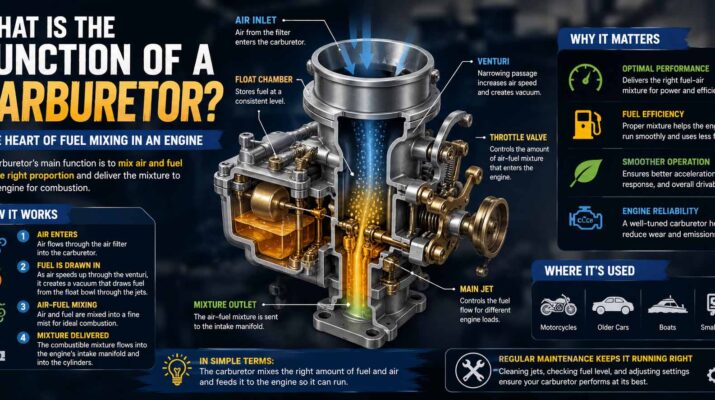
If you’ve ever looked under the hood of an older car or worked on a small engine, you’ve probably seen a carburetor. Although modern vehicles mostly rely on electronic fuel injection, carburetors remain an essential part of many motorcycles, lawn equipment, generators, classic cars, and other gasoline-powered machines.
So, what is the function of a carburetor? Simply put, a carburetor mixes the correct amount of air and fuel before sending that mixture into the engine’s cylinders.
Understanding how a carburetor works also helps explain why it played such a significant role in automotive engineering for more than a century. Even today, many mechanics and enthusiasts continue to maintain carbureted engines because of their simple design and ease of repair.
What Is the Function of a Carburetor?
The primary purpose of a carburetor is to create the ideal air-fuel mixture required for combustion inside a gasoline engine.
Gasoline cannot burn efficiently on its own. Instead, it must mix with air in the proper ratio before entering the combustion chamber. The carburetor performs this task mechanically by controlling both airflow and fuel delivery.
When the engine draws in air, the carburetor measures that airflow and introduces an appropriate amount of fuel. The resulting mixture then travels through the intake manifold and into the cylinders, where a spark plug ignites it.
In simple terms, what is the primary function of a carburetor? It is to ensure the engine receives the right fuel mixture whether the vehicle is idling, accelerating, climbing a hill, or cruising at a steady speed.
What Is the Function of a Carburetor in a Car?
Although many modern cars use electronic fuel injection systems, millions of older vehicles still rely on carburetors.
So, what is the function of a carburetor in a car specifically?
In a car, the carburetor helps:
- Mix gasoline with incoming air.
- Supply fuel according to engine demand.
- Maintain smooth idling.
- Improve throttle response.
- Support efficient combustion.
- Deliver consistent engine performance.
As the driver presses the accelerator pedal, the throttle valve inside the carburetor opens wider. This allows more air to enter while increasing the amount of fuel supplied to the engine.
How Does a Carburetor Work?
Although the design appears complicated at first glance, the operating principle is surprisingly straightforward.
Here’s the basic process:
Step 1: Air Enters the Carburetor
Fresh air enters through the air filter before flowing into the carburetor.
The air then passes through a narrow section called the venturi.
Step 2: The Venturi Creates Low Pressure
The venturi is the heart of the carburetor.
As air speeds up while passing through this narrow passage, air pressure drops.
This pressure difference pulls gasoline from the fuel bowl into the airflow.
Step 3: Fuel Mixes with Air
Tiny fuel passages and jets carefully meter the amount of gasoline entering the venturi.
The fast-moving air atomizes the fuel into fine droplets, creating a combustible air-fuel mixture.
Step 4: The Mixture Enters the Engine
The prepared mixture travels through the intake manifold into each cylinder.
When the spark plug fires, combustion occurs and produces the force that moves the pistons.
The process repeats hundreds or even thousands of times every minute while the engine runs.
Main Components of a Carburetor
Several components work together to control fuel delivery accurately.
| Component | Function |
|---|---|
| Air intake | Draws fresh air into the carburetor |
| Venturi | Creates pressure differences that pull fuel into the airflow |
| Float chamber | Maintains a steady fuel supply |
| Fuel jets | Control how much fuel enters the venturi |
| Throttle valve | Regulates engine speed by controlling airflow |
| Choke valve | Helps start a cold engine |
| Needle valve | Controls fuel entering the float chamber |
Each component has a specific role, allowing the carburetor to adjust fuel delivery under changing driving conditions.
Why the Air-Fuel Ratio Matters
The quality of combustion depends heavily on the air-fuel mixture.
Too much fuel creates a rich mixture, while too much air creates a lean mixture.
An incorrect mixture can lead to:
- Poor fuel economy
- Rough idling
- Engine hesitation
- Reduced power
- Increased emissions
- Difficult starting
The carburetor constantly balances fuel delivery based on airflow, making it an entirely mechanical method of engine management.
What Is the Primary Function of a Carburetor During Different Driving Conditions?
A carburetor doesn’t simply provide one fixed fuel mixture.
Instead, it adjusts fuel flow depending on engine demand.
Engine Idle
When the vehicle is stationary, only a small amount of air enters the engine.
The idle circuit provides enough fuel to keep the engine running smoothly without stalling.
Normal Cruising
At moderate speeds, the carburetor delivers a balanced mixture designed for steady performance and reasonable fuel efficiency.
Engine speed, often measured as what is rpm, directly affects how much air the engine draws in, which influences the amount of fuel the carburetor supplies.
Rapid Acceleration
When the accelerator pedal is pressed quickly, the carburetor temporarily enriches the mixture to prevent hesitation and improve acceleration.
High Engine Load
Driving uphill or towing a trailer requires additional power.
Under these conditions, the carburetor supplies more fuel to maintain reliable engine performance.
Advantages of Carburetors
Although electronic fuel injection has become the industry standard, carburetors still offer several benefits.
Some of their biggest advantages include:
- Simple mechanical design
- Easy to repair without advanced diagnostic equipment
- Lower replacement costs
- Fewer electronic components
- Popular among classic car restorers
- Reliable for many small gasoline engines
Because of this simplicity, carburetors remain common in equipment such as lawn mowers, chainsaws, portable generators, and older motorcycles.
Where Are Carburetors Still Used?
Many people assume carburetors disappeared years ago, but they continue to power numerous machines.
Common examples include:
- Classic automobiles
- Vintage pickup trucks
- Small motorcycles
- Dirt bikes
- All-terrain vehicles
- Snow blowers
- Portable generators
- Chainsaws
- Lawn tractors
- Outboard boat engines
Some engines, particularly older designs, continue using carburetors because they are inexpensive, durable, and relatively easy to maintain in the field.
Carburetor vs. Fuel Injection
One of the biggest changes in automotive engineering has been the shift from carburetors to electronic fuel injection (EFI).
While both systems deliver fuel to the engine, they do so in different ways.
| Feature | Carburetor | Electronic Fuel Injection |
|---|---|---|
| Fuel delivery | Mechanical | Electronically controlled |
| Precision | Moderate | High |
| Cold starting | May require a choke | Automatic |
| Fuel efficiency | Lower | Higher |
| Emissions | Higher | Lower |
| Maintenance | Easier to repair | More complex diagnostics |
| Common use today | Older vehicles and small engines | Most modern vehicles |
Electronic fuel injection uses sensors and a computer to calculate the ideal fuel mixture in real time. Even so, carburetors remain popular among hobbyists because they are relatively simple to understand and service.
Common Signs of Carburetor Problems
A carburetor can become dirty or worn over time. When that happens, the engine may not receive the proper air-fuel mixture.
Watch for these common symptoms:
- Difficulty starting the engine
- Rough or unstable idle
- Engine stalling
- Poor acceleration
- Reduced fuel economy
- Black exhaust smoke
- Fuel leaks
- Strong gasoline smell
These symptoms don’t always mean the carburetor is at fault, but they are often good indicators that it needs inspection or cleaning.
Simple Troubleshooting Checklist
Before replacing a carburetor, check a few basic items.
| Problem | Possible Cause | Basic Check |
| Engine won’t start | Clogged jet | Clean the carburetor |
| Poor acceleration | Dirty fuel passages | Inspect and clean |
| Engine stalls | Incorrect idle adjustment | Adjust idle settings |
| Fuel leak | Worn float valve or gasket | Replace damaged parts |
| Black smoke | Rich fuel mixture | Check float level and jets |
If cleaning and adjustment do not solve the problem, worn internal components may need to be replaced.
Basic Carburetor Maintenance
Routine maintenance helps a carburetor continue working efficiently for many years.
Good maintenance habits include:
- Replace the air filter when necessary.
- Use clean, fresh gasoline.
- Drain fuel before long-term storage.
- Clean the carburetor periodically.
- Replace damaged gaskets and seals.
- Inspect fuel lines for cracks or leaks.
Many carburetor issues result from old gasoline leaving varnish deposits inside the tiny fuel passages. Using fresh fuel and running the engine regularly can help reduce these problems.
Carburetors in Different Types of Engines
Not every carburetor works exactly the same way.
For example, small lawn equipment often uses a simple fixed-jet carburetor, while classic performance cars may have sophisticated multi-barrel carburetors that deliver greater airflow.
Motorcycles also vary depending on engine design. When comparing 2 stroke vs 4 stroke engines, you’ll notice that carburetor tuning differs because each engine completes the combustion cycle differently and has unique airflow requirements.
Can a Carburetor Work with Other Engine Technologies?
Yes. A carburetor is only one part of an engine’s overall intake system.
Some older performance vehicles combined carburetors with forced induction. If you’re curious about boost systems, understanding how does a turbo work helps explain how compressed air can increase engine power, although carburetor tuning becomes more complex in turbocharged applications.
Other engine components also contribute to smooth operation. For example, electrical devices such as what is a solenoid often control starter systems or fuel shutoff mechanisms in certain engines, even though they are separate from the carburetor itself.
Are Carburetors Still Relevant Today?
While fuel injection dominates today’s passenger vehicles, carburetors still have an important place.
They remain popular because they are:
- Simple to understand
- Affordable to repair
- Easy to tune by hand
- Suitable for many small engines
- Widely available through replacement parts suppliers
Classic car owners also appreciate the authentic driving experience that a properly tuned carburetor provides.
Frequently Asked Questions
What is the function of a carburetor?
The function of a carburetor is to mix the correct amount of air and gasoline before the mixture enters a gasoline engine for combustion.
What is the primary function of a carburetor?
The primary function of a carburetor is to maintain the proper air-fuel ratio under different engine operating conditions so the engine can run efficiently.
What is the function of a carburetor in a car?
In a car, the carburetor meters fuel according to incoming airflow, helping the engine start, idle, accelerate, and operate smoothly.
Why don’t modern cars use carburetors?
Most manufacturers now use electronic fuel injection because it offers greater precision, improved fuel economy, lower emissions, and better performance in changing conditions.
Can a carburetor be repaired?
Yes. Many carburetors can be cleaned, rebuilt, or repaired by replacing worn components such as gaskets, jets, float valves, and seals.
Key Takeaways
Understanding what is the function of a carburetor makes it easier to appreciate how gasoline engines operated before electronic fuel injection became standard. By mechanically blending air and fuel in the correct proportions, a carburetor helps an engine start reliably, produce power, and run smoothly across a variety of operating conditions.
Although modern vehicles have largely transitioned to computer-controlled fuel systems, carburetors continue to serve countless motorcycles, generators, lawn equipment, boats, and classic automobiles. Their straightforward design, ease of maintenance, and mechanical reliability ensure they remain relevant for enthusiasts, mechanics, and anyone interested in learning how traditional engines work.