
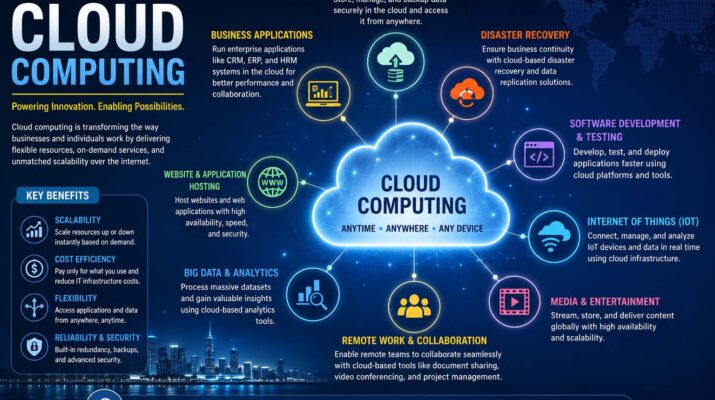
Cloud computing has become one of the most influential technologies in modern computing. From streaming your favorite shows to running enterprise software, cloud platforms power countless digital services behind the scenes. As businesses continue to embrace digital transformation, the applications of cloud computing continue to expand into nearly every industry.
Whether you’re a student learning about cloud technology, a business owner exploring digital solutions, or an IT professional evaluating cloud services, understanding where cloud computing is used helps explain why it has become an essential part of today’s technology ecosystem.
What Are Applications of Cloud Computing?
The applications of cloud computing refer to the different ways cloud-based services are used to store data, run software, process information, and deliver online services over the internet instead of relying entirely on local computers or on-premises servers.
Instead of purchasing expensive hardware and maintaining physical infrastructure, organizations can access computing resources whenever they need them through cloud service providers.
If you’ve ever wondered what are the applications of cloud computing, the answer covers everything from file storage and video conferencing to artificial intelligence, healthcare systems, online banking, and industrial automation.
How Cloud Computing Works
Cloud computing allows users to access shared computing resources hosted in secure data centers around the world.
These resources include:
- Virtual servers
- Data storage
- Databases
- Networking
- Artificial intelligence services
- Software applications
- Development platforms
Users connect to these resources through the internet, paying only for the capacity they use in many cloud pricing models.
Cloud services are generally grouped into three categories:
| Cloud Service Model | Purpose | Typical Users |
|---|---|---|
| Infrastructure as a Service (IaaS) | Virtual servers, networking, storage | IT teams and developers |
| Platform as a Service (PaaS) | Development environment | Software developers |
| Software as a Service (SaaS) | Ready-to-use applications | Businesses and consumers |
Many people ask, which of the following cloud computing solutions delivers software applications? The answer is Software as a Service (SaaS), which allows users to access applications like Microsoft 365, Google Workspace, Salesforce, and many others through a web browser.
Major Applications of Cloud Computing
Cloud Storage and Backup
One of the most common applications is cloud storage.
Instead of storing files on a single hard drive, users can save documents, photos, videos, and backups on remote servers that are available from almost any device.
Popular examples include:
- Google Drive
- Microsoft OneDrive
- Dropbox
- Apple iCloud
Cloud backups also protect important files from hardware failures, accidental deletion, or ransomware attacks.
Business Collaboration
Modern workplaces rely heavily on cloud collaboration.
Employees working from different locations can:
- Edit documents together
- Share files instantly
- Hold video meetings
- Manage projects online
- Communicate in real time
Many organizations also build a single source of truth by storing business documents and operational data in centralized cloud platforms that keep everyone working from the same information.
Applications of Cloud Computing in Healthcare
The applications of cloud computing in healthcare have grown rapidly as hospitals and clinics digitize patient care.
Healthcare organizations use cloud technology for:
- Electronic health records (EHR)
- Medical image storage
- Telemedicine platforms
- Appointment scheduling
- Patient portals
- AI-assisted diagnostics
- Secure data sharing between healthcare providers
Cloud systems also improve disaster recovery by keeping patient information safely replicated across multiple locations.
Healthcare providers must still comply with strict privacy regulations, making cloud security and encryption essential parts of any deployment.
Applications of Cloud Computing in Manufacturing Industry
The applications of cloud computing in manufacturing industry extend far beyond simple data storage.
Manufacturers use cloud platforms to:
- Monitor production lines
- Manage supply chains
- Predict equipment failures
- Track inventory
- Analyze production efficiency
- Coordinate factories across multiple locations
Factories increasingly combine cloud services with Industrial Internet of Things (IIoT) devices that collect machine information in real time. Understanding what is telemetry can help explain how these sensors continuously send operational data to cloud platforms for monitoring and predictive maintenance.
Education and Online Learning
Educational institutions use cloud computing to make learning more accessible.
Teachers can upload assignments, conduct virtual classrooms, grade work online, and collaborate with students regardless of location.
Students benefit from:
- Cloud-based learning platforms
- Digital textbooks
- Shared documents
- Online testing
- Virtual laboratories
- Remote learning
Cloud computing also reduces hardware costs because many educational applications run directly in a web browser.
Financial Services
Banks and financial institutions depend on cloud technology to improve customer experiences while maintaining security.
Cloud applications support:
- Mobile banking
- Fraud detection
- Payment processing
- Investment analysis
- Customer relationship management
- Risk assessment
Modern cloud providers include advanced encryption, identity management, and compliance features that help financial organizations meet regulatory requirements.
Artificial Intelligence and Machine Learning
Artificial intelligence requires enormous computing power.
Cloud platforms provide scalable infrastructure for:
- AI model training
- Natural language processing
- Image recognition
- Recommendation systems
- Predictive analytics
- Automation
Many cloud providers now offer AI services that developers can integrate into applications without building complex machine learning infrastructure from scratch.
Some innovative augmented reality applications also rely on cloud computing to process visual information quickly while synchronizing data across multiple devices.
Entertainment and Streaming
Streaming services are among the largest cloud computing users.
Cloud infrastructure enables:
- Video streaming
- Music streaming
- Online gaming
- Live broadcasting
- Content delivery
- Personalized recommendations
Instead of downloading large media files permanently, users stream content directly from distributed cloud servers.
E-Commerce Platforms
Online stores depend on cloud computing to remain available even during traffic spikes.
Cloud-powered e-commerce systems manage:
- Product catalogs
- Inventory
- Shopping carts
- Customer accounts
- Payment processing
- Order tracking
- Marketing analytics
Because cloud resources scale automatically, businesses can handle seasonal demand without purchasing permanent infrastructure.
Benefits of Cloud Computing Applications
Cloud computing offers advantages for organizations of every size.
Lower Infrastructure Costs
Businesses avoid purchasing and maintaining expensive physical servers.
Easy Scalability
Cloud resources can expand or shrink based on demand.
This flexibility allows companies to support growth without replacing hardware.
Improved Accessibility
Employees can securely access cloud resources from laptops, tablets, and smartphones wherever internet access is available.
Better Disaster Recovery
Cloud providers typically replicate data across multiple locations.
If one data center experiences problems, another can often continue serving customers.
Automatic Updates
Cloud providers regularly update infrastructure, security patches, and software, reducing maintenance work for customers.
Challenges of Cloud Computing
Although cloud computing offers many advantages, organizations should also understand its limitations.
Some common challenges include:
- Internet dependency
- Data privacy concerns
- Vendor lock-in
- Subscription costs over time
- Regulatory compliance
- Performance issues during network outages
Proper planning helps minimize these risks.
Cloud Computing Deployment Models
Organizations choose different cloud deployment models depending on their requirements.
| Deployment Model | Best For | Advantages |
|---|---|---|
| Public Cloud | General business workloads | Lower costs and high scalability |
| Private Cloud | Sensitive workloads | Greater control and customization |
| Hybrid Cloud | Mixed environments | Flexibility and workload balancing |
| Multi-Cloud | Large enterprises | Reduced dependency on one provider |
Many businesses adopt hybrid cloud strategies that combine local infrastructure with public cloud services.
Best Practices for Using Cloud Computing
Organizations can maximize cloud benefits by following a few practical guidelines.
- Enable multi-factor authentication.
- Encrypt sensitive information.
- Monitor cloud resource usage regularly.
- Apply software updates promptly.
- Perform regular backups.
- Review security settings periodically.
- Train employees on cybersecurity awareness.
Security is a shared responsibility between cloud providers and customers.
Common Cloud Computing Examples
Many popular services rely on cloud technology every day.
Examples include:
- Google Workspace
- Microsoft 365
- Netflix
- Spotify
- Zoom
- Salesforce
- Adobe Creative Cloud
- Amazon Web Services
- Microsoft Azure
- Google Cloud Platform
Millions of businesses depend on these services for communication, collaboration, development, and data management.
Cloud Computing and Emerging Technologies
Cloud computing continues to support new technological innovations.
For example, autonomous vehicles, smart cities, robotics, and connected devices all generate massive amounts of data that cloud platforms process and analyze efficiently.
Cloud computing also plays a significant role in immersive technologies. Developers building interactive simulations often combine cloud infrastructure with graphics processing and networking techniques. If you’re interested in immersive experiences, understanding how does virtual reality work provides useful background on how cloud resources support VR applications that require synchronized content and real-time collaboration.
As edge computing expands, cloud platforms will increasingly work alongside local processing devices to reduce latency while maintaining centralized management.
Frequently Asked Questions
Can individuals benefit from cloud computing?
Yes. Individuals use cloud storage, email, online productivity tools, streaming services, photo backups, and online gaming every day without needing specialized technical knowledge.
Is cloud computing secure?
Cloud providers invest heavily in security technologies. Still, users should enable strong passwords, multi-factor authentication, encryption, and regular backups for better protection.
Which industries use cloud computing the most?
Healthcare, finance, education, manufacturing, retail, entertainment, government, software development, and telecommunications are among the largest cloud users.
Does cloud computing require constant internet access?
Most cloud services require an internet connection, although some applications offer offline functionality that synchronizes data once connectivity returns.
Is cloud computing suitable for small businesses?
Yes. Cloud computing allows small businesses to access enterprise-grade technology without making large investments in servers and IT infrastructure.
Why Cloud Computing Continues to Grow
Cloud computing has evolved from a convenient storage solution into the foundation of modern digital services. Its ability to provide scalable computing power, reliable storage, powerful software, and advanced analytics makes it valuable for organizations of every size.
As artificial intelligence, automation, remote work, and connected devices continue to expand, the applications of cloud computing will become even more diverse. Businesses that understand where cloud technology fits into their operations can improve efficiency, reduce infrastructure costs, and adapt more quickly to changing customer needs. Whether supporting healthcare systems, manufacturing operations, online collaboration, or everyday consumer services, cloud computing remains one of the most practical and transformative technologies available today.