
Have you ever put on a VR headset and felt like you were standing inside another world? If you’ve wondered how does virtual reality work, you’re not alone. Virtual reality (VR) combines advanced displays, motion tracking, sensors, powerful software, and audio to create an immersive digital environment that responds to your movements in real time.
Although the technology may seem complex, the basic idea is surprisingly simple. A VR system tricks your brain into believing you’re somewhere else by replacing your normal view with a realistic virtual scene that changes naturally as you move.
What Is Virtual Reality and How Does It Work?
Before exploring the technology, it helps to answer the question, what is virtual reality and how does it work?
Unlike watching a movie on a screen, VR surrounds your field of view and reacts instantly to your head and body movements.
A complete VR experience usually includes:
- A VR headset
- Motion sensors
- High-resolution displays
- Audio systems
- Controllers or hand tracking
- Software that renders the virtual world
All these components work together thousands of times every second to maintain the illusion of being inside another environment.
While VR creates fully immersive experiences, many businesses also use augmented reality applications, which overlay digital content onto the real world instead of replacing it completely.
How Does Virtual Reality Work? The Core Technology
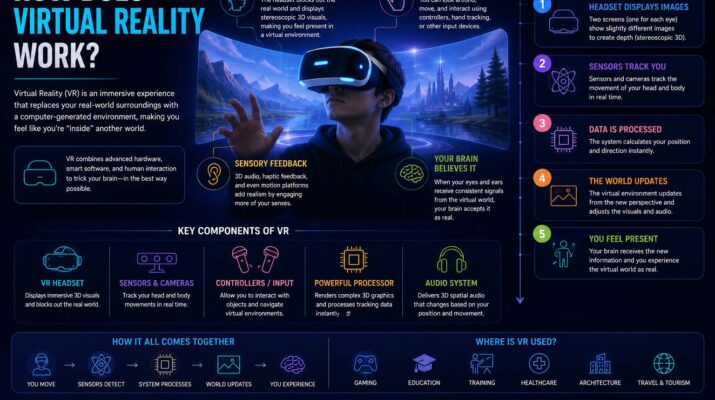
To understand how does virtual reality work, it’s helpful to break the process into individual steps.
Step 1: The Headset Displays Two Images
Most VR headsets contain two small screens or one display split into two sections.
Each eye sees a slightly different image.
Your brain combines these images into a single three-dimensional scene, much like how your eyes naturally create depth perception in everyday life.
Step 2: Sensors Track Your Movement
As you move your head, sensors inside the headset detect changes in:
- Position
- Rotation
- Direction
- Speed
The computer immediately updates the virtual environment so everything appears to move naturally around you.
Without accurate tracking, VR would feel unrealistic and uncomfortable.
Step 3: Software Renders the Scene
A gaming PC, console, smartphone, or the headset’s built-in processor continuously generates the virtual world.
As your viewpoint changes, the software redraws the scene almost instantly.
Modern systems often render between 72 and 120 frames per second to create smooth movement and reduce motion sickness.
Step 4: Audio Completes the Illusion
Spatial or 3D audio makes sounds appear to come from specific directions.
For example, if someone speaks behind your virtual character, you’ll hear the sound from behind you, making the experience much more realistic.
How Does a Virtual Reality Headset Work?
Many people specifically ask, how does a virtual reality headset work because the headset is the heart of every VR system.
A headset combines several technologies into one device.
| Component | Purpose |
|---|---|
| Displays | Show separate images to each eye |
| Lenses | Focus the images for comfortable viewing |
| Gyroscope | Measures head rotation |
| Accelerometer | Detects movement and speed |
| Cameras or sensors | Track position in space |
| Speakers or headphones | Produce immersive audio |
| Processor (standalone headsets) | Runs VR applications |
These components communicate continuously so the virtual world reacts immediately when you move.
Even slight delays can reduce immersion or cause discomfort.
Why Does VR Feel So Real?
Your brain naturally combines information from your eyes, ears, and inner ear to understand where you are.
Virtual reality carefully recreates those sensory cues.
Several factors contribute to realism:
- Wide field of view
- Accurate motion tracking
- Stereoscopic 3D images
- Realistic lighting
- Smooth animation
- Spatial sound
- Responsive controls
When these elements work together, your brain temporarily accepts the virtual environment as if it were real.
How Does Virtual Reality Work With Phones?
Although dedicated VR headsets have become more common, many people still wonder how does virtual reality work with phones.
Phone-based VR uses a smartphone as both the display and processor.
Here’s how it works:
- The phone slides into a VR viewer.
- The screen displays two separate images.
- Built-in motion sensors detect head movement.
- Lenses enlarge and focus the display.
- Apps adjust the images as you turn your head.
This approach offers an affordable introduction to VR, although it usually provides lower performance than standalone or PC-powered headsets.
Motion Tracking: The Secret Behind Immersion
Motion tracking is one of the most impressive parts of VR technology.
Without it, every movement would feel disconnected from the virtual environment.
Modern VR systems use several tracking methods:
Inside-Out Tracking
Cameras mounted on the headset observe the surrounding room.
The headset calculates its position without requiring external equipment.
Many modern consumer headsets use this method because setup is quick and convenient.
Outside-In Tracking
External sensors or cameras monitor the headset and controllers.
This method often provides extremely accurate tracking, making it popular for professional simulations and high-end gaming.
Controllers and Hand Tracking
Most VR systems allow users to interact with objects naturally.
Controllers typically include:
- Motion sensors
- Buttons
- Triggers
- Thumbsticks
Some newer headsets eliminate controllers entirely by tracking your hands using built-in cameras.
This creates a more natural experience for certain applications.
Touch sensations also improve realism. If you’d like to learn more about force feedback and tactile responses, our guide explaining what are haptics explores the technology behind vibrations and physical feedback in modern devices.
What Can You Do with Virtual Reality?
VR extends far beyond gaming.
Today, organizations use it across many industries.
Gaming
Gaming remains VR’s best-known application.
Players can:
- Explore virtual worlds
- Solve puzzles
- Compete in sports
- Experience action adventures
- Play rhythm games
- Practice realistic simulations
Education
Students can explore ancient civilizations, perform virtual science experiments, or visit locations that would otherwise be impossible to access.
Interactive learning often improves engagement and memory.
Healthcare
Medical professionals use VR for:
- Surgical training
- Rehabilitation exercises
- Pain management research
- Mental health therapy
- Anatomy education
Business
Companies use VR for employee training, product demonstrations, remote collaboration, and virtual meetings.
Many professionals creating these systems come from engineering backgrounds. If you’re curious about the careers behind innovations like VR, our article on what do engineers do explains the wide range of roles involved in designing advanced technology.
How VR Is Used Alongside Other Technologies
Virtual reality often works with other digital systems rather than replacing them.
For example, training simulations may collect performance data that instructors later review. Similar data collection methods are explained in our guide to what is telemetry, which covers how devices monitor and transmit information in real time.
Likewise, industries including aviation, construction, and emergency services combine VR with equipment such as unmanned aircraft for planning and simulation. If that interests you, you may also enjoy learning what is a drone and how these systems support mapping, inspections, and training.
Advantages of Virtual Reality
VR offers several significant benefits.
Highly Immersive Learning
People often retain information better when actively participating instead of simply reading or watching videos.
Safe Training
Pilots, surgeons, firefighters, and engineers can practice difficult procedures without real-world risks.
Better Collaboration
Teams in different locations can meet inside shared virtual environments.
Entertainment
VR creates gaming and storytelling experiences that traditional screens cannot easily replicate.
Challenges and Limitations
Despite its advantages, VR still has limitations.
Some users experience:
- Motion sickness
- Eye strain
- Fatigue after long sessions
- Limited battery life
- High equipment costs
Fortunately, newer hardware continues improving display quality, comfort, and tracking accuracy.
Tips for a Better VR Experience
You can make VR more enjoyable by following a few simple practices.
- Adjust the headset for a comfortable fit.
- Keep lenses clean.
- Use enough room to move safely.
- Take breaks every 30 to 60 minutes.
- Stay hydrated.
- Follow your headset’s safety guidelines.
Most people become more comfortable with VR after several sessions.
Common Myths About Virtual Reality
Myth: VR Is Only for Gaming
Gaming is popular, but education, healthcare, engineering, architecture, tourism, and business all use VR extensively.
Myth: Everyone Gets Motion Sickness
Some people experience discomfort, while many do not. Higher frame rates and improved tracking have reduced this issue significantly.
Myth: VR Completely Replaces Reality
VR creates immersive simulations, but users remain aware that they’re wearing a headset and interacting with digital content.
Frequently Asked Questions
How does virtual reality work?
Virtual reality works by displaying separate images to each eye, tracking your movements with sensors, and updating the virtual environment in real time to create the illusion of being inside another world.
Does VR require the internet?
Not always. Many VR games and applications run without an internet connection, although online multiplayer experiences require one.
Can you wear glasses with a VR headset?
Many modern VR headsets accommodate glasses or offer adjustable lens spacing. Some also support prescription lens inserts.
Is virtual reality safe?
For most healthy users, VR is generally safe when used as directed. Taking regular breaks and using the headset in a clear, obstacle-free space helps reduce the risk of discomfort or injury.
What’s the difference between VR and augmented reality?
VR replaces your surroundings with a digital environment, while augmented reality adds digital information to the real world through a phone, tablet, or smart glasses.
The Future of Virtual Reality
Virtual reality continues to evolve as displays become sharper, processors become faster, and tracking systems become more accurate. Developers are also working on lighter headsets, more natural hand tracking, improved eye tracking, and richer social experiences that make virtual environments feel even more lifelike.
As hardware and software continue to improve, VR is likely to become an even more common part of education, entertainment, healthcare, and everyday life.