
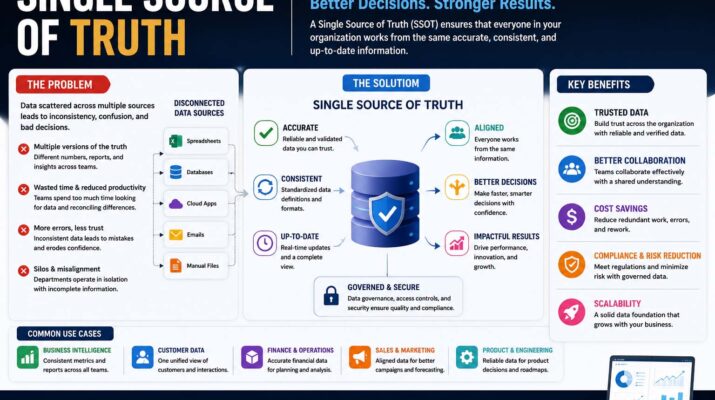
In today’s digital world, businesses collect enormous amounts of information from websites, applications, customers, and internal systems. However, when different departments maintain conflicting records, mistakes and confusion become common. A single source of truth (SSOT) helps organizations establish authoritative information that employees and systems can trust.
For example, marketing teams may store customer information in one platform while sales teams maintain separate records. If the information differs, employees can make decisions based on outdated details. Therefore, businesses need consistent data definitions, reliable synchronization, and clear ownership.
As organizations adopt cloud software, analytics platforms, and automation tools, effective data management becomes increasingly valuable. A well-designed approach can improve reporting, reduce duplication, and support better collaboration.
This guide explains the concept, its business benefits, practical examples, and the steps organizations can take to establish reliable information.
What Is a Single Source of Truth?
A single source of truth is an authoritative source that an organization uses to maintain consistent and reliable information.
Instead of allowing different departments to maintain conflicting versions of important records, businesses establish clear rules for managing and sharing data.
However, this does not always require storing everything in one physical database. Organizations may use multiple connected systems while designating one authoritative source for each type of information.
For example, a company might maintain customer records in a customer relationship management platform and product information in a separate inventory system.
The important requirement is that employees know which source provides the correct information.
How a Single Source of Truth Works
A reliable data system follows established processes for collecting, validating, updating, and distributing information.
First, an organization identifies its important data sources. Next, it determines which system should maintain each authoritative record.
Then, integration tools share approved changes with other applications.
As a result, employees can access consistent information without manually comparing multiple databases.
A Practical Business Example
Consider an e-commerce company that uses separate applications for sales, inventory, and customer support.
When a customer updates an address, the customer management system records the change. Connected applications can then receive the updated information.
Consequently, support agents and fulfillment teams are less likely to rely on conflicting records.
However, the company must maintain reliable integrations and validation rules to keep its information synchronized.
Why Businesses Need a Single Source of Truth
Organizations often struggle when departments use different applications without consistent data management practices.
For example, sales teams may track customer details in spreadsheets while marketing teams maintain separate contact databases.
If employees update only one system, conflicting information can spread throughout the business.
Therefore, establishing authoritative records helps reduce confusion and supports more dependable reporting.
Reducing Duplicate and Outdated Records
Duplicate records can create unnecessary work.
For instance, a business might store the same customer under several slightly different names.
As a result, employees may send duplicate messages or prepare inaccurate reports.
A well-managed data strategy helps identify duplicate information and establish consistent records.
Supporting Business Continuity
Reliable information also supports daily operations.
When employees can access accurate records, they spend less time correcting errors and searching for missing details.
This approach connects with what is continuity because consistent information helps organizations maintain dependable processes during operational changes.
However, businesses still need backups, recovery procedures, and suitable access controls.
Benefits of a Single Source of Truth
A well-managed authoritative data system can improve several areas of business performance.
However, the results depend on data quality, system integration, and how consistently employees follow established procedures.
More Accurate Business Decisions
Managers depend on reliable information when evaluating performance and planning future activities.
For example, a finance department needs accurate revenue figures to prepare budgets.
Similarly, marketing teams require consistent customer information to measure campaign performance.
When departments work from authoritative records, they can reduce disagreements caused by conflicting reports.
Better Team Collaboration
Shared information helps employees coordinate their work.
For instance, sales and customer support teams can use consistent account details when communicating with customers.
As a result, employees spend less time checking which record contains the latest information.
However, organizations must also establish clear responsibilities for maintaining those records.
Improved Operational Efficiency
Employees often waste time searching for information across disconnected systems.
A reliable data management process reduces this unnecessary work.
In addition, automation can distribute approved updates to connected applications.
Therefore, teams can focus more attention on their main responsibilities.
Stronger Data Governance and Security
Centralized governance helps organizations define who can access, modify, and approve important information.
For example, administrators can establish role-based permissions and monitor changes to sensitive records.
However, centralization does not automatically improve security. A poorly protected authoritative system can create significant operational risks.
Therefore, organizations should combine access controls with monitoring, backups, and recovery planning.
Businesses may also use what is instrumentation to understand how monitoring equipment and measurement systems support reliable operations.
Single Source of Truth Deutsch: German Meaning
The phrase “single source of truth deutsch” reflects interest in the German meaning of this data management concept.
In German, businesses may describe it as “eine zentrale und verlässliche Datenquelle,” meaning a central and reliable source of information.
The expression emphasizes consistency, authority, and trust.
However, the underlying principle remains the same regardless of language.
Why the Concept Matters for German Businesses
Companies in manufacturing, logistics, finance, and other industries often depend on information from multiple systems.
For example, manufacturers may need consistent product specifications across purchasing, production, and inventory applications.
Therefore, authoritative records can help departments coordinate activities and reduce discrepancies.
Organizations exploring digitale transformation in unternehmen may find this approach useful when connecting existing software with modern digital platforms.
One Single Source of Truth: How It Works
The expression “one single source of truth” emphasizes the importance of having a clearly identified authority for important information.
However, it does not necessarily mean that every department must use the same application.
Instead, organizations can establish authoritative systems for different data categories.
For example:
- A CRM platform maintains official customer contact records.
- An inventory system maintains product availability information.
- A financial system maintains accounting records.
- A human resources platform maintains employee information.
Other applications may receive approved updates from these systems.
Consequently, employees can work with consistent information while using software suited to their responsibilities.
Why Data Ownership Matters
Every important data category should have a clearly identified owner.
For example, the finance department may oversee accounting information, while the human resources department manages employee records.
These responsibilities help prevent conflicting updates.
In addition, clear ownership makes it easier to investigate and correct inaccurate information.
Single Source of Truth Bedeutung: Definition and Context
The German word “Bedeutung” means “meaning” or “significance.”
Therefore, “single source of truth bedeutung” refers to the meaning of an authoritative and reliable information source.
In business settings, the concept describes a structured approach to maintaining consistent data across teams and applications.
However, successful implementation requires more than choosing a central platform.
Organizations also need shared definitions, validation procedures, and effective integration methods.
The Role of Master Data Management
Master data management, or MDM, helps organizations maintain consistent records for important business entities.
These entities may include customers, products, suppliers, and employees.
For example, MDM processes can identify duplicate customer records and establish rules for maintaining approved information.
IBM explains these principles in its guide to master data management.
Although MDM can support authoritative data management, organizations may also need additional governance and integration practices.
Single Source of the Truth: Is There a Difference?
The phrase “single source of the truth” generally refers to the same concept as the more common expression “single source of truth.”
Both describe the need for reliable, authoritative information.
However, businesses should distinguish between a trusted data source and a reporting system that combines information from multiple platforms.
For example, an analytics dashboard may display information from several databases without serving as the authoritative source for those records.
Therefore, organizations should document where official information originates and how other systems receive updates.
Connecting Data Across Business Systems
Modern companies often use customer management software, accounting applications, inventory tools, and analytics platforms.
Without integration, these applications may contain conflicting information.
However, well-designed data pipelines and synchronization processes can improve consistency.
For example, businesses in industries covered by what companies are in the consumer services field often depend on accurate customer records to provide dependable service.
Likewise, what is telemetry explains how systems collect operational information that organizations can use for monitoring and analysis.
How to Implement an Authoritative Data Strategy
Businesses can establish reliable information through a structured process.
First, identify the records that matter most to daily operations and decision-making.
Next, review existing applications to locate duplicate, outdated, or inconsistent information.
Then, determine which system should serve as the authority for each important data category.
After establishing ownership, create procedures for validating records and distributing approved updates.
Finally, monitor data quality and review integration processes regularly.
Common Implementation Challenges
Organizations may encounter several difficulties during implementation.
For example, older applications may lack modern integration capabilities.
Different departments may also use inconsistent definitions for the same business information.
In addition, employees may resist changing familiar workflows.
Therefore, successful implementation requires technical planning, clear communication, and ongoing data governance.
Conclusion
A single source of truth helps organizations maintain consistent, authoritative information across departments and applications.
By establishing clear data ownership, reliable integration processes, and shared definitions, businesses can reduce duplicate records and improve decision-making.
However, the approach does not always require one physical database. Instead, organizations can maintain authoritative sources for different information categories while connecting their systems effectively.
Whether discussing the German meaning, master data management, or centralized business records, the main objective remains the same: ensuring that employees and applications can rely on accurate, consistent information.