
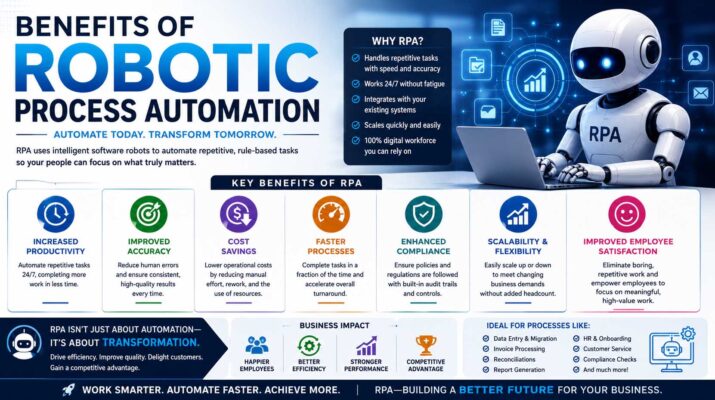
Every business has repetitive tasks that consume valuable time. Employees often spend hours entering data, processing invoices, updating spreadsheets, or transferring information between software systems. While these jobs are necessary, they rarely require creative thinking. That’s where the benefits of robotic process automation become easy to see.
Robotic Process Automation (RPA) uses software bots to perform repetitive digital tasks by following predefined rules. Instead of replacing employees, these bots handle routine work so teams can focus on solving problems, serving customers, and making better business decisions. As automation technology continues to mature, organizations of every size are using RPA to improve productivity while reducing operational costs.
Benefits of Robotic Process Automation for Businesses
The biggest reason companies invest in RPA is simple—it helps complete repetitive work faster and more accurately.
Some of the most valuable benefits of robotic process automation include:
- Faster business processes
- Reduced manual data entry
- Fewer human errors
- Lower operating costs
- Improved compliance
- Increased employee productivity
- Better customer experiences
- Easy scalability
Unlike people, software bots can work around the clock without becoming tired or distracted. As a result, businesses can process larger workloads while maintaining consistent quality.
What Is Robotic Process Automation?
Robotic Process Automation is a software technology that allows digital bots to imitate the actions people perform inside business applications.
Rather than physically operating machines, RPA interacts with computer software. A bot can open applications, copy information, fill out forms, send emails, generate reports, and move data between systems just as a human employee would.
Because RPA works with existing software, organizations often improve efficiency without replacing their current applications.
Many businesses that already rely on applications of cloud computing use RPA to automate workflows across cloud-based platforms, customer relationship management systems, accounting software, and enterprise applications.
How Does Robotic Process Automation Work?
Although RPA may sound complex, the workflow is fairly straightforward.
Step 1: A Process Begins
The bot starts when a trigger occurs.
Common triggers include:
- A customer submits an online form.
- A new email arrives.
- A scheduled task begins.
- A file is uploaded.
- A database record changes.
Step 2: The Bot Collects Information
The software bot gathers the required information from one or more systems.
It may:
- Read spreadsheets
- Access databases
- Retrieve customer information
- Download documents
- Open websites
- Verify records
Step 3: Rules Are Applied
The bot follows predefined business rules exactly as programmed.
Examples include:
- Validating customer information
- Calculating totals
- Updating databases
- Routing approvals
- Creating invoices
- Sending notifications
Step 4: The Task Is Completed
Finally, the bot records the results, updates systems, and moves to the next assignment without requiring manual intervention.
This entire process often takes seconds instead of several minutes.
Why Organizations Are Investing in RPA
Businesses adopt automation because it solves practical operational problems rather than simply introducing new technology.
Higher Productivity
Employees frequently spend much of their day performing repetitive administrative work.
RPA removes many of these routine activities, allowing staff to focus on projects that require communication, creativity, analysis, and decision-making.
Instead of replacing employees, automation usually helps them become more productive.
Better Accuracy
Manual data entry naturally leads to occasional mistakes.
Even a small typing error can create delays, incorrect reports, or compliance issues.
Software bots perform the same task consistently, reducing the number of processing errors while improving data quality.
Lower Operating Costs
One of the strongest business cases for RPA is cost reduction.
By automating repetitive processes, organizations often complete more work without increasing staffing levels.
Over time, the savings generated by improved efficiency can offset the initial implementation costs.
Faster Customer Service
Customers expect quick responses.
When routine requests are automated, businesses process orders, update accounts, and respond to inquiries much faster.
This creates a smoother customer experience while reducing waiting times.
Robotic Process Automation Benefits of RPA Across Departments
The robotic process automation benefits of RPA extend across nearly every business function because repetitive digital work exists in almost every department.
Common areas include:
- Human resources
- Finance
- Customer service
- Healthcare
- Manufacturing
- Insurance
- Retail
- Information technology
Since each department performs structured, rule-based activities, software bots can automate many daily workflows with minimal disruption.
Creating More Reliable Business Data
Automation doesn’t just save time—it also improves data consistency.
When information is entered manually across multiple applications, differences often appear between departments.
Many organizations address this challenge by creating a single source of truth, where automated workflows help keep business information synchronized across different systems.
This consistency improves reporting, reduces duplicate records, and supports better decision-making throughout the organization.
Benefits of Robotic Process Automation in Banking
Financial institutions process enormous volumes of transactions every day.
Because many banking activities follow well-defined rules, automation can significantly improve efficiency.
Some key benefits of robotic process automation in banking include:
- Faster loan application processing
- Automated customer verification
- Fraud detection support
- Account reconciliation
- Regulatory reporting
- Payment processing
- Compliance monitoring
Banks also benefit from improved accuracy because software bots follow established procedures every time they execute a process.
Improving Compliance and Security
Many industries must comply with strict regulations regarding data handling and reporting.
RPA helps organizations standardize processes by ensuring each workflow follows the same approved steps.
Since software bots automatically generate activity logs, businesses gain a detailed record of completed actions.
This transparency makes audits easier while helping organizations demonstrate compliance with internal policies and external regulations.
Where RPA Delivers the Greatest Value
Although RPA can automate thousands of tasks, it performs best when work shares several characteristics.
Ideal processes are typically:
- Repetitive
- Rule-based
- Digital
- High-volume
- Time-consuming
- Stable over time
- Prone to manual errors
Organizations often begin with a small automation project before expanding to more advanced workflows across multiple departments. This gradual approach allows teams to measure results, refine processes, and build confidence before investing in larger automation initiatives.
Many businesses also view RPA as a practical step in broader digitale transformation in unternehmen, where automation supports faster operations, improved service quality, and greater operational efficiency without requiring major changes to existing software systems.
8 Leading Benefits of Robotic Process Automation
Organizations often begin using RPA to save time, but the long-term advantages go much further. Here are the 8 leading benefits of robotic process automation that make it a valuable investment.
| Benefit | Business Impact |
|---|---|
| Faster processing | Completes repetitive tasks in less time |
| Higher accuracy | Reduces manual errors |
| Lower costs | Improves operational efficiency |
| Better compliance | Follows standardized procedures |
| Greater scalability | Handles growing workloads easily |
| Improved employee satisfaction | Removes repetitive work |
| Enhanced customer service | Speeds up response times |
| Better business insights | Produces consistent and reliable data |
Together, these advantages help organizations improve productivity while maintaining high-quality results.
Best Practices for Implementing Robotic Process Automation
Successful automation begins with selecting the right business processes instead of trying to automate everything at once.
A practical implementation usually follows these steps:
- Identify repetitive and rule-based tasks.
- Document the existing workflow.
- Choose an RPA platform that meets your business needs.
- Build and thoroughly test the automation.
- Deploy the bot in a controlled environment.
- Monitor its performance regularly.
- Improve workflows based on performance data and user feedback.
Taking a gradual approach reduces implementation risks while helping teams become comfortable with automation.
Common Challenges and How to Overcome Them
Although the benefits of robotic process automation RPA are significant, organizations should understand its limitations before deployment.
Here are some common challenges and practical solutions.
| Challenge | Recommended Solution |
|---|---|
| Poorly documented processes | Standardize workflows before automation |
| Frequent software updates | Review and update automation scripts regularly |
| Unstructured data | Combine RPA with AI technologies where appropriate |
| Employee resistance | Provide training and communicate automation goals clearly |
| Unrealistic expectations | Begin with simple, high-value automation projects |
With proper planning, most of these challenges can be minimized.
Measuring the Success of RPA
After implementation, businesses should evaluate whether automation is delivering measurable improvements.
Useful performance indicators include:
- Processing time
- Error rates
- Operational cost savings
- Employee productivity
- Customer response times
- Compliance performance
- Process completion rates
- Return on investment (ROI)
Monitoring these metrics helps organizations identify new automation opportunities while continuously improving existing workflows.
Industries That Benefit Most from RPA
Robotic Process Automation has become valuable across many industries because repetitive digital work exists almost everywhere.
Banking
Banks automate customer onboarding, payment processing, fraud detection support, compliance reporting, and account reconciliation.
These improvements allow financial institutions to process transactions more efficiently while maintaining regulatory compliance.
Healthcare
Healthcare organizations automate patient registration, appointment scheduling, insurance claims, billing, and medical record updates.
Automation helps reduce paperwork while allowing healthcare professionals to spend more time with patients.
Human Resources
HR teams automate employee onboarding, payroll support, leave requests, recruitment workflows, and document management.
This reduces administrative work and improves the employee experience.
Retail and E-commerce
Retailers use software bots to update inventory, process online orders, handle returns, and respond to customer inquiries.
Automation also helps businesses manage seasonal spikes in demand without significantly increasing manual workloads.
Manufacturing
Manufacturers automate purchasing, production reporting, inventory management, supplier communication, and quality documentation.
These improvements create smoother operations across production and supply chain processes.
Robotic Process Automation vs Traditional Automation
Although both technologies improve efficiency, they work differently.
| Feature | Robotic Process Automation | Traditional Automation |
|---|---|---|
| Uses existing software | ✔ | Sometimes requires software modifications |
| Development speed | Fast | Usually slower |
| Coding requirements | Low to moderate | Often high |
| User interface interaction | Yes | Limited |
| Scalability | High | Moderate |
| Best for | Repetitive digital business processes | System-specific automation |
Because RPA works through existing software interfaces, organizations can often automate workflows without replacing their current applications.
Does Robotic Process Automation Replace Employees?
One of the biggest misconceptions about automation is that software bots exist to replace people.
In reality, RPA is designed to remove repetitive administrative work rather than eliminate jobs.
Employees continue to perform tasks involving:
- Decision-making
- Customer communication
- Strategic planning
- Creative thinking
- Problem-solving
- Relationship management
Instead of replacing people, automation allows employees to focus on work that delivers greater business value.
Frequently Asked Questions
What are the benefits of robotic process automation?
The primary benefits include improved productivity, faster processing, lower operating costs, fewer manual errors, stronger compliance, better scalability, and enhanced customer service.
Is Robotic Process Automation suitable for small businesses?
Yes. Many modern RPA platforms are scalable, making them suitable for both small businesses and large enterprises.
Which processes should businesses automate first?
Organizations usually achieve the best results by starting with repetitive, rules-based, high-volume digital tasks.
Does RPA require replacing existing software?
No. One of the biggest advantages of RPA is its ability to work alongside existing business applications without major system changes.
Is RPA secure?
Most enterprise RPA platforms include role-based access controls, encryption, activity logging, and audit capabilities to support secure business operations.
Building a More Efficient Digital Workplace
The benefits of robotic process automation go far beyond reducing repetitive work. Businesses gain faster workflows, improved accuracy, lower operating costs, stronger compliance, and better customer experiences while allowing employees to concentrate on strategic responsibilities that require human expertise.
As organizations continue modernizing their operations, RPA works alongside technologies such as artificial intelligence, cloud platforms, and advanced business systems to improve efficiency. Companies that already rely on what is telemetry to collect operational data can also use automation to process that information more quickly and consistently, helping teams make faster, data-driven decisions.
When businesses start with carefully selected automation projects and continue refining their workflows over time, Robotic Process Automation becomes a long-term investment that supports sustainable growth, higher productivity, and ongoing digital innovation.