
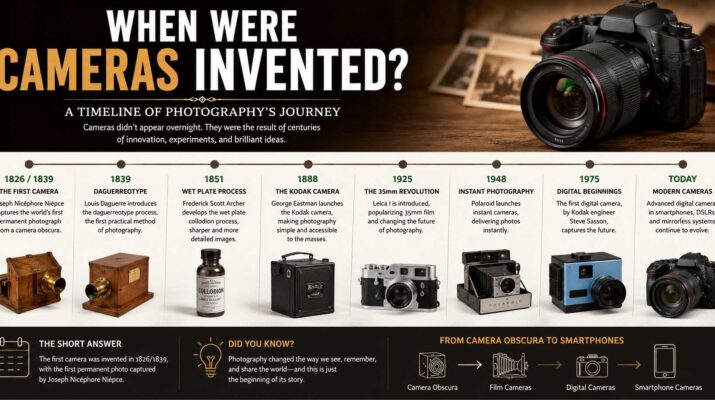
If you have ever wondered when were cameras invented, there isn’t just one date that tells the whole story. The basic idea behind a camera is centuries old, while practical photography arrived during the 1800s. Joseph Nicéphore Niépce created the earliest surviving photograph made with a camera in the 1820s, and Louis Daguerre introduced the daguerreotype process publicly in 1839. From there, cameras evolved through glass plates, flexible film, color photography, video, digital sensors, and eventually the tiny cameras built into modern smartphones.
Understanding that timeline explains why historians often separate the invention of the camera from the invention of photography. Long before anyone could permanently record an image, people already understood how to project one.
When Were Cameras Invented? The Quick Timeline
The easiest way to answer the question is to look at several major milestones rather than choosing a single invention date.
| Period | Major Development |
|---|---|
| Ancient era | Basic camera obscura principles were observed |
| 11th century | Ibn al-Haytham described camera obscura principles in detail |
| 1820s | Niépce produced the earliest surviving camera photograph |
| 1839 | Daguerreotype photography was publicly introduced |
| 1880s | Roll-film technology helped make cameras more practical |
| Early 1900s | Consumer photography expanded rapidly |
| Mid-1900s | Color photography became increasingly mainstream |
| 1950s onward | Video camera technology developed rapidly |
| 1975 | Kodak engineer Steven Sasson built an early self-contained digital camera prototype |
| 1990s | Consumer digital cameras became increasingly available |
| 2000s | Camera phones began transforming everyday photography |
| 2010s–today | Smartphones combined advanced sensors with computational photography |
So, if someone asks when the recognizable photographic camera appeared, the early 19th century is the key period. However, the optical principle behind it is far older.
The Camera Obscura Came Before Photography
Before photographic film or electronic sensors existed, inventors worked with a device known as the camera obscura.
The basic concept is surprisingly simple. As a result, an inverted image of the outside scene appears on the opposite surface.
Ancient thinkers recognized versions of this optical effect. Later, scholars studied it much more carefully.
The 11th-century scholar Ibn al-Haytham, also known as Alhazen, made major contributions to understanding optics and vision. His work helped explain how light traveling through a small opening could create an image.
Over time, artists and scientists used camera obscura devices as drawing aids and tools for studying perspective.
Still, there was one major limitation: the projected picture disappeared when the light disappeared.
The next challenge was finding a way to preserve that image.
Historical discussions of Renaissance technology also sometimes connect optical devices with famous inventors and artists. Readers interested in that broader period may find leonardo da vinci erfindungen useful for understanding how observation, mechanics, art, and scientific experimentation often overlapped.
The First Permanent Camera Photograph
The major breakthrough came from French inventor Joseph Nicéphore Niépce.
During the 1820s, Niépce experimented with light-sensitive materials and a camera obscura. Eventually, he created what is generally recognized as the oldest surviving photograph produced using a camera.
The image, known as View from the Window at Le Gras, showed a scene from his property in France.
However, early photography wasn’t convenient.
Exposure times were extremely long, while image quality and reproduction methods remained limited. Therefore, researchers continued searching for faster and more practical photographic processes.
Niépce later worked with Louis Daguerre. After Niépce died in 1833, Daguerre continued developing photographic technology.
That work helped lead to one of photography’s biggest early breakthroughs.
Why 1839 Is Such an Important Year for Cameras
In 1839, the daguerreotype process was announced publicly in France.
Daguerreotypes produced detailed images on silver-coated copper plates. Compared with earlier experiments, the process represented a major improvement and quickly attracted international attention.
Because of this breakthrough, 1839 is often treated as a landmark year in the history of practical photography.
However, Daguerre wasn’t working in isolation.
Around the same period, British inventor William Henry Fox Talbot developed photographic processes based on paper negatives. His negative-positive approach was especially significant because a negative could be used to create multiple positive prints.
That idea became fundamental to later photographic systems.
As a result, modern photography didn’t emerge from one invention. Instead, several discoveries gradually solved different technical problems involving optics, light-sensitive chemistry, exposure, reproduction, and camera design.
How Early Cameras Actually Worked
Early photographic cameras shared the same fundamental optical principle as modern cameras.
First, light reflected from a scene entered through a lens. Next, the lens focused that light onto a light-sensitive surface inside a dark enclosure.
The recording medium changed dramatically over time.
Early systems used chemically treated metal plates or paper. Later cameras used glass plates and photographic film. Modern digital cameras use electronic image sensors.
However, several core components remain recognizable:
- A light-tight camera body
- A lens for focusing light
- An aperture for controlling incoming light
- A shutter or exposure mechanism
- A light-sensitive recording surface
This combination lets a photographer control how an image reaches the recording medium.
The concept may sound simple today, yet generations of inventors had to improve chemistry, optics, mechanics, and manufacturing before photography became convenient for ordinary users.
Film Cameras Made Photography More Accessible
Early photography required specialized knowledge and cumbersome equipment.
Then, photography became much more accessible during the late 19th century.
George Eastman played a major role in this change. His company developed practical roll-film systems and introduced Kodak cameras aimed at ordinary consumers.
Instead of handling individual photographic plates, users could take multiple pictures on a roll.
Consequently, photography became easier to carry, use, process, and eventually afford.
This change mirrors the evolution of other analog technologies. For example, anyone learning how does a record player work will notice a similar pattern: early mechanical and analog systems gradually became more convenient as materials, manufacturing, and consumer design improved.
By the early 20th century, cameras were no longer tools reserved mainly for scientists and professional photographers. Families could increasingly use them to document holidays, children, travel, celebrations, and everyday life.
When Were Color Cameras Invented?
The question when were color cameras invented is slightly misleading because color photography developed through photographic processes rather than through one completely separate type of camera.
Experiments with color photography took place throughout the 19th century.
In 1861, physicist James Clerk Maxwell demonstrated an influential early color photographic experiment using three separate exposures made through red, green, and blue filters.
However, practical consumer color photography arrived much later.
The Autochrome process, introduced commercially by the Lumière brothers in 1907, became the first widely successful color photographic process.
Later, color film improved significantly.
Kodachrome, introduced in 1935, became one of the best-known color film products of the 20th century. Other color negative and transparency films followed, while processing became more widely available.
As a result, color photography gradually moved from a specialized technique to an everyday part of photography.
When Were Video Cameras Invented?
People asking when were video cameras invented are usually asking about technology that records moving electronic images rather than individual photographic frames.
Early television camera experiments developed during the first half of the 20th century.
Mechanical television systems appeared first. However, electronic television cameras became far more practical as electronic imaging technology advanced during the 1920s and 1930s.
Early systems were large, expensive, and intended mainly for television studios.
Later, video recording changed the industry.
Magnetic videotape systems allowed television images to be recorded and replayed instead of always being broadcast live. During the second half of the 20th century, video cameras became smaller and increasingly practical.
Camcorders then combined a camera and recorder into one portable device.
By the 1980s and 1990s, home video cameras had become familiar consumer products.
Eventually, digital video replaced much of the analog technology, while smartphones made video recording available to billions of people.
When Were Security Cameras Invented?
The history behind when were security cameras invented is closely connected with closed-circuit television, or CCTV.
One early CCTV system was developed in Germany in 1942 to observe V-2 rocket launches. The system allowed remote monitoring rather than conventional public television broadcasting.
However, security surveillance expanded much more gradually.
During later decades, CCTV systems appeared in commercial buildings, banks, public spaces, government facilities, and other locations where remote observation offered practical value.
Early security systems had major limitations. Cameras were bulky, storage was expensive, and analog video quality could be poor compared with modern standards.
Then digital recording, network connections, compact image sensors, and inexpensive storage changed the market.
Today, security cameras may include motion detection, remote viewing, night vision, cloud storage, local recording, smart notifications, and software-based object recognition.
When Were Digital Cameras Invented?
The answer to when were digital cameras invented depends on whether you’re asking about early electronic imaging or a self-contained digital camera.
Digital imaging technology developed through several stages.
In 1969, Willard Boyle and George E. Smith at Bell Labs invented the charge-coupled device, or CCD. This technology became highly influential in electronic imaging.
Then, in 1975, Kodak engineer Steven Sasson built an early self-contained digital camera prototype.
It looked nothing like today’s pocket-sized cameras.
The prototype used a CCD sensor, captured a black-and-white image at roughly 0.01 megapixels, and recorded the data onto a cassette tape. Capturing an image took seconds, while displaying it required separate equipment.
Nevertheless, the concept was revolutionary: a photograph could be captured electronically without photographic film.
Commercial digital photography grew during the following decades.
By the 1990s, consumer digital cameras were becoming increasingly practical. Then, throughout the 2000s, improving resolution, memory cards, rechargeable batteries, LCD screens, and falling prices accelerated adoption.
From Digital Cameras to Smartphone Photography
The arrival of the digital camera didn’t end camera development.
Instead, it opened another major chapter.
Early consumer digital cameras initially competed with film cameras. However, their biggest advantage was convenience. Users could review photos immediately, delete unwanted shots, transfer files to computers, and take many pictures without purchasing new film.
Then camera phones changed user behavior again.
Early camera-equipped mobile phones appeared around the turn of the 21st century. At first, image quality was limited. Yet sensors, lenses, processors, and software improved quickly.
Modern smartphones now use multiple cameras, optical stabilization, high-resolution sensors, computational photography, HDR processing, low-light algorithms, and sophisticated autofocus.
As a result, the camera has shifted from a dedicated device that people intentionally carried to something billions of users keep in their pockets every day.
Photography and the History of Communication Technology
Cameras didn’t evolve alone. Instead, their history overlaps with broader attempts to capture, store, and transmit information.
Photography preserved visual information. Meanwhile, technologies such as the telegraph allowed information to travel quickly over long distances.
Learning how does morse code work provides an interesting comparison because both technologies transformed communication during the 19th century, although they solved very different problems.
Photography recorded visual moments, while telegraph systems encoded messages for transmission.
Later technologies began combining these ideas.
Television transmitted moving images, digital networks moved photographs around the world, and smartphones eventually combined photography, video, messaging, computing, and internet communication in one device.
Film Cameras vs Digital Cameras
Although digital photography dominates everyday use today, film hasn’t disappeared.
| Feature | Film Camera | Digital Camera |
|---|---|---|
| Recording medium | Photographic film | Electronic sensor |
| Image review | After processing | Usually immediate |
| Per-shot cost | Film and processing required | Usually minimal after purchase |
| Storage | Physical negatives/prints | Memory cards or internal storage |
| Editing | Darkroom or scanned workflow | Software-based workflow |
| ISO behavior | Determined largely by loaded film | Adjustable electronically |
| Typical appeal today | Analog process and distinctive film characteristics | Convenience, speed, flexibility |
Film remains popular with some enthusiasts because the shooting process is deliberate and different from digital photography.
Digital cameras, meanwhile, provide immediate feedback and efficient workflows for casual users and professionals.
Neither format changes the basic idea behind a camera: controlled light creates an image on a recording medium.
How Camera Technology Changed Everyday Life
The earliest photographers could wait hours for a single exposure.
Today, a smartphone can capture dozens of high-resolution photographs in seconds.
That enormous shift came from improvements across several technologies.
Lens manufacturing became more precise. Shutters became faster. Film became more sensitive. Electronic sensors improved. Storage became cheaper. Meanwhile, processors became powerful enough to enhance images instantly.
Cameras also became useful far beyond personal photography.
Scientists use specialized cameras to observe phenomena humans cannot easily see. Manufacturers use machine-vision cameras for inspection and automation. Vehicles use cameras for driver-assistance systems. Doctors use imaging equipment in many diagnostic and procedural applications. Spacecraft use cameras to document distant worlds.
Therefore, the history of the camera isn’t simply the story of photography. It’s also part of the broader development of optical sensing and information technology.
FAQs About When Cameras Were Invented
When was the first camera invented?
Camera obscura devices existed centuries before photography. However, practical photographic cameras emerged during the early 19th century, while Niépce created the earliest surviving camera photograph in the 1820s.
Who invented the camera?
There isn’t one single inventor of the camera. Many people contributed to its development, including Ibn al-Haytham, Joseph Nicéphore Niépce, Louis Daguerre, William Henry Fox Talbot, George Eastman, and later electronic-imaging pioneers.
Was the camera invented in 1816?
Niépce was conducting early photographic experiments around this period, but camera history cannot be reduced to one year. His earliest surviving photograph dates from the 1820s.
Why is 1839 important in photography history?
In 1839, the daguerreotype process was publicly introduced. The event helped launch photography as a practical technology with international interest.
When did cameras become common?
Cameras became increasingly accessible during the late 19th and early 20th centuries, especially after roll film and easy-to-use consumer cameras reduced the complexity of photography.
When did digital cameras become popular?
Digital cameras grew rapidly during the 1990s and became mainstream consumer products during the late 1990s and 2000s. Later, smartphones replaced dedicated compact cameras for many everyday users.
Were cameras invented before electricity?
Yes. Early photographic cameras relied on optics and chemical light-sensitive materials rather than electricity.
From a Dark Box to a Camera in Every Pocket
So, when were cameras invented? The best answer depends on what you call a camera. The camera obscura established the optical principle centuries ago, Niépce successfully preserved a camera-made image in the 1820s, and the daguerreotype helped turn photography into a practical technology in 1839.
After that, progress accelerated. Roll film made photography accessible, color processes made images more lifelike, video captured motion electronically, and digital sensors removed the need for film. Smartphones then placed sophisticated cameras into devices people carry everywhere.
Yet the basic principle remains remarkably familiar: collect light, control how it enters, focus it, and record the resulting image. What changed over the centuries was our ability to make that process faster, smaller, cheaper, and dramatically more capable.