
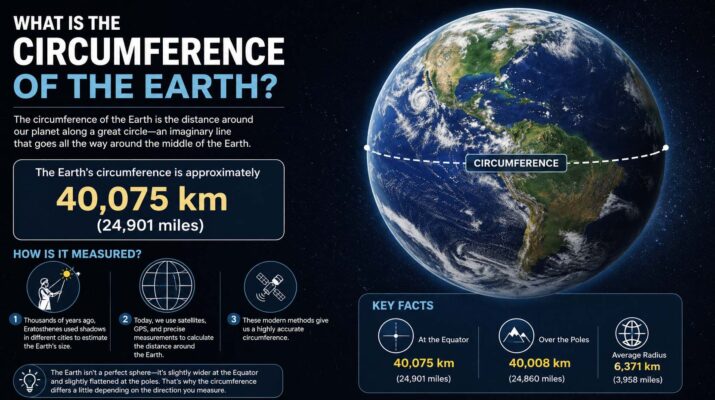
The question has fascinated scientists, explorers, and students for centuries. The circumference of Earth refers to the total distance around the planet. Measuring this distance helped ancient civilizations better understand geography, navigation, and astronomy. Today, modern science provides highly accurate calculations of Earth’s size, shape, and dimensions.
Earth is not a perfect sphere. Instead, it is slightly flattened at the poles and wider around the equator. Because of this shape, known as an oblate spheroid, the circumference varies depending on where it is measured. Even with this variation, the planet’s circumference remains one of the most important measurements in geography and science.
Understanding Earth’s circumference has helped humans improve navigation systems, map the globe, launch satellites, and even travel into space. The measurement also demonstrates how advanced ancient mathematics and astronomy were long before modern technology existed.
What Is the Circumference of the Earth in Miles
One of the most common questions people ask is: What is the circumference of the Earth in miles? The equatorial circumference is approximately 24,901 miles. This measurement is taken around the widest part of the planet at the equator.
The polar circumference, which measures around the poles, is slightly smaller at about 24,860 miles. The small difference exists because Earth bulges outward near the equator due to its rotation. Even though the difference is relatively minor, it is scientifically significant.
To better understand this distance, imagine traveling around the entire planet by car or airplane. Covering nearly 25,000 miles would require crossing oceans, continents, and multiple time zones. This enormous distance highlights the true scale of our planet.
Scientists use satellites and what is telemetry technology alongside advanced mathematical models to calculate Earth’s exact dimensions. These calculations are important for aviation, navigation, climate research, and space exploration.
The History of Measuring Earth’s Circumference
The effort to measure Earth’s circumference dates back more than two thousand years. The ancient Greek mathematician Eratosthenes produced one of the earliest estimates. His method was remarkably accurate despite the limited tools available during that time.
Eratosthenes noticed that sunlight hit different cities at different angles during the same time of day. By comparing shadows in two locations and calculating the distance between them, he estimated Earth’s circumference with impressive precision.
His work demonstrated that Earth was round and provided one of the earliest scientific measurements of the planet’s size. Modern scientists admire his achievement because it relied mainly on observation, geometry, and logical reasoning.
What Is the Circumference of Earth
The phrase “what is the circumference of Earth” is commonly searched by students and curious learners who want to understand the planet’s size. Earth’s circumference depends on the specific line used to measure around the globe.
At the equator, the circumference is larger because Earth bulges outward. At the poles, the circumference is slightly smaller due to the planet’s flattened shape. This phenomenon occurs because Earth rotates continuously, creating centrifugal force that pushes the equator outward.
Earth’s average circumference is often rounded to about 24,900 miles or 40,075 kilometers. These measurements are widely used in textbooks, scientific studies, and educational materials worldwide.
Knowing Earth’s circumference is essential in many scientific fields. Geographers use it for mapping, while students exploring aerial surveying may also learn what is a drone and how this technology supports modern geographic research. Pilots and ship navigators also rely on accurate Earth measurements for global travel routes.
Earth’s Shape and Rotation
Although many people imagine Earth as a perfect ball, the planet actually has a slightly oval shape. Scientists describe Earth as an oblate spheroid because it is wider at the equator and flatter near the poles.
Earth rotates once approximately every 24 hours. This constant rotation affects the planet’s shape and contributes to the difference between equatorial and polar circumference measurements.
The rotation of Earth also creates day and night, influences weather patterns, and affects ocean currents. Understanding what is dimensional analysis can help students see how scientists compare measurements and study these natural systems more effectively.
What Is the Circumference of the Earth at the Equator
Many people specifically ask what the circumference of the Earth is at the equator because this is the planet’s largest circumference measurement.
The equator is an imaginary line that divides Earth into the Northern Hemisphere and Southern Hemisphere. Because Earth bulges outward at this point, the equatorial measurement is slightly greater than the polar circumference.
The equator passes through several countries across South America, Africa, and Asia. Regions near the equator often experience warm climates and relatively consistent daylight throughout the year.
Why Earth’s Circumference Matters
Earth’s circumference is not just an interesting scientific fact. It plays an important role in many aspects of modern life. GPS systems rely on precise Earth measurements to provide accurate navigation. Without understanding Earth’s dimensions, modern mapping technology would not function properly.
Space agencies also use Earth’s circumference when launching satellites and planning missions. The planet’s size influences orbital paths and communication systems.
Climate scientists use Earth measurements to study weather systems, ocean currents, and environmental changes. Accurate calculations help researchers predict storms, monitor global warming, and understand natural disasters.
What Is the Circumference of the Earth?
The question “What is the circumference of the Earth?” remains one of the most fundamental scientific questions about our planet. The answer depends slightly on where the measurement is taken, but Earth’s average circumference is approximately 24,900 miles or 40,000 kilometers.
This measurement represents the incredible size of our world and highlights the achievements of scientists throughout history. From ancient Greek mathematicians to modern space agencies, understanding Earth’s circumference has shaped human knowledge and exploration.
Conclusion
Understanding Earth’s circumference helps people appreciate the scale and complexity of our planet. Earth’s circumference is approximately 24,901 miles at the equator and slightly smaller around the poles due to the planet’s oblate shape.