
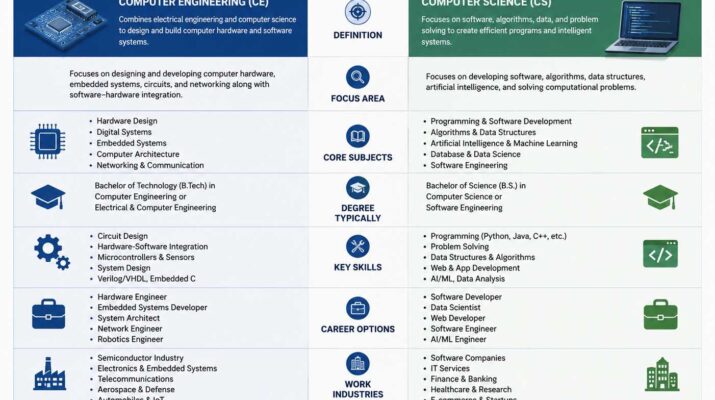
Choosing between computer engineering vs computer science can feel confusing because both degrees involve computers, programming, and problem-solving. However, the two fields focus on different aspects of technology. Understanding these differences can help you select a degree that matches your interests and career goals.
Computer engineering combines electrical engineering and computing to design hardware and integrated systems. In contrast, computer science focuses primarily on software, algorithms, data, and computational theory.
Although both fields offer opportunities in technology, their coursework and career paths differ. For example, computer engineers often work with processors, electronic circuits, and embedded devices. Meanwhile, computer science graduates commonly develop applications, software systems, and artificial intelligence tools.
If you’re new to technology, learning basic coding concepts can help you discover whether programming interests you. In addition, trying small technology projects can give you a clearer understanding of both fields.
This guide compares the two degrees, including subjects, programming requirements, career opportunities, salary potential, and practical considerations.
Computer Engineering vs Computer Science: Quick Comparison
The following table highlights the main differences between these technology degrees.
| Feature | Computer Engineering | Computer Science |
|---|---|---|
| Main focus | Hardware and software integration | Software, algorithms, and computation |
| Programming | Significant | Extensive |
| Electronics | Major component | Usually limited |
| Mathematics | Extensive | Extensive |
| Circuit design | Common | Rare |
| Operating systems | Common | Common |
| Embedded systems | Major specialization | Available in some programs |
| Artificial intelligence | Hardware and embedded applications | Algorithms, models, and software |
| Typical projects | Microcontrollers, processors, robotics | Applications, databases, AI systems |
| Career examples | Hardware engineer, firmware engineer | Software developer, data scientist |
Although the two degrees share foundational subjects, their practical applications differ.
For example, computer engineering students may design electronic systems that run software. Computer science students, on the other hand, may develop the software that controls those systems.
Therefore, your preferred type of project can help determine which degree suits you.
What Is Computer Engineering?
Computer engineering combines principles from electrical engineering and computer science. As a result, students learn how hardware and software work together to create functional computing systems.
Its primary goal is to develop computer hardware and systems that integrate physical components with software. For example, engineers may design processors, embedded controllers, and electronic devices.
In addition, students study electronic design, programming, and system integration. These subjects help them understand how computers operate from the component level.
What Do Computer Engineering Students Learn?
Typical subjects include:
- Computer processors
- Digital circuits
- Microcontrollers
- Embedded systems
- Networking hardware
- Computer architecture
- Robotics
- Firmware development
In addition, students learn how electronic components communicate and how software interacts with hardware.
For example, a computer engineer might design a microcontroller-based system that collects information from sensors and controls a physical device.
Therefore, computer engineering requires both practical electronics knowledge and programming skills.
What Do Computer Engineers Build?
Computer engineers contribute to products such as:
- Smartphones
- Medical devices
- Automotive control systems
- Industrial robots
- Smart home products
- Internet of Things devices
- Computer processors
However, their responsibilities vary by employer and specialization.
Some engineers focus on electronic design, while others develop firmware or test integrated systems.
Many embedded devices also rely on specialized startup software. Therefore, understanding what is a bootloader can help students learn how hardware initializes before running an operating system or application.
As a result, computer engineering graduates can contribute to different stages of hardware and system development.
What Is Computer Science?
Computer science studies computation, software, algorithms, and information processing. In particular, it examines how computers process information and solve problems.
Although programming plays a major role, the field also explores mathematical reasoning and computational theory.
Therefore, computer science is broader than simply learning to write code.
For example, computer scientists may develop algorithms that improve data processing or create software systems that automate complex tasks.
What Do Computer Science Students Learn?
Common subjects include:
- Programming languages
- Data structures
- Algorithms
- Artificial intelligence
- Databases
- Operating systems
- Software development
- Cybersecurity
- Cloud computing
In addition, students study mathematical concepts that support software design and computational problem-solving.
For example, algorithms help developers organize information, process data, and improve software performance.
As a result, computer science students develop skills that apply across many technology industries.
What Do Computer Scientists Create?
Computer science graduates may develop:
- Mobile applications
- Websites
- Operating systems
- Video games
- Artificial intelligence systems
- Enterprise software
- Database applications
However, not every computer science graduate becomes a software developer.
Some pursue research, cybersecurity, data science, or systems engineering.
For instance, a computer science graduate might work on software that detects suspicious network activity.
As a result, the degree offers several possible career directions.
Key Differences Between Computer Engineering and Computer Science
Although both degrees teach computing fundamentals, they approach technology from different perspectives.
Hardware and Electronics
Computer engineering places greater emphasis on physical computing components.
For example, students may study electronic circuits, processor architecture, and communication between hardware devices.
Computer science programs generally focus less on electronic circuit design.
Instead, they emphasize software behavior, algorithms, and computational systems.
Therefore, students interested in electronic devices may find computer engineering more suitable.
Programming and Software Development
Both degrees require programming skills.
However, computer science typically provides more extensive coursework in software development and algorithm design.
Computer engineering students also write code, particularly when working with firmware and embedded systems.
For example, an embedded engineer may program a microcontroller to control a motor.
Meanwhile, a software developer may create an application that monitors the motor’s performance.
Therefore, programming is important in both fields, even though its applications differ.
Mathematics and Physics
Both programs require mathematical reasoning.
Computer engineering often includes:
- Calculus
- Differential equations
- Linear algebra
- Physics
- Electrical circuit analysis
Meanwhile, computer science commonly emphasizes:
- Discrete mathematics
- Algorithms
- Probability
- Statistics
- Linear algebra
- Computational theory
However, specific requirements depend on the university.
For example, some computer science programs include advanced calculus, while certain engineering programs place greater emphasis on physics.
Practical Projects
Computer engineering projects often involve physical equipment.
For example, students may program microcontrollers, test circuits, or build robotic systems.
Computer science projects usually focus on software.
As a result, students might create applications, develop databases, or implement machine learning algorithms.
Nevertheless, interdisciplinary projects frequently combine both fields.
Subjects You’ll Study in Each Degree
University curricula vary, but most programs share several foundational subjects.
However, the balance between electronics and software courses usually reveals the biggest difference.
Common Computer Engineering Courses
Typical courses include:
- Digital Logic
- Computer Architecture
- Embedded Systems
- Electronics
- Microprocessors
- Signals and Systems
- Computer Networks
- Operating Systems
In addition, computer engineering programs often include laboratory sessions.
For example, students may connect sensors to microcontrollers and develop systems that collect information.
These projects introduce concepts related to what is telemetry, including remote measurement and data transmission.
Therefore, practical laboratory experience plays an important role in understanding hardware behavior.
Common Computer Science Courses
Computer science programs frequently include:
- Programming Fundamentals
- Object-Oriented Programming
- Algorithms
- Data Structures
- Software Engineering
- Database Systems
- Artificial Intelligence
- Machine Learning
- Cybersecurity
Although computer science students may complete hardware-related courses, most projects emphasize software and computational methods.
For example, a final-year project might involve building a mobile application or training a machine learning model.
In addition, students often develop teamwork and software testing skills through group projects.
Which Degree Has More Programming?
Computer science generally involves more extensive programming coursework. For example, students develop applications, implement algorithms, and work with different software development tools.
Common programming languages include:
- Python
- Java
- C++
- JavaScript
- SQL
- C#
However, language requirements vary by university and specialization.
Meanwhile, computer engineering students also learn programming, particularly for embedded devices and hardware control.
Common technologies include:
- C
- C++
- Assembly language
- Verilog
- VHDL
Verilog and VHDL are hardware description languages rather than conventional software programming languages.
Therefore, students use them to describe and design digital hardware.
If you enjoy building websites, applications, and software systems, computer science may be more appealing.
On the other hand, computer engineering may suit you if you prefer programming physical devices.
As a result, both degrees require coding skills, although their programming applications differ.
Hardware vs Software: What Do Graduates Build?
One practical way to compare these degrees is to examine the products their graduates help create.
For example, hardware specialists design physical computing components, while software specialists develop programs that run on those components.
Computer Engineering Projects
Computer engineers may contribute to:
- Computer processors
- Motherboards
- Embedded devices
- Robotics systems
- Smart sensors
- Electronic control systems
For example, an engineer might develop a controller that manages temperature sensors in an industrial machine.
In addition, hardware engineers often collaborate with firmware developers to ensure that the system operates correctly.
Therefore, their work frequently involves testing both electronic components and software behavior.
Computer Science Projects
Computer science graduates may develop:
- Mobile applications
- Desktop software
- Websites
- Artificial intelligence systems
- Operating systems
- Video games
- Business software
For example, a software developer might create an application that displays information from an industrial monitoring system.
Therefore, both fields can contribute to the same technology product.
A smartphone illustrates this relationship. Hardware engineers design its electronic components, while software developers create applications and system software.
As a result, successful technology products often depend on collaboration between both disciplines.
Career Opportunities in Both Fields
Graduates from both programs can pursue technology careers. However, the available roles depend on technical skills, experience, specialization, and local employment markets.
For instance, computer engineering graduates may work in hardware development or embedded systems. In contrast, computer science graduates often pursue software engineering, cybersecurity, or data science.
Therefore, students should consider their preferred responsibilities when comparing career opportunities.
Careers in Computer Engineering
Common career paths include:
- Computer Hardware Engineer
- Embedded Systems Engineer
- Robotics Engineer
- Network Hardware Engineer
- Firmware Engineer
- IoT Engineer
- Systems Engineer
Computer engineering graduates may work in:
- Electronics manufacturing
- Automotive technology
- Aerospace
- Semiconductor development
- Industrial automation
- Telecommunications
For example, an embedded systems engineer may develop firmware for automotive electronics.
Meanwhile, a hardware engineer might help design and test processor components.
In addition, robotics companies often need engineers who understand both electronic systems and programming.
Careers in Computer Science
Common career paths include:
- Software Engineer
- Web Developer
- Mobile App Developer
- AI Engineer
- Data Scientist
- Cybersecurity Analyst
- Cloud Engineer
- Game Developer
Computer science graduates work across many industries, including finance, healthcare, education, entertainment, and technology.
For example, a software engineer may develop business applications, while a cybersecurity analyst helps protect computer systems.
In addition, computer science graduates can pursue advanced study in artificial intelligence or computational research.
Therefore, the degree can support both practical software careers and academic research.
Computer Science vs Computer Engineering: Which Is Harder?
Neither degree is universally harder.
Instead, each presents different academic challenges.
Computer engineering often requires strong knowledge of:
- Physics
- Electrical engineering
- Circuit design
- Hardware troubleshooting
- Embedded programming
Computer science emphasizes:
- Algorithms
- Mathematical logic
- Programming
- Computational thinking
- Software architecture
For example, students who struggle with physics may find certain computer engineering courses challenging.
On the other hand, students who dislike abstract mathematics may struggle with advanced computer science theory.
Therefore, the difficulty depends partly on your interests, strengths, and university curriculum.
In addition, consistent practice and practical projects can make challenging subjects easier to understand.
Computer Science vs Software Engineering
Students also frequently compare computer science with software engineering.
Although the fields overlap, their educational emphasis can differ.
Computer Science
Computer science examines computing principles and the theory behind software systems.
Its subjects commonly include:
- Algorithms
- Data structures
- Computational theory
- Artificial intelligence
- Programming
- Computer systems
Therefore, the degree can provide a strong foundation for software development and research.
For example, students may study how algorithms affect software efficiency.
Software Engineering
Software engineering focuses on designing, developing, testing, and maintaining reliable software products.
Its major topics include:
- Software architecture
- Team collaboration
- Project management
- Software testing
- Development processes
- Quality assurance
For example, software engineering students may spend more time studying how teams deliver and maintain large applications.
However, computer science programs also teach many of these practical skills.
As a result, graduates from both disciplines often pursue similar software development positions.
Software Engineering vs Computer Science: Career Differences
Software engineering and computer science graduates frequently compete for similar jobs.
However, their educational backgrounds may emphasize different strengths.
Computer science students often study the theoretical foundations of computing in greater depth.
Meanwhile, software engineering programs may devote additional attention to software development processes and project management.
For example, someone interested in algorithms or computing research may prefer computer science.
In contrast, someone who enjoys coordinating software projects may find software engineering particularly appealing.
Nevertheless, either degree can lead to software development careers.
Therefore, practical experience and technical skills often matter more than small differences between degree titles.
Computer Science vs Engineering: The Broader Comparison
The phrase computer science vs engineering can also refer to differences between computing and traditional engineering disciplines.
Engineering programs commonly apply mathematics and science to design practical systems.
For example, engineering students may work with:
- Mechanical systems
- Electronics
- Manufacturing processes
- Physical equipment
- Industrial infrastructure
Computer science focuses on computation, software, information, and algorithms.
However, the distinction isn’t absolute because engineering also includes software-related disciplines.
Computer engineering connects these areas by combining computing knowledge with electronic system design.
For example, electrical reliability matters when building hardware. Understanding what is continuity can help future engineers recognize how electrical connections support functioning circuits.
Therefore, computer engineering can appeal to students interested in both physical systems and computing.
Skills You’ll Develop During Your Degree
Both programs develop technical and analytical skills.
However, their practical training emphasizes different activities.
Computer Engineering Skills
Students commonly develop skills in:
- Circuit design
- Hardware debugging
- Embedded programming
- Printed circuit board fundamentals
- Electronics testing
- System integration
- Technical troubleshooting
For example, hardware debugging requires students to identify faults in electronic systems and test possible solutions.
In addition, laboratory projects help students understand how components behave under different conditions.
Computer Science Skills
Students commonly develop skills in:
- Software development
- Problem-solving
- Algorithm design
- Database management
- Programming
- Software architecture
- Software testing
For example, software developers use debugging and testing to identify errors and improve application reliability.
Meanwhile, algorithm design helps students create efficient solutions to computational problems.
Communication and Teamwork
Technical knowledge alone doesn’t guarantee career success.
In addition, engineers and software developers often collaborate with colleagues from different departments.
Therefore, communication, teamwork, documentation, and project planning are valuable skills.
Understanding what do engineers do can also help students explore how technical professionals solve problems and contribute to real-world projects.
As a result, developing interpersonal skills alongside technical abilities can improve career preparation.
Which Degree Is Better for Artificial Intelligence?
Computer science is often the more direct educational route into AI software development and research.
This is because artificial intelligence relies heavily on programming, mathematics, data processing, and algorithms.
Relevant subjects include:
- Machine Learning
- Neural Networks
- Data Science
- Natural Language Processing
- Computer Vision
For example, computer science graduates may develop machine learning models or AI-powered applications.
However, computer engineers also contribute to artificial intelligence.
Their work may involve:
- AI accelerators
- Specialized processors
- Embedded AI devices
- Edge computing systems
- Robotics hardware
As a result, both degrees can lead to AI careers, although the technical focus differs.
If you’re mainly interested in developing AI algorithms, computer science may be the better starting point.
On the other hand, computer engineering may suit you if you want to build hardware that runs AI systems efficiently.
Therefore, your preferred AI specialization should guide your degree choice.
Salary Potential and Job Outlook
Both degrees can lead to well-paid careers. However, salaries depend on the job title, location, industry, experience, and technical specialization.
Factors affecting earnings include:
- Professional experience
- Industry
- Geographic location
- Educational qualifications
- Specialized skills
- Employer size
- Job responsibilities
For example, a software developer and a computer hardware engineer may earn different salaries even when they have similar experience.
In addition, employment opportunities vary by region.
For reliable U.S. occupational information, consult the U.S. Bureau of Labor Statistics Occupational Outlook Handbook.
It provides information about occupations, education requirements, pay, and employment outlook.
However, U.S. salary figures shouldn’t be treated as representative of every country.
Therefore, students should compare local job listings and salary information before making a decision.
In addition, reviewing employer requirements can help students identify valuable technical skills.
Which Degree Fits Your Interests?
The best degree depends on what you enjoy studying and the type of problems you want to solve.
Therefore, consider your preferred activities before choosing a university program.
Choose Computer Engineering If You Enjoy
- Electronics
- Robotics
- Computer hardware
- Building physical devices
- Embedded systems
- Circuit design
For example, computer engineering may appeal to someone who enjoys assembling electronic projects and programming microcontrollers.
In addition, it can provide a foundation for careers involving hardware and software integration.
Choose Computer Science If You Enjoy
- Coding
- Software development
- Artificial intelligence
- Algorithmic problem-solving
- Application development
- Cloud computing
For example, computer science may suit someone who enjoys creating websites, developing applications, or solving programming challenges.
Therefore, consider your interests before comparing degree titles or prestige.
Common Misunderstandings About Both Degrees
Several misconceptions make it harder for students to choose between these fields.
However, understanding the actual coursework can help you avoid these assumptions.
Computer Engineering Doesn’t Involve Coding
This is incorrect.
Computer engineers often write substantial amounts of code, especially when developing firmware and embedded systems.
For example, programming allows a microcontroller to communicate with sensors and control connected equipment.
Therefore, coding remains an important computer engineering skill.
Computer Science Only Teaches Programming
Computer science involves much more than writing code.
Students also study:
- Mathematics
- Algorithms
- Operating systems
- Data structures
- Artificial intelligence
- Computational theory
As a result, computer science develops both practical programming abilities and theoretical knowledge.
For example, students learn why certain algorithms solve problems more efficiently than others.
Both Degrees Lead to Exactly the Same Jobs
The career paths overlap, but they aren’t identical.
For example, hardware-focused employers may prefer candidates with electronics and circuit design experience.
Meanwhile, software development employers may prioritize programming, algorithms, and application development skills.
However, graduates can move between certain roles by developing the necessary expertise.
Therefore, the skills you develop can influence your career options as much as your degree title.
Tips Before Choosing a Technology Degree
Before applying to a university, consider your interests and career expectations.
Start by asking yourself:
- Do I enjoy working with electronics?
- Would I like to build physical devices?
- Do I prefer writing software?
- Am I more interested in hardware or software problems?
- Do I want to work in AI, robotics, or cybersecurity?
- Do I enjoy mathematics and logical problem-solving?
Next, review the curriculum of each university.
For example, compare the number of electronics, programming, mathematics, and laboratory courses.
In addition, consider trying small beginner projects.
You could:
- Write a simple Python program.
- Build a basic website.
- Experiment with an Arduino or similar development board.
- Explore introductory electronics lessons.
- Speak with current students or graduates.
These activities can help you understand what studying each subject feels like.
Finally, research internships and entry-level jobs in your preferred industry.
As a result, you’ll have a clearer picture of the education and experience required for your preferred career.
Frequently Asked Questions
Is Computer Engineering Better Than Computer Science?
Neither degree is better for everyone.
Computer engineering emphasizes hardware and integrated computing systems. In contrast, computer science focuses more on software, algorithms, and computational theory.
Therefore, the best option depends on your interests and career plans.
Can Computer Engineers Become Software Engineers?
Yes. Many computer engineering graduates pursue software development careers.
Because their programs include programming and computing fundamentals, they may already have relevant technical knowledge.
However, additional software projects and experience can improve their preparation.
Which Degree Has Better Job Opportunities?
Both fields offer career opportunities.
Software development includes a broad range of occupations across many industries. Meanwhile, computer engineering supports specialized careers involving hardware, embedded systems, and electronics.
Therefore, compare employment opportunities in your preferred location rather than assuming one degree always guarantees more jobs.
Is Mathematics Important in Both Degrees?
Yes. Mathematics supports both fields.
For example, computer engineering uses mathematics in circuit analysis and system design.
Computer science, on the other hand, applies mathematical reasoning to algorithms, data structures, and computational theory.
However, specific mathematics requirements vary by program.
Can I Work in AI With a Computer Engineering Degree?
Yes. Computer engineering graduates can work with AI hardware, embedded AI, robotics, and specialized computing systems.
In addition, they can pursue AI software roles by developing strong programming, mathematics, and machine learning skills.
However, computer science is often the more direct route for students interested primarily in AI algorithms and software research.
Making the Right Choice
When comparing computer engineering vs computer science, the best decision comes down to your interests, strengths, and career goals.
Computer engineering may suit you if you enjoy electronics, processors, robotics, and embedded systems. In contrast, computer science may be a better fit if you prefer software development, algorithms, applications, or artificial intelligence.
Although their coursework differs, both degrees provide valuable technical foundations.
Therefore, focus on choosing a program that matches the work you want to do. In addition, build practical skills through personal projects, internships, and continuous learning.
With the right preparation, either degree can support a rewarding career in technology.