
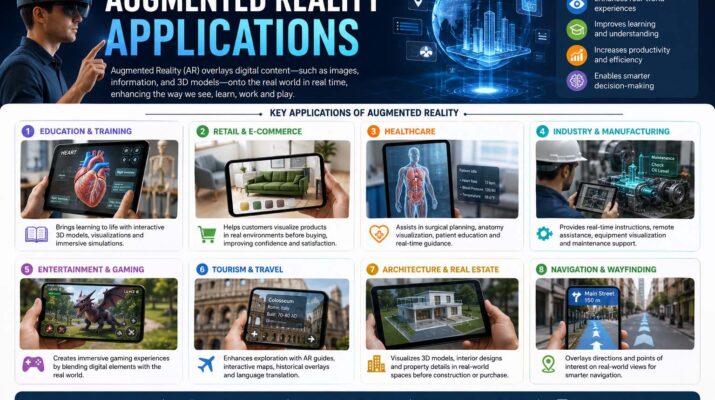
Augmented reality applications are changing how people interact with technology in everyday life. From gaming and shopping to healthcare and manufacturing, augmented reality (AR) combines digital information with physical surroundings. Unlike virtual reality, which creates an immersive digital environment, AR adds virtual elements to the real world through smartphones, tablets, smart glasses, and other compatible devices.
Businesses, schools, and industrial companies are exploring AR because it can improve efficiency, engagement, and user experiences. However, the benefits depend on the technology, its implementation, and the needs of individual users.
Similar interactive technologies appear in what are haptics, where touch-based feedback enhances digital interactions. Together, these technologies support increasingly interactive experiences across industries in 2026 and beyond.
Augmented Reality Applications in Industrial Workplaces
One important use of AR involves supporting workers in industrial environments. Manufacturing companies can use augmented reality systems to simplify complex tasks, provide visual instructions, and improve access to technical information.
Instead of relying entirely on printed manuals or separate computer screens, employees can view instructions directly on equipment through compatible AR glasses or mobile devices.
Augmented Reality for Equipment Maintenance
Maintenance teams can use augmented reality to identify machine components and follow step-by-step repair instructions.
For example, an AR application might highlight a component that requires inspection. It could also display maintenance procedures beside the actual equipment.
As a result, technicians may spend less time searching for information. However, the system must provide accurate instructions and should not replace required safety procedures.
AR Applications for Warehouse Management and Training
Warehouse employees can use AR tools to locate products, follow picking instructions, and identify storage locations.
These systems may help reduce navigation time and picking errors when companies integrate them with accurate inventory data.
Training also becomes more interactive. Instead of learning through classroom instruction alone, workers can practice procedures using digital overlays on real equipment.
Many industrial systems combine mechanics, electronics, and software. This integration relates closely to what is mechatronics?.
Augmented Reality for Workplace Safety
AR systems can display hazard warnings, equipment instructions, and restricted-area indicators.
For instance, a maintenance application may highlight a potentially dangerous component before a technician begins work.
Nevertheless, digital warnings cannot replace physical safeguards, appropriate training, or established workplace safety requirements.
Augmented Reality Applications in Manufacturing
Manufacturers use AR for product design, assembly assistance, quality inspection, and remote technical support.
These applications connect digital information with real production environments. Consequently, workers can access relevant guidance without constantly switching between equipment and external documents.
AR Applications for Product Design and Assembly
Engineers can visualize digital prototypes in real-world environments before creating physical products.
For example, a design team might place a virtual machine model inside a factory layout. This allows them to evaluate dimensions, positioning, and accessibility.
During assembly, AR can display component locations and procedural instructions. Such guidance may reduce confusion when employees perform complicated tasks.
However, companies still need to validate designs and inspect finished products through appropriate engineering processes.
Augmented Reality for Quality Inspection and Remote Assistance
Quality inspection teams can compare physical products with digital models or reference instructions.
AR overlays may highlight inspection points and help workers identify components requiring closer examination.
Remote collaboration provides another useful application. Experts in different locations can guide technicians through troubleshooting using shared visual information.
Some organizations also combine these tools with what is telemetry systems to monitor equipment and transmit operational data.
Automotive, aerospace, and electronics manufacturers are among the industries exploring these capabilities.
Augmented Reality Applications for Businesses
Businesses use AR to help customers visualize products, explore spaces, and interact with digital content.
Retailers, real estate companies, and marketing teams can create experiences that connect online information with physical environments.
Augmented Reality in Retail and Shopping
Retail companies can use AR to let customers preview products before purchasing them.
For example, furniture applications allow shoppers to place virtual sofas or tables inside their homes. Customers can examine approximate size, appearance, and placement through a smartphone camera.
Similarly, beauty brands may provide virtual makeup demonstrations.
These features can make shopping more convenient. However, digital previews may not perfectly reproduce physical dimensions, lighting, colors, or materials.
AR Applications for Real Estate and Property Planning
Real estate businesses can use AR to display virtual furniture, room layouts, and renovation concepts within physical spaces.
For example, potential buyers may explore how a room could look with different furnishings.
This approach can help users understand possible design arrangements before making decisions.
However, AR property visualization differs from a fully virtual tour. Virtual tours often use panoramic images or simulated environments, while AR places digital content within a real-world view.
Augmented Reality for Marketing and Customer Engagement
Marketing teams can create interactive advertisements, product demonstrations, and branded AR experiences.
For instance, a company might offer a mobile filter that lets customers preview a product in their surroundings.
Such experiences can encourage exploration and provide additional product information.
Nevertheless, business results depend on usability, audience interest, and the quality of the experience.
Augmented Reality Applications in Education
Educational institutions can use AR to make lessons more interactive and visually engaging.
Students may explore three-dimensional models, historical reconstructions, and scientific simulations through compatible devices.
These experiences can support classroom instruction by making difficult concepts easier to visualize.
AR Applications for Science and Medical Education
AR can help students examine anatomical structures, planetary systems, and scientific models.
For example, a biology student might explore a three-dimensional model of the human heart. The application could highlight chambers, blood vessels, and other anatomical features.
Medical training programs may also use AR to demonstrate procedures or illustrate spatial relationships.
However, these tools should supplement accurate educational resources and supervised practical training.
Augmented Reality for History and Interactive Learning
History teachers can use AR to display digital reconstructions of buildings, artifacts, and historical locations.
Students may examine a virtual representation of an ancient structure while learning about its historical context.
Similarly, interactive models can help learners explore engineering principles and geometric concepts.
Developing these experiences often involves programming and software design. Students interested in those foundations can explore basic coding concepts.
How Augmented Reality Applications Work
AR systems combine camera input, device sensors, software, and digital graphics to place virtual objects within a real-world view.
The technology may use motion tracking, environmental understanding, and spatial positioning to keep digital content aligned with physical surroundings.
For example, a furniture visualization application needs to understand the position of a floor before placing a virtual chair.
AR Motion Tracking and Environmental Understanding
Many mobile AR systems analyze camera images and device movement to estimate the device’s position.
Some systems also identify horizontal or vertical surfaces.
This information helps applications position digital objects and maintain their apparent location as the user moves.
Developers can learn more about these capabilities through the official Google ARCore documentation.
Devices That Support Augmented Reality
Common AR devices include smartphones, tablets, and compatible head-mounted displays.
Smartphones remain a practical option for many consumer applications because they combine cameras, sensors, displays, and processing capabilities.
Meanwhile, specialized headsets can support hands-free experiences in certain professional environments.
Device compatibility and performance vary according to the hardware and software requirements.
Future Augmented Reality Applications
The future of augmented reality depends on improvements in hardware, software, spatial computing, and artificial intelligence.
More capable processors and sensors may improve object tracking and environmental understanding. Meanwhile, AI could help applications recognize objects and provide more relevant contextual information.
Augmented Reality Smart Glasses and Wearable Devices
Smart glasses could make certain AR experiences more convenient by presenting information without requiring users to hold a smartphone.
Potential applications include navigation assistance, maintenance instructions, and contextual workplace information.
However, widespread adoption still faces challenges involving battery life, comfort, privacy, affordability, and display quality.
AR Integration With Other Technologies
AR may also work alongside robotics, computer vision, and connected devices.
For example, technicians could combine real-time sensor information with visual overlays during equipment inspections.
Related visualization technologies also appear in fields involving what is a drone technology, including mapping, inspection, and navigation.
As these systems develop, businesses will need to consider security, reliability, training, and practical implementation costs.
Conclusion
Augmented reality applications offer practical opportunities across manufacturing, business, education, and everyday technology.
Industrial teams can use AR for maintenance guidance, assembly support, and employee training. Meanwhile, retailers can provide interactive product previews, and educators can introduce visual learning experiences.
Although AR offers useful capabilities, its effectiveness depends on accurate information, suitable hardware, and thoughtful implementation.
As technology advances, augmented reality may become more accessible and useful across additional industries.