
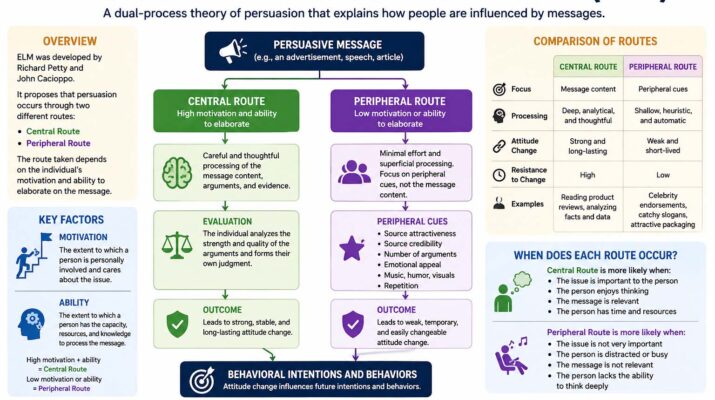
The elaboration likelihood model is one of the most influential theories in communication and psychology. It explains how people are persuaded and why some messages create lasting attitude changes while others only have temporary effects. Developed to understand how audiences process information, this model is widely used in marketing, advertising, politics, education, and social psychology.
When businesses create ads, when political campaigns try to win voters, or when teachers attempt to motivate students, they often rely on principles connected to the elaboration likelihood model. By understanding how persuasion works, organizations can communicate more effectively and ethically.
Elaboration Likelihood Model Petty Cacioppo 1986
The origins of the elaboration likelihood model petty cacioppo 1986 go back to psychologists Richard E. Petty and John T. Cacioppo. In 1986, they formally introduced the theory in their research on persuasion and attitude change. Their work became highly respected because it offered a practical explanation of how people respond differently to persuasive messages.
Petty and Cacioppo proposed that people process persuasive communication through two main routes: the central route and the peripheral route. This distinction helped researchers understand why some arguments deeply influence beliefs while others only create short-term impressions.
Their 1986 publication remains a foundation in modern psychology courses, especially in areas related to communication, consumer behavior, and decision science. Today, many textbooks still reference the elaboration likelihood model petty cacioppo 1986 as a landmark contribution.
What Is the Core Idea of the Model?
At its heart, the elaboration likelihood model focuses on how much thought a person gives to a persuasive message. The word “elaboration” means careful thinking and analysis. The more someone thinks critically about a message, the more likely they are to be influenced through logic and evidence.
When people are motivated and able to think carefully, they tend to use the central route. When they are distracted, uninterested, or lack time, they often use the peripheral route.
This theory helps explain why the same advertisement may persuade one person but fail with another. It depends on motivation, interest, prior knowledge, and the situation.
Understanding audience behavior is also important in marketing and communication. Tools such as a mapa de empatia help businesses study customer thoughts, feelings, and motivations, which connects closely with understanding how people respond to different messages.
Elaboration Likelihood Model Psychology Definition
The elaboration likelihood model psychology definition describes a dual-process theory of persuasion where attitudes can change through either careful reasoning or surface-level cues. In psychology, it is considered a cognitive model because it focuses on thought processes during persuasion.
The central route involves evaluating facts, evidence, message quality, and logical consistency. For example, a person buying a car may carefully compare safety ratings, fuel efficiency, and price before deciding.
The peripheral route relies on cues unrelated to the strength of the argument. These cues may include attractiveness, celebrity endorsements, emotional music, or simple repetition. For example, someone may prefer a product because a famous athlete promotes it.
This elaboration likelihood model psychology definition is especially important because it shows that persuasion is not always based on rational analysis. Sometimes people make decisions quickly using mental shortcuts.
Central Route Persuasion
Central route persuasion happens when people care deeply about the topic and have the ability to think carefully. They analyze arguments and compare evidence before forming opinions.
If a student is choosing a university, they may study tuition costs, rankings, programs, scholarships, and future career outcomes. Because the decision matters, they are likely using the central route.
Attitude changes created through this route are usually stronger, more stable, and more resistant to future persuasion. That is why organizations selling high-value products often provide detailed information, reviews, and comparisons.
Peripheral Route Persuasion
Peripheral route persuasion occurs when people are less motivated or unable to think deeply. They rely on quick cues such as popularity, authority, or visual appeal.
A consumer choosing a snack in a supermarket might buy the one with colorful packaging or a familiar logo. They are not analyzing ingredients in depth but responding to peripheral signals.
Changes from this route can happen quickly, but they are often weaker and easier to reverse later.