The term thrust appears in many fields, including aerospace engineering, mechanical systems, transportation, and even health and fitness discussions. Although the meaning can vary depending on the context, generally refers to a force that pushes an object in a specific direction.
What Is Thrust?
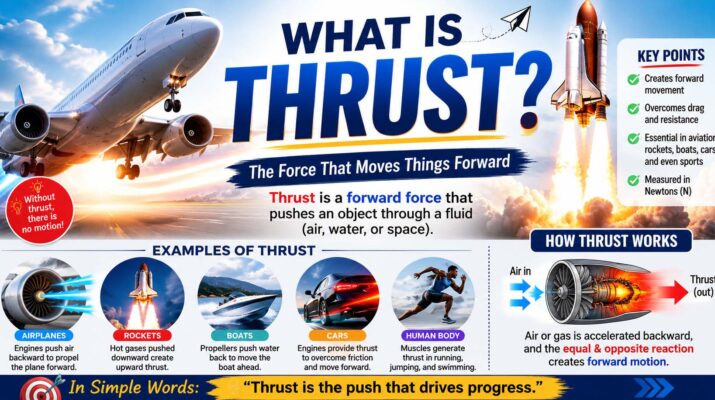
is a force that moves an object forward by pushing it in the opposite direction.
For every action, there is an equal and opposite reaction.
When an engine expels gas backward, the object attached to that engine moves forward. This forward-moving force is called .
- Newtons (N)
- Pounds-force (lbf)
- Kilonewtons (kN)
Without , modern aircraft, rockets, and many transportation systems would not function.
How Does Thrust Work?
The basic principle is simple.
Step 1: Energy Is Generated
An engine creates energy through:
- Fuel combustion
- Electric power
- Mechanical movement
Step 2: Material Is Accelerated
Step 3: Forward Force Is Created
The reaction force moves the object forward.
This process powers:
- Airplanes
- Rockets
- Jet skis
- Ships
- Drones
Why Is Thrust Important?
allows machines to overcome resistance and move efficiently.
Benefits of
- Enables flight
- Supports space travel
- Moves marine vessels
- Powers industrial systems
- Improves transportation efficiency
It remains one of the most fundamental concepts in modern engineering.
Types of Thrust
Different technologies use in different ways.
Jet Engine Thrust
Jet engines create by:
- Drawing in air.
- Compressing it.
- Mixing it with fuel.
- Igniting the mixture.
- Expelling hot gases.
The resulting force moves the aircraft forward.
Rocket
Unlike aircraft, rockets carry both:
- Fuel
- Oxidizer
This allows them to generate even without atmospheric oxygen.
Marine
Ships and boats create through propellers.
The propeller pushes water backward, causing the vessel to move forward.
Thrust vs Drag
A useful comparison involves and drag.
| Thrust | Drag |
|---|---|
| Pushes forward | Resists motion |
| Generated by engines | Caused by air or water resistance |
| Increases speed | Reduces speed |
| Supports movement | Opposes movement |
What Is Thrust Vectoring?
One of the most advanced aerospace technologies is what is vectoring.
vectoring refers to controlling the direction of engine exhaust to improve maneuverability.
Benefits include:
- Better agility
- Enhanced aircraft control
- Improved takeoff performance
- Superior combat maneuvering
Aircraft Using Vectoring
Examples include:
- F-22 Raptor
- Su-35
- F-35 Lightning II
Advantages of Vectoring
Improved Control
Aircraft maintain better control at low speeds.
Enhanced Performance
Pilots can change direction more rapidly.
Increased Safety
This technology continues to evolve in modern aviation.
What Is a Thrust Bearing?
In mechanical engineering, many people ask what is a bearing.
A bearing is a specialized bearing designed to handle axial loads.
Axial Load Definition
Examples include forces pushing:
- Forward
- Backward
- Upward
- Downward along a rotating axis
How Thrust Bearings Work
Common applications include:
- Automotive transmissions
- Industrial machinery
- Turbines
- Marine propulsion systems
Without bearings, excessive friction could damage equipment.
Types of Thrust Bearings
Ball Bearings
Suitable for lighter loads.
Roller Bearings
Designed for heavier applications.
Fluid Bearings
Used in high-speed industrial systems.
Each type serves different engineering requirements.
Common Thrust Bearing Problems
Excessive Wear
Caused by heavy loads or poor lubrication.
Overheating
Often linked to friction or improper maintenance.
Vibration
May indicate bearing damage.
Noise
Unusual sounds often signal wear.
Routine inspections help prevent failures.
What Is a Hip Thrust?
Another frequently searched term is what is a hip .
Primary Muscles Targeted
- Glutes
- Hamstrings
- Core muscles
What Is Tongue Thrust?
People also search for what is tongue .
Tongue is a condition in which the tongue pushes forward against or between the teeth during swallowing, speaking, or resting.
Possible Effects
- Dental alignment issues
- Speech difficulties
- Orthodontic complications
Dentists and speech specialists often help manage this condition.
Again, the term “” refers to a pushing force.
Real-World Applications of Thrust
influences many technologies we use every day.
Aviation
Aircraft rely on for takeoff and flight.
Space Exploration
Rockets use to escape Earth’s gravity.
Transportation
Marine vessels depend on for propulsion.
Manufacturing
Industrial equipment often uses bearings to support moving parts.
This demonstrates the broad importance of across multiple industries.
Future Developments in Technology
Modern engineers continue improving propulsion systems.
Emerging areas include:
- Electric aircraft propulsion
- Advanced rocket engines
- Hybrid propulsion systems
- Sustainable aviation fuels
- Improved vectoring technologies
These innovations aim to improve efficiency and reduce environmental impact.
FAQ
What is thrust?
is a force that pushes an object forward by expelling material or energy in the opposite direction.
How does thrust work?
works through Newton’s Third Law, where pushing mass backward creates forward motion.
What is thrust vectoring?
vectoring is a technology that changes the direction of engine exhaust to improve maneuverability and control.
What is a thrust bearing?
What is a hip thrust?
A hip is a strength-training exercise focused on developing the glute muscles and lower body.
What is tongue ?
Tongue is a condition where the tongue pushes against the teeth during swallowing or speaking.
Conclusion
Understanding what is provides insight into one of the most important concepts in engineering and technology. From jet engines and rockets to ships and industrial machinery, enables movement and powers many modern systems.