Whether you’re buying your first vessel or upgrading to a newer model, understanding inboard vs outboard engines can help you make an informed decision.
Both engine types power boats effectively, but they differ in design, performance, maintenance requirements, fuel efficiency, and overall boating experience.
This guide explains everything you need to know about inboard and outboard systems, including their advantages, disadvantages, maintenance considerations, and ideal use cases.
What Is an Inboard Engine?
The engine is typically mounted near the center of the vessel and connected to a driveshaft that powers the propeller underneath the boat.
Common applications include:
- Ski boats
- Wake boats
- Large cruisers
- Yacht-style vessels
- Commercial boats
Because the engine sits inside the hull, it is protected from direct exposure to water and weather.
What Is an Outboard Engine?
An outboard engine is mounted externally on the rear of the boat, known as the transom.
The engine, gearbox, and propeller are integrated into a single unit.
Common applications include:
- Fishing boats
- Pontoon boats
- Small recreational boats
- Center-console boats
- Coastal vessels
Outboard systems are popular because they are easy to access and replace when needed.
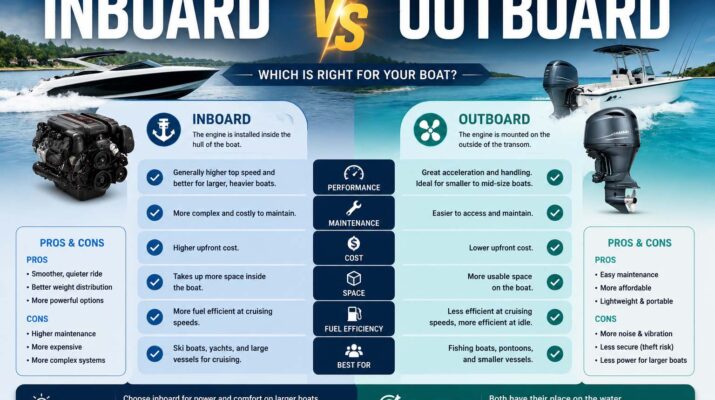
Inboard vs Outboard Comparison Table
| Feature | Inboard Engine | Outboard Engine |
|---|---|---|
| Engine Location | Inside Hull | Outside Transom |
| Maintenance Access | Moderate | Easy |
| Initial Cost | Often Higher | Usually Lower |
| Space Efficiency | Less Interior Space | More Interior Space |
| Fuel Efficiency | Good for Large Boats | Excellent for Small Boats |
| Replacement Ease | More Complex | Easier |
| Shallow Water Use | Less Suitable | Better |
| Top Speed | Strong Performance | Often Faster |
This overview highlights some of the biggest differences between the two systems.
Outboard vs Inboard Boats: Which Is Better?
The answer depends on how you plan to use your boat.
Outboard Boats
Best for:
- Recreational boating
- Fishing
- Coastal cruising
- Weekend use
Advantages include:
- Easy maintenance
- Better fuel economy
- More interior space
- Simpler engine replacement
Inboard Boats
Best for:
- Watersports
- Long-distance cruising
- Heavy-duty applications
- Large vessels
Advantages include:
- Better weight distribution
- Strong towing capability
- Improved handling in rough conditions
The ideal choice depends on your boating priorities.
Outboard vs Inboard Motor: How They Work
Understanding the mechanics behind each system can simplify your decision.
Inboard Motor Operation
The engine remains fixed inside the hull.
Steering is controlled using rudders positioned behind the propeller.
This design provides stable handling and smooth power delivery.
Outboard Motor Operation
Because the engine itself rotates, steering response is often quicker and more precise.
This makes outboards particularly popular among anglers and recreational boaters.
Performance Differences
Performance is often a major factor when comparing outboard vs inboard motor systems.
Speed
Modern outboards have become extremely powerful.
Advantages:
- Higher top speeds
- Faster acceleration
- Lightweight design
Towing Power
Inboard engines often excel when:
- Pulling wakeboarders
- Towing skiers
- Carrying heavy loads
Their centralized weight distribution improves stability.
Fuel Efficiency Comparison
Fuel costs can significantly affect long-term ownership.
Outboard Efficiency
Many modern outboards offer:
- Advanced fuel injection
- Lightweight construction
- Efficient cruising performance
This often results in lower fuel consumption.
Inboard Efficiency
Inboard systems can be efficient on larger boats where consistent power output is needed.
Efficiency depends heavily on:
- Boat size
- Weight
- Engine type
- Cruising speed
Maintenance Requirements
Maintenance is another important consideration.
Outboard Maintenance
Outboards are easier to service because the engine is easily accessible.
Common maintenance tasks include:
- Oil changes
- Spark plug replacement
- Propeller inspection
- Cooling system checks
Inboard Maintenance
Inboards may require more effort because the engine is located within the hull.
Common tasks include:
- Engine servicing
- Shaft inspection
- Cooling system maintenance
- Bilge checks
Routine maintenance remains essential regardless of engine type.
Inboard vs Outboard Boat Maintenance Costs
Cost differences vary depending on engine size and usage.
Outboard Costs
Generally:
- Lower repair costs
- Easier replacement
- Faster servicing
Inboard Costs
Often involve:
- More labor-intensive repairs
- Complex drivetrain components
- Higher installation expenses
However, inboards can provide excellent longevity when properly maintained.
Best Applications for Inboard Boats
An inboard vs outboard boat comparison often comes down to intended use.
Choose inboard when you need:
Watersports Performance
Wakeboarding and waterskiing benefit from:
- Consistent power delivery
- Better wake characteristics
Large Vessel Operation
Cruisers and yachts often rely on inboard propulsion systems.
Improved Weight Balance
Centralized engine placement enhances stability.
Best Applications for Outboard Boats
Outboards excel in several scenarios.
Fishing
Advantages include:
- More deck space
- Better maneuverability
- Easier shallow-water operation
Family Recreation
Outboard boats often provide:
- Simple operation
- Lower ownership costs
- Easier maintenance
Coastal Cruising
Many modern center-console boats use multiple outboard engines for reliability and speed.
Troubleshooting Common Boat Engine Issues
Both engine types can experience problems.
Engine Won’t Start
Possible causes:
- Dead battery
- Fuel delivery issues
- Ignition problems
Overheating
Check:
- Water intake blockage
- Cooling system operation
- Impeller condition
Loss of Power
Possible issues include:
- Dirty fuel filters
- Propeller damage
- Engine tuning requirements
Excessive Vibration
Inspect:
- Propeller condition
- Engine mounts
- Driveshaft alignment
Early diagnosis can prevent more costly repairs.
How to Choose Between Inboard and Outboard.
Step 1: Define Your Primary Activity
Ask yourself:
- Fishing?
- Watersports?
- Cruising?
- Offshore boating?
Step 2: Consider Maintenance Preferences
Outboards typically offer easier access for maintenance.
Step 3: Evaluate Your Budget
Factor in:
- Purchase price
- Fuel costs
- Service expenses
- Long-term ownership costs
Step 4: Assess Storage Requirements
Outboards can often be tilted out of the water, reducing corrosion risks.
Step 5: Think Long-Term
Consider how your boating needs may change over the coming years.
Future Trends in Boat Engine Technology
Recent innovations continue to improve both systems.
Current trends include:
- More efficient fuel injection
- Digital engine monitoring
- Electric propulsion systems
- Hybrid marine technologies
- Advanced corrosion protection
These developments are making boat ownership easier and more efficient than ever.
FAQ
Inboard engines are installed inside the boat hull, while outboard engines are mounted externally on the transom.
Which is easier to maintain?
Are outboards faster than inboards?
Many modern outboards offer higher top speeds and quicker acceleration.
Which is better for watersports?
Inboard boats are often preferred for wakeboarding and waterskiing.
Do outboard boats use less fuel?
In many smaller recreational boats, outboards can be more fuel efficient.
Which lasts longer?
Both can provide many years of service when properly maintained.
Conclusion
When comparing inboard vs outboard, neither option is universally better. The right choice depends on how you use your boat, your maintenance preferences, performance expectations, and budget.
Outboards are ideal for fishing, recreational boating, and easy maintenance, while inboards excel in watersports, larger vessels, and applications requiring strong towing performance. By understanding the differences between outboard vs inboard boats, evaluating your boating goals, and considering long-term ownership costs, you can confidently choose the engine system that best fits your needs.