
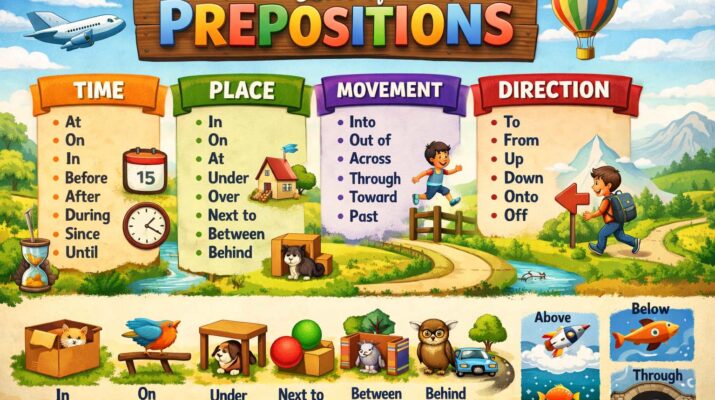
Prepositions are small but powerful words that connect nouns, pronouns, and phrases to the rest of a sentence. If you are learning grammar, writing essays, or improving your spoken English, understanding the list of prepositions is very important. In short, these words show direction, place, time, movement, reason, and relationships between ideas.
Many students find prepositions confusing because they have so many uses. However, once you learn the rules and practice often, they become much easier. So, this guide explains the meaning of prepositions, gives examples and uses, and shares a helpful list of prepositions to improve your grammar skills.
What Are Prepositions?
A preposition is a word placed before a noun or pronoun to show its relationship with another word in the sentence.
For example: “The book is on the table,” “She walked to school,” and “We arrived after lunch.” In each example, the preposition explains location, direction, or time.
Why Learning the List of Prepositions Is Important
Knowing the list of prepositions helps you build correct sentences and improve your spoken English. In addition, it helps you write better essays and emails, understand reading passages faster, and avoid common grammar mistakes.
Since we use prepositions every day in conversation and writing, mastering them is essential.
List of Common Prepositions
Below is a useful list of common prepositions used in daily English.
First, from A to D: about, above, across, after, against, among, around, at, before, behind, below, beside, between, by, and during.
Next, from F to O: for, from, in, inside, into, near, of, off, on, and over.
Finally, from T to W: through, to, under, until, up, with, and without.
Together, these are some of the most frequently used prepositions in English grammar.
List of Prepositions in English by Category
Prepositions become easier to understand when you group them by purpose. So, here is a practical list of prepositions in English by category.
1. Prepositions of Place
These prepositions show location. For example, the main ones are in, on, at, under, above, behind, near, and beside.
For instance: “The keys are on the desk,” “She is waiting at the door,” and “The dog is sleeping under the chair.”
2. Prepositions of Time
These prepositions show time. For example, the main ones are at, on, in, before, after, during, until, and since.
For instance: “Class starts at 9 AM,” “We met on Monday,” and “Flowers bloom in spring.”
3. Prepositions of Movement
These prepositions show direction or movement. For example, the main ones are to, into, onto, across, through, toward, and from.
For instance: “He ran to the park,” “The bird flew into the tree,” and “She walked across the road.”
List of All Prepositions Often Used in Grammar
Many learners search for a list of all prepositions to study grammar deeply. While English has many prepositions and prepositional phrases, here are some more important ones.
For example, aboard, along, amid, beneath, beyond, despite, except, inside, outside, past, regarding, throughout, underneath, unlike, upon, and within all work as prepositions. Generally, you will find these words in books, essays, and formal writing.
How to Use Prepositions Correctly
Learning the list of prepositions is useful, but using them correctly matters most. For a deeper explanation, the Purdue OWL guide to prepositions of time and place shows when to use in, on, and at.
Use “in” for enclosed spaces, months, years, and long periods, for example, “in the room,” “in July,” and “in 2026.”
Similarly, choose “on” for surfaces and specific days, such as “on the wall” and “on Friday.”
Use “at” for exact places or times, such as “at home” and “at 6 PM.”
In fact, these three prepositions are among the most common and the most often confused.
Common Mistakes with Prepositions
Many English learners make small errors with prepositions. For example, “She arrived to school early” is incorrect. Instead, say “She arrived at school early.”
Similarly, “I was born on 2001″ is incorrect. Instead, say “I was born in 2001.”
Overall, regular practice helps you avoid these mistakes.
List of Prepositions PDF for Easy Study
Many students prefer downloading a list of prepositions pdf for offline study. That’s because a printable sheet helps you memorize prepositions faster, practice grammar anytime, finish school homework, and keep quick reference notes.
Alternatively, you can create your own study sheet by copying the categories in this article.
Prepositions in Daily Sentences
Here are examples that use the list of prepositions in natural sentences. For example: “The phone is on the table,” “We walked through the forest,” and “She sat beside me.”
Likewise: “He stayed with friends,” “They arrived after dinner,” “The picture hangs above the sofa,” and “We traveled from Karachi to Lahore.”
Clearly, prepositions appear all the time in real communication.
Tips to Memorize the List of Prepositions
If you want to master the list of prepositions, follow these simple tips. First, learn by category and study place, time, and movement separately. Second, read English every day and notice how writers use prepositions in articles and books.
Third, practice writing ten sentences a day with different prepositions. Also, make flashcards with the word on one side and examples on the other. Finally, speak often and use prepositions in conversation to learn faster.
Why Prepositions Matter in Writing
Prepositions make writing clearer and more professional. Without them, sentences sound incomplete or confusing.
For example, “The cat sits chair” is missing a preposition. In contrast, “The cat sits on the chair” is correct. As you can see, this small word changes everything.
Clear communication matters beyond grammar as well. For instance, businesses and marketers often use tools like Mapa de Empatia to understand how people think, feel, and respond to information. As a result, they create messages that connect better with their audience.
Conclusion
Learning the list of prepositions is one of the best ways to improve your grammar and communication skills. Prepositions explain place, time, movement, and relationships between words. Whether you need a list of common prepositions, a list of prepositions pdf, a list of prepositions in English, or a list of all prepositions, studying these words will strengthen your English.
So, practice daily, read often, and use prepositions when you speak and write. Over time, these small grammar words will become natural and easy to use.