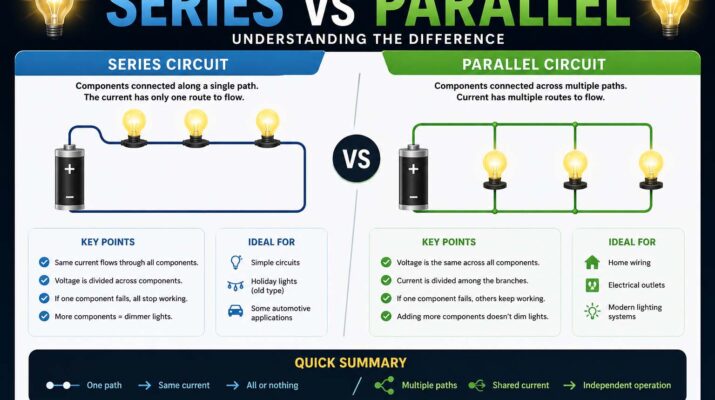
Electrical circuits power everything from household devices to industrial machinery. When designing or troubleshooting electrical systems, one of the most important concepts to understand is series vs parallel.
These two circuit configurations determine how electricity flows through components and how devices behave when connected together.
Whether you’re a student, DIY enthusiast, electronics hobbyist, or technology professional, understanding series and parallel circuits is essential for building, maintaining, and troubleshooting electrical systems.
This guide explains how each configuration works, compares their advantages and disadvantages, and explores real-world applications.
What Is a Series Circuit?
In this setup:
- Current flows through every component sequentially.
- All components share the same current.
Examples of series circuits include:
- Flashlights
- Certain decorative light strings
- Basic electronic training projects
Because all devices share the same path, any interruption affects the entire circuit.
What Is a Parallel Circuit?
A parallel circuit provides multiple paths for electrical current.
In this configuration:
- Each component operates on its own branch.
- Components receive the same voltage.
Examples include:
- Home wiring
- Office electrical systems
- Automotive electronics
- Computer power distribution
Parallel circuits offer greater flexibility and reliability.
Series vs Parallel Circuit: Quick Comparison
| Feature | Series Circuit | Parallel Circuit |
|---|---|---|
| Current Path | Single path | Multiple paths |
| Voltage Distribution | Shared among components | Same across branches |
| Failure Impact | Entire circuit affected | Other branches continue working |
| Wiring Complexity | Simpler | More complex |
| Common Uses | Basic electronics | Homes and buildings |
| Reliability | Lower | Higher |
This comparison highlights why parallel circuits dominate modern electrical systems.
How a Series Circuit Works
Understanding current flow helps explain circuit behavior.
Step 1: Power Source
Electricity leaves the battery or power supply.
Step 2: Component Sequence
Step 3: Return Path
Electricity returns to the power source.
Because there is only one path, every component depends on the others.
How a Parallel Circuit Works
Parallel circuits function differently.
Step 1: Power Source
Electricity leaves the power supply.
Step 2: Branch Distribution
Current splits into multiple paths.
Step 3: Independent Operation
Each branch operates independently.
Step 4: Current Recombination
This design improves reliability and performance.
Advantages of Series Circuits
Series circuits offer several benefits.
Simple Design
Fewer wires are required.
Easy to Build
Beginners often use series circuits when learning electronics.
Lower Cost
Simpler wiring may reduce material costs.
Useful for Basic Applications
Ideal for small educational projects and simple devices.
These advantages make series circuits valuable despite their limitations.
Advantages of Parallel Circuits
Parallel circuits are widely used because of their practical benefits.
Independent Operation
Devices continue working even if one component fails.
Consistent Voltage
Each branch receives the full supply voltage.
Improved Reliability
Better Performance
Multiple devices can operate efficiently at the same time.
These benefits explain why most modern electrical systems use parallel configurations.
Disadvantages of Series Circuits
Series circuits also have drawbacks.
Single Point of Failure
One broken component can stop the entire circuit.
Voltage Sharing
Components receive only a portion of the total voltage.
Limited Flexibility
Adding additional components affects overall performance.
For these reasons, series circuits are less common in large electrical systems.
Disadvantages of Parallel Circuits
Although effective, parallel circuits have some challenges.
More Complex Wiring
Additional branches require more wiring.
Higher Installation Costs
More materials may be necessary.
Increased Design Complexity
Engineers must account for multiple current paths.
Despite these challenges, the benefits usually outweigh the disadvantages.
Parallel vs Series: Which Is Better?
The answer depends on the application.
Choose Series When:
- Simplicity is important
- Costs must remain low
- Educational demonstrations are needed
Choose Parallel When:
- Reliability matters
- Multiple devices must operate independently
- Consistent voltage is required
In most practical situations, parallel vs series comparisons favor parallel circuits because of their flexibility.
Batteries in Series vs Parallel
One of the most common technology questions involves batteries in series vs parallel.
Batteries in Series
When batteries are connected in series:
- Voltage increases
- Capacity remains the same
Example:
Two 12V batteries in series create:
- 24V output
Batteries in Parallel
When batteries are connected in parallel:
- Voltage remains the same
- Capacity increases
Example:
Two 12V batteries in parallel remain:
- 12V output
But available capacity increases.
This distinction is important in:
- Solar systems
- Electric vehicles
- Backup power systems
- Recreational vehicles
Understanding battery configurations helps ensure proper system performance.
Household Wiring
Homes primarily use parallel circuits.
Benefits include:
- Independent appliance operation
- Reliable power distribution
Flashlights
Many traditional flashlights use series configurations.
Christmas Lights
Modern versions frequently use parallel wiring for improved reliability.
Automotive Systems
Vehicles typically use parallel designs for lighting and electronics.
These examples demonstrate how circuit choice depends on application requirements.
Troubleshooting Series and Parallel Circuits
Understanding circuit behavior simplifies troubleshooting.
Series Circuit Problems
Common issues include:
- Broken bulbs
- Loose connections
- Damaged wires
Because all components share one path, locating a fault often involves checking each component.
Parallel Circuit Problems
Common issues include:
- Branch failures
- Overloaded circuits
- Faulty connections
Because branches operate independently, troubleshooting may focus on a specific section.
Proper testing tools can speed diagnosis.
Future Applications of Circuit Design
As technology evolves, circuit principles remain important.
Applications include:
- Renewable energy systems
- Electric vehicles
- Smart homes
- Robotics
- Consumer electronics
Engineers continue using both series and parallel configurations to optimize performance.
Understanding these foundations supports future technological innovation.
FAQ
What is the difference between series and parallel circuits?
Which is better, series or parallel?
Parallel circuits are generally preferred for reliability and flexibility.
Why do homes use parallel circuits?
The entire circuit usually stops working.
How do batteries in series vs parallel differ?
Are series circuits still used today?
Yes. They remain useful in educational projects and certain specialized applications.
Conclusion
Understanding series vs parallel circuits is essential for anyone interested in technology, electronics, or electrical systems. Whether comparing a series vs parallel circuit, evaluating parallel vs series designs, or learning about batteries in series vs parallel, the key differences involve current paths, voltage distribution, reliability, and performance. While series circuits offer simplicity, parallel circuits provide the flexibility and dependability required for most modern applications. By understanding how these configurations work, students, hobbyists, and professionals can make better decisions when designing, troubleshooting, or maintaining electrical systems.