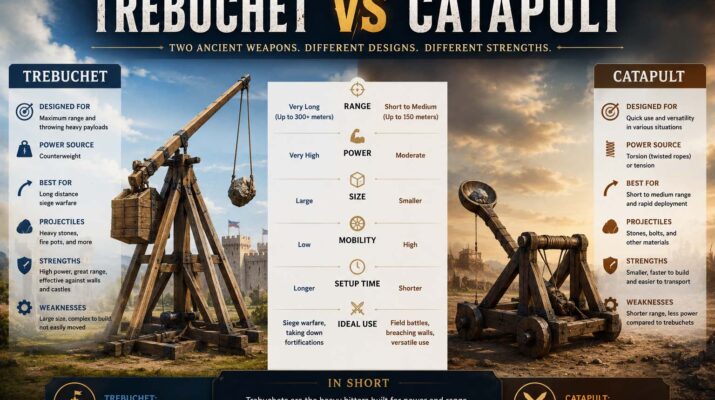
The debate over trebuchet vs catapult has fascinated historians, engineers, students, and technology enthusiasts for years. Both machines were used as powerful siege weapons during ancient and medieval warfare, helping armies attack fortifications from a distance.
Although many people use the terms interchangeably, trebuchets and catapults operate using different engineering principles. Understanding how they work provides valuable insight into historical military technology and mechanical design.
This guide explores the differences, advantages, disadvantages, and technological significance of these famous siege machines.
What Is a Trebuchet?
A trebuchet is a type of siege engine that uses a large counterweight to launch projectiles over long distances.
The machine consists of:
- A sturdy frame
- A long throwing arm
- A sling
- A heavy counterweight
When the counterweight falls, gravity causes the throwing arm to rotate rapidly, launching the projectile toward its target.
Trebuchets became popular during the Middle Ages because they could throw large objects with impressive accuracy and range.
What Is a Catapult?
A catapult is a broad category of siege machines designed to launch projectiles without using explosives.
Unlike trebuchets, many catapults rely on:
- Tension
- Torsion
- Stored mechanical energy
Common catapult designs include:
- Mangonels
- Onagers
- Ballista-like systems
When released, the stored energy propels the projectile toward the target.
Catapults were widely used throughout ancient history by civilizations such as the Greeks and Romans.
Trebuchet vs Catapult: Quick Comparison
| Feature | Trebuchet | Catapult |
|---|---|---|
| Power Source | Gravity and counterweight | Tension or torsion |
| Range | Very long | Moderate to long |
| Accuracy | Generally higher | Moderate |
| Projectile Size | Large objects | Smaller to medium objects |
| Construction Complexity | More complex | Simpler |
| Reload Speed | Slower | Faster |
| Historical Popularity | Medieval period | Ancient and medieval periods |
Both machines served important battlefield roles, but their strengths differed significantly.
How Does a Trebuchet Work?
The trebuchet uses a simple but effective concept.
Step 1: Raise the Counterweight
Operators lift the heavy counterweight into position.
Step 2: Load the Projectile
A stone, fireball, or other projectile is placed in the sling.
Step 3: Release the Mechanism
The counterweight falls under gravity.
Step 4: Launch the Projectile
The throwing arm swings rapidly, releasing the projectile toward the target.
This design converts gravitational potential energy into kinetic energy.
How Does a Catapult Work?
Catapults use stored energy rather than gravity.
Step 1: Tension Storage
The throwing arm is pulled back.
Step 2: Energy Accumulation
Ropes, springs, or twisted materials store energy.
Step 3: Trigger Release
The locking mechanism is released.
Step 4: Projectile Launch
The stored energy propels the projectile forward.
This mechanical system allows catapults to fire relatively quickly.
Catapult vs Trebuchet: Which Was More Powerful?
The catapult vs trebuchet debate often focuses on power.
Trebuchet Advantages
Trebuchets generally excelled in:
- Projectile weight
- Range
- Accuracy
- Siege effectiveness
They could launch massive stones capable of damaging castle walls.
Catapult Advantages
Catapults offered:
- Faster setup
- Faster firing rates
- Simpler construction
For prolonged battles requiring frequent shots, catapults often provided practical advantages.
Overall, trebuchets usually delivered greater destructive force.
Trebuchet vs Catapult vs Ballista
Many discussions expand into trebuchet vs catapult vs ballista comparisons.
While all three are siege weapons, they operate differently.
Trebuchet
Uses gravity and counterweights.
Catapult
Uses stored tension or torsion energy.
Ballista
Functions similarly to a giant crossbow.
Ballistas launch bolts or spears rather than heavy stones.
Because of this, they are often used for precision attacks rather than wall destruction.
Catapult vs Trebuchet vs Ballista: Battlefield Roles
The comparison of catapult vs trebuchet vs ballista reveals that each machine had a specialized purpose.
Trebuchet Role
- Castle sieges
- Wall destruction
- Long-range bombardment
Catapult Role
- General battlefield support
- Medium-range attacks
- Rapid projectile launching
Ballista Role
- Precision targeting
- Anti-personnel attacks
- Defensive fortifications
Commanders often used multiple siege engines together to maximize effectiveness.
Why Trebuchets Became So Popular
Trebuchets represented a major technological advancement.
Key advantages included:
Increased Range
They could attack targets from safer distances.
Larger Projectiles
Heavy stones caused significant structural damage.
Better Accuracy
Compared to many earlier siege weapons, trebuchets often delivered more predictable results.
Psychological Impact
Massive projectiles flying through the air could intimidate defenders.
These factors contributed to widespread adoption during medieval warfare.
Engineering Principles Behind Siege Machines
The trebuchet and catapult demonstrate several important engineering concepts.
Potential Energy
Stored energy that can later be converted into motion.
Mechanical Advantage
Lever systems amplify force.
Energy Transfer
Stored energy becomes projectile motion.
Projectile Physics
Launch angle affects range and accuracy.
Studying these machines helps students understand basic physics and engineering principles.
Troubleshooting Common Model Trebuchet Problems
Many students build miniature trebuchets for science projects.
Common issues include:
Poor Launch Distance
Possible causes:
- Insufficient counterweight
- Incorrect sling length
- Excessive friction
Inconsistent Accuracy
Potential reasons:
- Uneven construction
- Incorrect release angle
- Loose components
Weak Structure
Reinforcing the frame often improves performance.
Testing and adjustments are important parts of engineering design.
Trebuchet vs Catapult Meme Culture
The phrase trebuchet vs catapult meme has become popular online.
Internet communities often jokingly portray trebuchets as superior to catapults.
Reasons include:
- Impressive engineering
- Larger projectiles
- Historical fascination
- Educational popularity
These memes have introduced many younger audiences to medieval technology.
Although humorous, they have helped keep interest in siege engineering alive.
Modern Educational Uses
Today, trebuchets and catapults are no longer battlefield weapons.
Instead, they are used for:
- Physics education
- Engineering demonstrations
- Historical reenactments
- STEM projects
Building model siege machines remains a popular classroom activity because it combines creativity with science.
FAQ
A trebuchet uses a counterweight and gravity, while most catapults use stored tension or torsion energy.
Which is stronger, a trebuchet or a catapult?
Trebuchets generally launch heavier projectiles farther and with greater force.
What is a ballista?
A ballista is a large crossbow-like siege weapon that fires bolts or spears.
Why were trebuchets effective?
They provided long range, heavy projectiles, and improved siege capabilities.
Are trebuchets still used today?
They are mainly used for educational demonstrations, competitions, and historical reenactments.
Why are trebuchet memes popular?
Many internet users admire the trebuchet’s engineering and historical power, leading to humorous comparisons with catapults.
Conclusion
The comparison of trebuchet vs catapult highlights two of history’s most fascinating engineering achievements. While catapults offered faster firing and simpler construction, trebuchets delivered greater range, accuracy, and destructive power. Expanding the discussion to trebuchet vs catapult vs ballista and catapult vs trebuchet vs ballista reveals how each machine served unique battlefield roles. Whether you’re interested in medieval warfare, engineering, physics, or even the famous trebuchet vs catapult meme, these siege engines remain excellent examples of human innovation and mechanical design. Their legacy continues to inspire students, historians, and technology enthusiasts around the world.