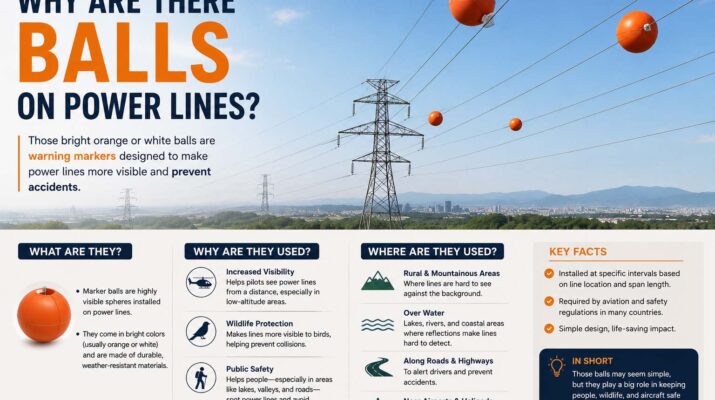
If you’ve ever looked up at overhead power lines near rivers, highways, airports, or open fields, you’ve probably noticed large colored balls attached to the wires. Many people wonder, why are there balls on power lines and what purpose they serve.
Although they may seem unusual, these brightly colored spheres play an important role in public safety. They are not decorative, nor are they used to improve electrical performance. Instead, they help make power lines more visible to aircraft, particularly helicopters and low-flying airplanes.
What Are the Balls on Power Lines?
The large spheres attached to overhead electrical wires are called aerial marker balls or visibility marker balls.
These devices are designed to make power lines easier to see from the air.
Power lines can be difficult to spot because:
- Wires are thin
- Background landscapes can reduce visibility
- Certain weather conditions create visual challenges
- Pilots often fly at varying altitudes
Marker balls help reduce the risk of aircraft colliding with power lines.
Their bright colors and large size improve visibility from long distances.
Why Are There Balls on Power Lines?
Power lines crossing open areas such as rivers, canyons, valleys, and airports may be difficult for pilots to see.
The marker balls help by:
- Increasing wire visibility
- Reducing collision risks
- Improving pilot awareness
- Supporting aviation safety regulations
Without these markers, pilots flying at lower altitudes may have difficulty identifying power lines in time to avoid them.
This is especially important for helicopters, agricultural aircraft, rescue operations, and sightseeing flights.
How Do Power Line Marker Balls Work?
Step 1: Bright Colors Improve Visibility
The balls are painted in highly visible colors.
Common colors include:
- Orange
- Red
- White
- Yellow
These colors stand out against natural landscapes and skies.
Step 2: Large Size Makes Detection Easier
Most marker balls range from 20 to 36 inches in diameter.
Their large size helps pilots identify obstacles from a safe distance.
Step 3: Strategic Placement
Utility companies place marker balls in locations where aircraft are most likely to encounter power lines.
Examples include:
- River crossings
- Mountain valleys
- Airport approaches
- Remote terrain
This strategic placement maximizes safety benefits.
Why Are There Orange Balls on Power Lines?
Many people specifically ask, why are there orange balls on power lines.
Orange is one of the most commonly used colors because it provides excellent visibility against:
- Blue skies
- Green vegetation
- Water surfaces
- Cloudy conditions
The bright orange color catches a pilot’s attention quickly, even from long distances.
In many installations, orange balls are alternated with white balls to create even greater contrast.
This alternating color pattern helps improve visibility under changing weather conditions.
Why Are There Red Balls on Power Lines?
Another common question is why are there red balls on power lines.
Red marker balls serve the same basic purpose as orange ones.
They are often used because:
- Red is highly visible
- It contrasts well against many backgrounds
- It attracts attention quickly
Some utility companies use red markers in areas where aviation authorities require specific visibility standards.
The choice between orange, red, and other colors often depends on local regulations and environmental conditions.
Why Are There Big Balls on Power Lines?
People frequently wonder, why are there big balls on power lines instead of smaller markers.
The answer is simple: larger objects are easier to see.
A pilot traveling at high speed has limited time to identify obstacles.
Large marker balls:
- Improve detection distance
- Increase reaction time
- Enhance safety margins
- Reduce visual confusion
Smaller markers would be less effective and could become difficult to see under certain lighting conditions.
The larger size ensures maximum visibility.
Where Are Marker Balls Most Commonly Found?
Not every power line requires marker balls.
They are typically installed in locations where aircraft may operate nearby.
River Crossings
Power lines crossing rivers can be difficult to spot because of water reflections.
Near Airports
Aircraft approaching or departing airports may fly close to utility infrastructure.
Mountain Valleys
Terrain can limit visibility, making marker balls especially important.
Agricultural Areas
Crop-dusting aircraft often fly at low altitudes and benefit from enhanced wire visibility.
Emergency Response Zones
Helicopter operations frequently occur in remote areas where power lines present potential hazards.
These locations are considered higher-risk environments.
What Are Marker Balls Made Of?
Modern marker balls are designed to withstand years of outdoor exposure.
Common materials include:
- High-density plastic
- Fiberglass
- UV-resistant polymers
These materials provide:
- Durability
- Weather resistance
- Lightweight construction
- Minimal maintenance requirements
Manufacturers design them to resist:
- Rain
- Snow
- Wind
- Sunlight
- Temperature changes
This durability ensures long-term effectiveness.
Do Marker Balls Affect Electricity?
A common misconception is that marker balls help distribute electricity.
In reality, they have no direct role in electrical transmission.
They do not:
- Increase power flow
- Improve signal strength
- Regulate voltage
- Store electricity
Their primary purpose is visual identification and aviation safety.
The electrical performance of the power line remains unchanged whether marker balls are present or not.
Marker Balls vs Other Power Line Safety Features
Power lines use several safety technologies.
| Feature | Primary Purpose |
|---|---|
| Marker Balls | Aviation visibility |
| Insulators | Electrical isolation |
| Ground Wires | Lightning protection |
| Warning Signs | Public awareness |
| Pole Markings | Maintenance identification |
Each safety component serves a different role within the electrical infrastructure system.
Marker balls specifically focus on aircraft safety.
Installation and Maintenance
Installing marker balls requires specialized equipment.
Utility crews may use:
- Bucket trucks
- Helicopters
- Specialized lifting equipment
Installation Process
- Identify high-risk locations.
- Select appropriate marker size.
- Position markers at specified intervals.
- Secure markers around the wire.
- Conduct inspections.
Regular inspections help ensure continued effectiveness.
Damaged markers are replaced as needed.
Common Myths About Power Line Balls
Several misconceptions surround these devices.
Myth: They Store Electricity
False. Marker balls contain no electrical storage components.
Myth: They Improve Internet Signals
False. They have no communication-related functions.
Myth: They Prevent Birds From Landing
False. Although birds may notice them, that is not their primary purpose.
Myth: They Are Decorative
False. They exist for aviation safety and regulatory compliance.
Understanding their true purpose helps clear up confusion.
Future Developments in Marker Technology
While traditional marker balls remain effective, new technologies continue to emerge.
Future improvements may include:
- Reflective coatings
- Solar-powered lighting
- Enhanced visibility materials
- Smart monitoring systems
These advancements could further improve aviation safety in challenging environments.
However, the basic concept remains highly effective and widely used today.
Frequently Asked Questions
Why are there balls on power lines?
They make power lines more visible to pilots and help prevent aircraft collisions.
Why are there orange balls on power lines?
Orange provides excellent visibility against many natural backgrounds and weather conditions.
Why are there red balls on power lines?
Red markers improve visibility and may be used to meet specific aviation safety requirements.
Why are there big balls on power lines?
Larger markers are easier for pilots to see from greater distances.
Do all power lines have marker balls?
No. They are typically installed only in locations where aircraft safety is a concern.
Do marker balls affect electricity?
No. They serve only as visibility markers and do not impact electrical transmission.
Conclusion
These visibility markers help pilots identify power lines from a distance, reducing the risk of collisions in areas where aircraft frequently operate.
Whether you’re curious about why are there orange balls on power lines, why are there red balls on power lines, why are there balls on the power lines, or why are there big balls on power lines, the purpose remains the same: improving visibility and protecting lives. Though simple in design, these brightly colored markers continue to play a vital role in modern infrastructure and aviation safety around the world.