Nature has spent billions of years solving problems through evolution. Scientists, engineers, and designers often look to these natural solutions when creating new technologies.
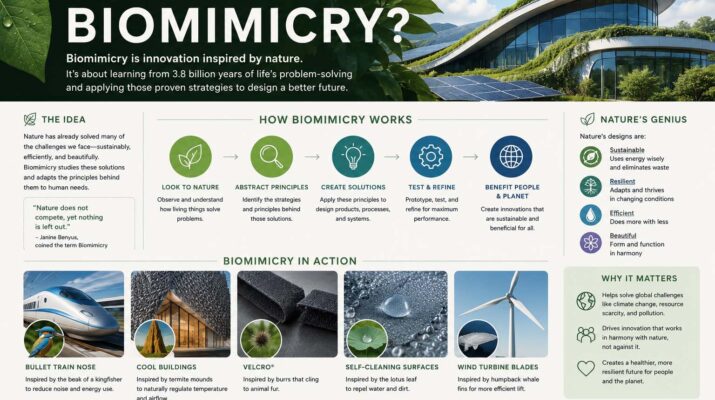
If you’ve ever wondered what is biomimicry, the concept is simple: it involves studying nature’s designs, systems, and processes and applying those lessons to human innovation. From energy-efficient buildings to high-speed trains, continues to influence modern technology in remarkable ways.
In this guide, you’ll learn the biomimicry definition, practical examples, applications in architecture, STEM education benefits, and how is shaping the future of technology.
What Is Biomimicry?
The answer to what is biomimicry? is the practice of imitating nature’s strategies to solve human challenges.
The word combines two terms:
- “Bio” meaning life
- “Mimicry” meaning imitation
Biomimicry involves observing how plants, animals, and ecosystems function and then adapting those ideas into technological, engineering, and design solutions.
Rather than forcing nature to fit human needs, asks:
“How has nature already solved this problem?”
This approach often leads to sustainable, efficient, and innovative designs.
What Is Biomimicry Definition?
A common what is biomimicry definition used by researchers is:
Biomimicry is the practice of learning from and emulating nature’s forms, processes, and ecosystems to create sustainable solutions to human challenges.
Unlike simply copying the appearance of nature, focuses on understanding the underlying principles behind natural success.
For example:
- Birds inspired aircraft wing designs.
- Shark skin inspired antibacterial surfaces.
- Termite mounds inspired energy-efficient buildings.
The goal is to create smarter technologies by using nature as a model.
How Does Biomimicry Work?
generally follows a structured process.
Step 1: Identify a Problem
Engineers begin by defining a challenge.
Examples include:
- Reducing energy consumption
- Improving transportation efficiency
- Creating stronger materials
- Managing water resources
Step 2: Study Nature
Researchers search for organisms or ecosystems that solve similar challenges.
Questions include:
- How does nature regulate temperature?
- How do animals move efficiently?
- How do plants collect water?
Step 3: Analyze Natural Solutions
Scientists examine the biological mechanisms behind the solution.
This may involve studying:
- Structure
- Materials
- Behavior
- Ecosystem relationships
Step 4: Apply the Design
The natural strategy is adapted into a technological solution.
Step 5: Test and Improve
Engineers evaluate performance and refine the design for real-world use.
This process helps create sustainable and efficient innovations.
Real-World Biomimicry Examples
can be found in many technologies people use every day.
Velcro Inspired by Burr Plants
One of the most famous examples involves Velcro.
A Swiss engineer noticed how burrs stuck to clothing and animal fur. After studying them under a microscope, he developed the hook-and-loop fastening system known as Velcro.
Bullet Train Inspired by Kingfishers
Japan’s high-speed bullet trains once created loud sonic booms when exiting tunnels.
Engineers studied the beak of the kingfisher bird, which enters water with minimal splash.
The redesigned train nose reduced noise while improving speed and energy efficiency.
Shark Skin Technology
Shark skin contains microscopic patterns that resist bacteria and reduce drag in water.
These patterns have inspired:
- Hospital surfaces
- Swimwear
- Marine coatings
Gecko-Inspired Adhesives
Geckos can climb walls using tiny hair-like structures on their feet.
Researchers have developed advanced adhesives based on this natural mechanism.
What Is Biomimicry in Architecture?
One of the fastest-growing applications is what is biomimicry in architecture.
Architects increasingly use nature-inspired designs to improve sustainability and efficiency.
Termite Mound Buildings
Termite mounds maintain stable temperatures despite extreme outdoor conditions.
Architects have used this concept to create buildings with natural ventilation systems that require less air conditioning.
Lotus Leaf Surfaces
This inspired self-cleaning glass and building materials that reduce maintenance costs.
Tree-Inspired Structures
Some modern buildings mimic the structural strength and efficiency of trees.
These designs can:
- Reduce material usage
- Improve stability
- Enhance energy performance
in architecture helps create environmentally friendly buildings while lowering operating costs.
What Is Biomimicry STEM Education?
Many teachers ask what is biomimicry STEM education and why it matters.
provides an engaging way to connect science, technology, engineering, and mathematics.
Students learn to:
- Observe natural systems
- Solve real-world problems
- Think creatively
- Apply scientific principles
For example, students might study bird wings to design paper airplanes or examine plant structures to create water collection devices.
encourages innovation while promoting environmental awareness.
Because it combines multiple disciplines, it has become a valuable teaching tool in modern STEM programs.
Biomimicry vs Traditional Engineering
| Feature | Biomimicry | Traditional Engineering |
|---|---|---|
| Inspiration Source | Nature | Human-created designs |
| Sustainability Focus | High | Varies |
| Resource Efficiency | Often optimized | Depends on design |
| Innovation Method | Learning from ecosystems | Human problem-solving |
| Environmental Impact | Usually lower | Can be higher |
Traditional engineering relies heavily on human-developed solutions.
Biomimicry adds another layer by using nature’s proven strategies as inspiration.
The two approaches often work together rather than competing.
Benefits of Biomimicry
offers several advantages.
Improved Sustainability
Natural systems tend to minimize waste and maximize efficiency.
Energy Savings
Many biomimetic designs consume less energy than conventional alternatives.
Innovation Opportunities
Nature provides countless ideas that can inspire breakthrough technologies.
Cost Reduction
Efficient designs often reduce long-term operating expenses.
Environmental Protection
encourages solutions that work with nature rather than against it.
Common Challenges of Biomimicry
Despite its benefits, biomimicry is not always easy to implement.
Complex Biological Systems
Research Requirements
Studying biological systems often requires extensive scientific expertise.
Technical Limitations
Current technology may not always replicate natural mechanisms accurately.
Higher Initial Costs
Research and development investments can be significant before commercialization.
Troubleshooting Biomimicry Projects
Organizations adopting may encounter obstacles.
Problem: Limited Biological Knowledge
Solution: Collaborate with biologists and environmental scientists.
Problem: Design Doesn’t Scale
Solution: Create prototypes and conduct extensive testing.
Problem: High Development Costs
Solution: Focus on long-term efficiency gains and sustainability benefits.
Problem: Difficulty Finding Natural Models
Solution: Use biomimicry databases and interdisciplinary research teams.
Future of Biomimicry Technology
The future of looks promising.
Emerging fields include:
- Artificial intelligence inspired by neural networks
- Self-healing materials modeled after living tissues
- Water-harvesting systems inspired by desert insects
- Energy-efficient transportation inspired by animal movement
- Smart robotics based on biological organisms
As sustainability becomes increasingly important, is expected to play a larger role in technology development worldwide.
FAQ About Biomimicry
What is biomimicry?
Biomimicry is the practice of studying and imitating nature’s solutions to create innovative and sustainable technologies.
What is biomimicry definition in simple words?
It means learning from plants, animals, and ecosystems to solve human problems.
What is biomimicry in architecture?
It is the use of nature-inspired designs and systems in buildings to improve efficiency, sustainability, and performance.
Why is biomimicry important?
Biomimicry helps create environmentally friendly, energy-efficient, and innovative solutions.
What is STEM education?
It is a teaching approach that uses nature-inspired problem-solving to integrate science, technology, engineering, and mathematics learning.
Is biomimicry used in modern technology?
Yes. influences transportation, robotics, medicine, architecture, manufacturing, and many other industries.
Conclusion
Understanding what is biomimicry reveals how nature continues to inspire some of humanity’s most innovative technologies. By studying millions of years of evolutionary success, engineers and designers can create solutions that are efficient, sustainable, and practical.