
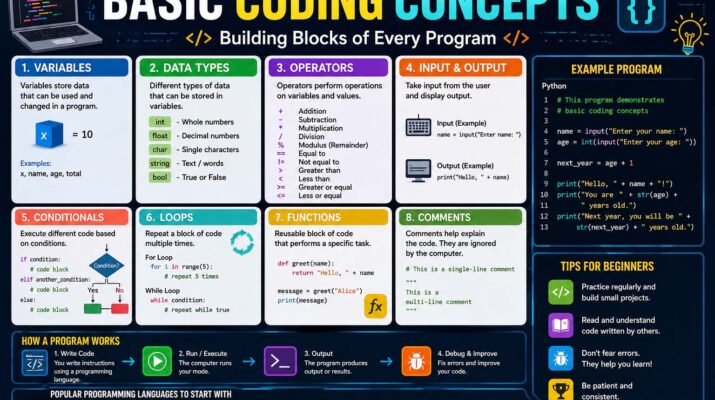
Learning basic coding concepts is one of the smartest skills you can develop in today’s digital world. Coding powers websites, apps, games, robots, and even smart home devices. Whether you want to become a software developer, create your own website, or simply understand how technology works, starting with the fundamentals makes everything easier.
Many people think programming is difficult, but once you understand the core ideas, coding becomes much more approachable. The truth is that every expert programmer once started by learning simple principles such as variables, loops, conditions, and functions. This guide explains everything in an easy-to-understand way so you can build confidence from day one.
What Are Basic Coding Concepts?
The phrase basic coding concepts refers to the essential ideas used in programming languages. These concepts are universal, meaning they apply to languages like Python, JavaScript, Java, C++, and many others. Once you understand the fundamentals, learning any language becomes easier.
Coding is simply giving instructions to a computer. Computers follow commands exactly as written, so programmers must think clearly and logically. Good code solves problems step by step.
Some of the most common beginner topics include variables, data types, loops, functions, debugging, algorithms, and conditional statements. These building blocks help create everything from simple calculators to advanced software systems.
Basic Coding Concepts for Beginners
Understanding basic coding concepts for beginners starts with learning how computers process instructions. Every program is made of commands arranged in a logical order. Here are some of the first ideas beginners should know.
Variables are used to store information. For example, you can save a person’s name, age, or score inside a variable. This allows the computer to remember and use data later.
Data types describe what kind of information is being stored. Numbers, text, and true or false values are common examples. Choosing the correct data type helps programs work efficiently.
Conditional statements let a program make decisions. If a user enters the correct password, access is granted. If the password is wrong, access is denied.
Loops repeat actions automatically. Instead of writing the same command many times, a loop can run it until a condition is met. This saves time and keeps code organized.
Functions are reusable blocks of code designed to perform specific tasks. Instead of rewriting the same instructions, programmers create functions and call them whenever needed.
Why Coding Matters Today
Coding is no longer limited to professional developers. Businesses, schools, healthcare systems, and entertainment platforms all depend on software. Understanding basic coding concepts can improve career opportunities and problem-solving skills.
Even non-programmers benefit from coding knowledge. Marketers use automation tools, designers work with websites, and entrepreneurs launch online businesses. Coding creates flexibility in many careers.
Learning programming also trains the brain to think logically. It teaches patience, attention to detail, and creativity. These skills are valuable in almost any field.
Basic Coding Concepts for Kids
Teaching basic coding concepts for kids can be fun and rewarding. Children often learn quickly when coding is introduced through games, animations, and interactive tools.
For kids, coding should begin with patterns and sequences. They learn that actions happen in order. For example, a game character moves forward, jumps, then turns left.
Simple loops can be taught using repetition. If a child wants a character to take five steps, they can use a repeat command instead of clicking forward five times.
Conditions are another easy concept for children. If the player touches a coin, points increase. If they hit an obstacle, points decrease. Kids naturally understand cause and effect, making this concept easier to learn.
Visual coding platforms such as block-based programming tools help children focus on logic without worrying about typing errors. Once they understand the fundamentals, they can transition into text-based coding languages later.
Basic Concepts of Coding
The basic concepts of coding go beyond writing commands. They also include understanding how to solve problems effectively. Good programmers first analyze the task, break it into smaller steps, and then write code.
Algorithms are an important part of coding. An algorithm is simply a sequence of steps used to solve a problem. For example, making tea follows an algorithm: boil water, add tea, pour water, and serve.
Debugging is another essential concept. Errors happen in every programming project. Debugging means finding mistakes and fixing them. This process teaches patience and persistence.
Just like grammar in spoken language, code must follow correct syntax to run properly.
Comments are notes inside code that explain what certain parts do. They help programmers understand projects later and make teamwork easier.
Coding Basic Concepts and Logic Building
Mastering coding basic concepts requires strong logical thinking. Computers do not guess or assume anything. Every instruction must be clear and precise.
For example, if you tell a program to calculate a total price, you must define where the numbers come from and how they should be added. Missing steps cause errors.
Best Programming Languages for Beginners
After learning basic coding concepts, many people ask which language to start with. Python is one of the most popular beginner choices because it uses simple syntax and is widely used in automation, web development, and data science.
JavaScript is excellent for web development because it powers interactive websites. HTML and CSS are often learned alongside JavaScript.
How to Practice Coding Daily
Consistency is the fastest way to improve. Start by coding small projects such as calculators, to-do lists, or number guessing games. These projects help reinforce basic coding concepts through real experience.
Reading code written by others also improves understanding. You learn structure, style, and new techniques.
Conclusion
Learning basic coding concepts is the first step toward understanding technology and creating your own digital projects. Once you grasp variables, loops, functions, conditions, algorithms, and debugging, programming becomes much easier to understand.