Dry ice is one of the coldest commonly available substances used for cooling and freezing. Unlike regular ice made from frozen water, dry ice is actually solid carbon dioxide. It is widely used in food transportation, scientific experiments, fog effects, and medical shipping because of its extremely low temperature and unique properties.
Many people ask, how cold is dry ice? The answer is surprisingly extreme. Dry ice is far colder than regular ice and can quickly freeze materials it touches. Understanding its temperature and safety is important before handling it.
What Is Dry Ice?
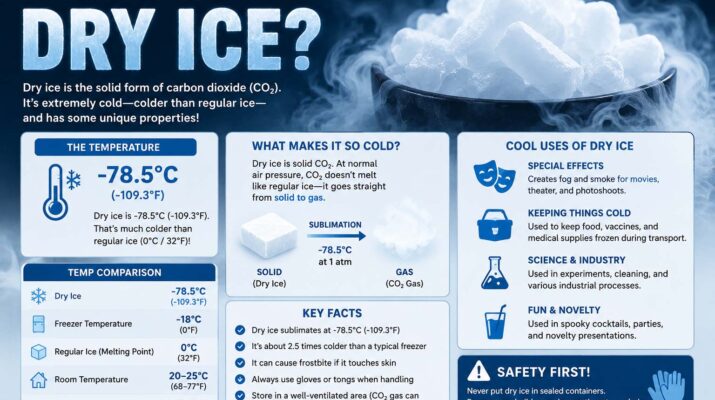
Dry ice is the solid form of carbon dioxide gas, often called CO₂. Instead, it changes directly from solid into gas through a process called sublimation.
This special property makes dry ice useful for keeping products cold without leaving behind water. It is commonly used for shipping frozen foods, preserving medical supplies, and creating theatrical smoke effects.
Because it evaporates into gas instead of liquid, dry ice requires careful handling and proper ventilation.
How Cold Is Dry Ice?
The temperature of dry ice is extremely low compared to normal ice. Standard water ice freezes at 0°C or 32°F, but dry ice is much colder.
When people search how cold is dry ice?, they are often surprised to learn that it can instantly freeze skin and materials upon contact. This intense cold is why thick gloves and protective handling are recommended.
Dry ice can rapidly cool objects, making it useful in industrial and scientific environments.
How Cold Is Dry Ice in Fahrenheit
Many people want to know how cold is dry ice in fahrenheit because Fahrenheit is commonly used in the United States.
Dry ice has a surface temperature of approximately minus 109.3 degrees Fahrenheit. This is far colder than a household freezer, which usually operates around 0°F.
Because of this extremely low temperature, touching dry ice with bare skin can cause frostbite-like injuries within seconds. The cold temperature also allows it to preserve frozen products for extended periods during transport.
How Cold Is Dry Ice in Celsius
If you use the metric system, you may wonder .
Dry ice has a temperature of about minus 78.5 degrees Celsius.
Scientists and laboratories often use dry ice in cooling applications because it can maintain temperatures much lower than traditional refrigeration systems.
Its low temperature also makes it useful for preserving biological samples and temperature-sensitive materials.
How Cold Is Dry Ice in Kelvin
In scientific measurements, some people ask how cold is dry ice in kelvin.
Dry ice is approximately 194.65 Kelvin. The Kelvin scale is commonly used in physics and chemistry because it begins at absolute zero.
Although Kelvin values may seem unfamiliar to many people, they are important in scientific research and temperature calculations.
Why Is Dry Ice So Cold?
Dry ice remains extremely cold because carbon dioxide becomes solid under high pressure and low temperature conditions. When exposed to normal atmospheric pressure, it sublimates directly into gas while maintaining its low temperature.
The energy required for this phase change helps keep dry ice cold for a long time. Unlike regular ice, it does not become liquid and warm surrounding areas with melted water.
This unique behavior is what makes dry ice ideal for cooling and preservation.
Common Uses of Dry Ice
Dry ice has many practical applications in different industries. It is often used to transport frozen foods because it keeps products cold longer than traditional ice.
Medical companies use dry ice to ship vaccines, laboratory specimens, and temperature-sensitive medicines. Restaurants and entertainment companies also use it for dramatic fog effects in drinks, concerts, and stage productions.
Campers and travelers sometimes use dry ice in coolers for long trips because it lasts longer than regular ice.
Safety Tips for Handling Dry Ice
Because dry ice is extremely cold, safety is very important. Direct contact with skin can cause burns similar to frostbite.
Always use gloves or tongs when handling dry ice. Never place it directly on skin or inside the mouth. It should also be stored in insulated containers rather than airtight containers.
Since dry ice releases carbon dioxide gas, proper ventilation is necessary. Using large amounts in small enclosed spaces can reduce oxygen levels and create breathing hazards.
Children should only handle dry ice under adult supervision.
Can Dry Ice Be Dangerous?
Dry ice can be dangerous if used incorrectly. Touching it without protection can damage skin, while storing it improperly can create pressure buildup.
If dry ice is placed in a sealed container, the expanding gas may cause the container to burst. Breathing high levels of carbon dioxide in enclosed spaces can also lead to dizziness or breathing difficulties.
Despite these risks, dry ice is generally safe when handled responsibly.
How Long Does Dry Ice Last?
The lifespan of dry ice depends on storage conditions and quantity. In an insulated cooler, dry ice may last between 18 and 24 hours or longer.
Larger blocks usually last longer than smaller pellets because they have less exposed surface area. Opening containers frequently can also speed up sublimation.
Keeping dry ice in a high-quality cooler helps extend its cooling performance.
Dry Ice vs Regular Ice
Dry ice and regular ice are very different materials. Water ice melts into liquid at 32°F or 0°C, while dry ice sublimates directly into gas at much lower temperatures.
Dry ice is significantly colder, making it better for freezing and long-term cooling. However, it requires more careful handling because of its extreme temperature and gas release.
Conclusion
Dry ice is an incredibly cold substance used for cooling, shipping, and scientific applications. Whether you want to know how cold is dry ice in fahrenheit, , or how cold is dry ice in kelvin, the answer shows just how powerful this material can be.