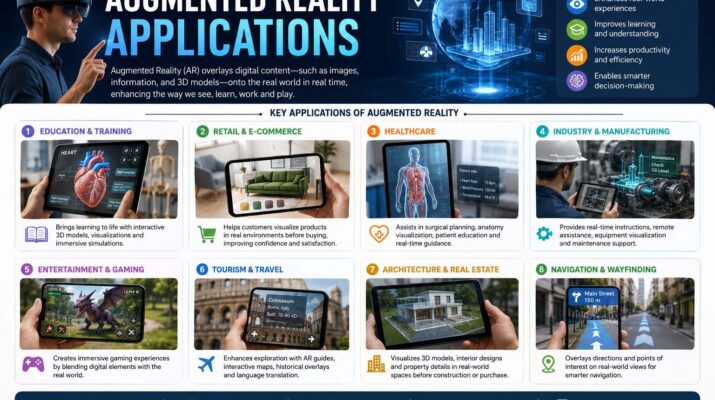
Augmented reality applications are rapidly changing the way people interact with technology in everyday life. From gaming and shopping to healthcare and manufacturing, augmented reality has become one of the most innovative digital technologies in the modern world. Unlike virtual reality, which creates a completely digital environment, augmented reality adds digital elements to the real world through smartphones, tablets, smart glasses, and other connected devices.
Businesses, schools, and industrial companies continue investing heavily in augmented reality because it improves efficiency, engagement, and user experiences. industries in 2026 and beyond.
Augmented Reality for Industrial Applications
One of the fastest-growing uses of augmented reality technology involves augmented reality for industrial applications. Manufacturing companies use AR systems to improve productivity, reduce errors, and simplify complex tasks for workers. Instead of relying entirely on printed manuals or computer screens, employees can view instructions directly on machinery through AR glasses or mobile devices.
Factories benefit greatly from this technology because workers can receive step-by-step guidance in real time. Maintenance teams use augmented reality to identify machine parts quickly and complete repairs more accurately. This reduces downtime and increases operational efficiency in industrial environments.
Warehouse management is another area where AR technology is making a major impact. Employees can use augmented reality tools to locate products, optimize inventory management, and improve order fulfillment processes. These systems save time and reduce mistakes, especially in large storage facilities.
Training new employees also becomes easier with AR support. Instead of learning through traditional classroom methods alone, workers can interact with virtual instructions overlaid onto real equipment. This hands-on experience improves understanding and helps employees gain confidence faster.
Safety is another major advantage. Augmented reality systems can highlight dangerous areas, provide hazard alerts, and display safety instructions instantly. This contributes to a safer work environment while helping companies meet industry regulations.
Augmented Reality Industrial Applications in Manufacturing
The growth of augmented reality industrial applications continues to reshape modern manufacturing industries. Companies now use AR technology for product design, assembly line support, quality inspections, and remote assistance.
Engineers can visualize digital prototypes in real-world environments before creating physical products. This allows businesses to test designs, identify flaws, and improve products more efficiently.
Assembly processes have also improved dramatically with augmented reality support. Workers receive visual guidance directly in their field of vision, reducing confusion during complicated assembly tasks. This increases speed while minimizing costly production errors.
Remote collaboration is another major benefit of industrial AR technology. Experts located in different countries can guide technicians through repairs or installations using live AR overlays. This reduces travel expenses and ensures faster problem-solving in industrial operations.
Automotive manufacturers, aerospace companies, and electronics producers are among the industries adopting AR technology most aggressively. As smart factories continue evolving, augmented reality will likely become a standard tool across global industrial sectors.
Augmented Reality for Business Applications
The popularity of augmented reality for business applications continues growing because companies want more interactive and personalized customer experiences. Retail brands, real estate companies, healthcare providers, and marketing agencies now use AR to engage consumers more effectively.
Retail businesses use augmented reality to allow customers to visualize products before purchasing them. Furniture companies let shoppers place virtual sofas inside their homes using smartphones, while beauty brands offer virtual makeup testing experiences. These interactive features improve customer satisfaction and increase online sales.
Real estate businesses also benefit from augmented reality technology. Buyers can explore virtual property tours without physically visiting locations. AR applications allow users to see furniture arrangements, room dimensions, and renovation possibilities instantly.
Marketing campaigns powered by augmented reality attract significant attention because they create memorable user experiences. Brands use AR filters, interactive advertisements, and virtual product demonstrations to increase engagement on social media platforms. Consumers are more likely to remember brands that provide immersive experiences compared to traditional advertising methods.
Augmented Reality Applications in Education 2026
Experts predict that augmented reality applications in education 2026 will become even more advanced and widely adopted. Schools, universities, and online learning platforms already use AR technology to create immersive educational experiences for students of all ages.
Traditional learning methods sometimes struggle to keep students fully engaged. Augmented reality changes this by transforming lessons into interactive experiences. Instead of simply reading textbooks, students can explore 3D models, historical reconstructions, and scientific simulations directly in their classrooms.
Science education benefits significantly from augmented reality tools. Students can study the human body, chemical reactions, and planetary systems through realistic visualizations. These experiences improve understanding because learners interact directly with educational content rather than only reading about it.
History lessons also become more exciting through AR applications. Students can view ancient civilizations, historical landmarks, and famous events recreated digitally within real environments. This immersive approach increases curiosity and improves memory retention.
The Future of Augmented Reality Applications
The future of augmented reality applications looks extremely promising as hardware and software technologies continue advancing. Faster internet speeds, artificial intelligence integration, and improved mobile devices will make AR experiences more realistic and accessible.
Wearable technology such as smart glasses may eventually replace smartphones for many AR interactions. This could allow users to receive navigation guidance, shopping recommendations, business information, and educational content seamlessly throughout daily life.
Conclusion
Augmented reality applications are transforming industries, businesses, and educational systems around the world. From augmented reality for industrial applications to advanced augmented reality industrial applications in manufacturing, companies are discovering new ways to improve productivity and efficiency. At the same time, augmented reality for business applications is helping brands create more interactive and personalized customer experiences.